
OpenAI's o3 model just scored 25.2% on FrontierMath. The previous best on that benchmark was 2%, and leading mathematicians publicly estimated that reaching 5% would take years. That is benchmark-chasing at its most extreme: the model reasons for longer, burns more tokens, and occasionally cracks problems that were assumed to be out of reach for automated systems.
On the same day, Anthropic shipped Claude Opus 4.8 and advertised the opposite strategy. Not more power. More honesty.
The headline claim: Opus 4.8 is roughly four times less likely than its predecessor to let flawed code pass without flagging the error. The mechanism behind that claim is not a leap in raw reasoning. It is an increase in abstention. When the model is uncertain, it now refuses to answer more often.
The question for anyone building agentic pipelines is not which model is "better." It is which failure mode you prefer. Do you want a model that confidently ships broken code? Or a model that silently declines to ship anything at all? Both outcomes break production workflows. Only one of them shows up in your logs.
What "Honesty" Actually Means in LLM Engineering
In machine learning, calibration is an architectural property, not a marketing feature. A well-calibrated model assigns accurate confidence to its outputs. A poorly calibrated model is either overconfident, hallucinating boldly on tasks it does not understand, or underconfident, refusing valid tasks that sit comfortably inside its capability envelope.
Most frontier models today suffer from both pathologies at once: they overstate confidence on some queries while deferring unnecessarily on others. Anthropic's approach with Opus 4.8 centers on Constitutional AI combined with RLHF tuning to increase abstention on low-confidence outputs. The system card notes that Opus 4.8 achieved the lowest incorrect-rate across all six models tested on every benchmark, which sounds like a clean win until you inspect the mechanism.
The model is not necessarily answering incorrectly less often because it reasons better. It is answering less often overall.
This is a fundamentally different trajectory from the one OpenAI and Google are pursuing. OpenAI's o3 scales test-time compute: it thinks longer before answering. Google's Gemini 2.5 Flash introduces an explicit "thinking budget" that lets developers cap reasoning tokens per request. Both of those strategies keep the model in the conversation and give the operator control over the depth of inference.
Anthropic's strategy removes the model from the conversation when its internal uncertainty crosses a threshold. That is a reliability feature for a chatbot. It is a liability for an autonomous agent.
Opus 4.8 does ship one unambiguous infrastructure improvement: mid-conversation system messages now preserve prompt cache hits when a "system" role follows a user turn, and the prompt cache minimum has dropped from 4,096 tokens to 1,024 tokens. These changes reduce latency and cost for multi-turn sessions. They are good engineering. They do not address calibration.
The economics remain unchanged. Opus 4.8 is priced at $5 per million input tokens and $25 per million output tokens. The context window stays at 1 million tokens, with a maximum output of 128,000 tokens. The knowledge cutoff is January 2026. Anthropic did not raise prices or expand context to pay for the honesty tuning. It tuned abstention instead.
The Misalignment Data That Undermines the Honesty Narrative
According to ZDNet's Model Release Tracker, Opus 4.8's misalignment rates (defined as behavioral deviation from intended conduct, distinct from simple factual error) are statistically comparable to the Claude Mythos Preview. Mythos Preview was the internal model Anthropic deemed too powerful to release.
The fact that a publicly shipped model exhibits a misalignment profile similar to a withheld model is, on its face, a signal that the honesty gains are marginal rather than transformative. This observation is a theoretical interpretation of the available data, not a confirmed engineering fact. Anthropic has not published the full Mythos evaluation suite. But if the metric that justifies withholding one model looks similar on a released model, the improvement narrative deserves skepticism.
Releasing a model whose behavioral safety profile resembles a model you called too dangerous to release is not a victory for alignment. It is a calibration failure dressed in safer language.
Compounding the uncertainty is evidence that LLM performance remains highly sensitive to prompt formatting. The recent arXiv paper "Mind Your Tone" (Om Dobariya and Akhil Kumar, arXiv:2605.29027) demonstrates that tonal variations in prompts produce measurable shifts in accuracy on objective multiple-choice questions. If Opus 4.8's honesty behavior is similarly prompt-dependent, then its calibration is not a stable architectural property. It is a surface behavior that shifts with phrasing. That is exactly the opposite of what an infrastructure team needs from a model powering an automated pipeline.
This prompt-level fragility acts as a failure multiplier in multi-agent networks. In the recent arXiv paper "Hallucination Mitigation with Agentic AI and Semantic Caching" (Diego Gosmar and Deborah A. Dahl, arXiv:2605.29055), the authors show that hallucinations in multi-agent pipelines compound as unsupported claims propagate across agent interactions. Semantic caching of verified facts reduces hallucination rates by up to 35.9%, but only if the infrastructure layer is built to support it.
The critical point for Opus 4.8 is that honesty at the single-model layer does not necessarily transfer to multi-agent systems. An agent that abstains in isolation will cause cascading failures when its refusal stalls a downstream dependency.
Opus 4.8 may have the lowest incorrect-rate of any model tested. Incorrect-rate measures factual mistakes on static benchmarks. Misalignment measures whether the model behaves the way the operator expects under full conditions. Those are different metrics, and the latter is the one that matters for agent deployments. The available data suggests that Opus 4.8's improvement on the first metric does not translate to improvement on the second.
The Pareto Frontier Trade-Off Every Pipeline Must Make
The AI industry has split into two camps. One camp chases capability. OpenAI's o3 is the clearest current example: it scales test-time compute to crack harder problems, pushing the FrontierMath ceiling from 2% to 25.2%. The price is latency and token cost.
The other camp chases reliability. Anthropic's Opus 4.8 is the current flagship of that camp: it tunes abstention to reduce unflagged errors, pushing the incorrect-rate down. The price is throughput and answer coverage.
Neither model moves the capability-reliability Pareto frontier outward simultaneously. They move along it. That distinction matters because engineers have been trained to think in terms of capability curves. A new model release usually means better numbers on favored benchmarks. The calibration story requires a different frame: model choice is now an optimization problem across two axes with an explicit trade-off between them.
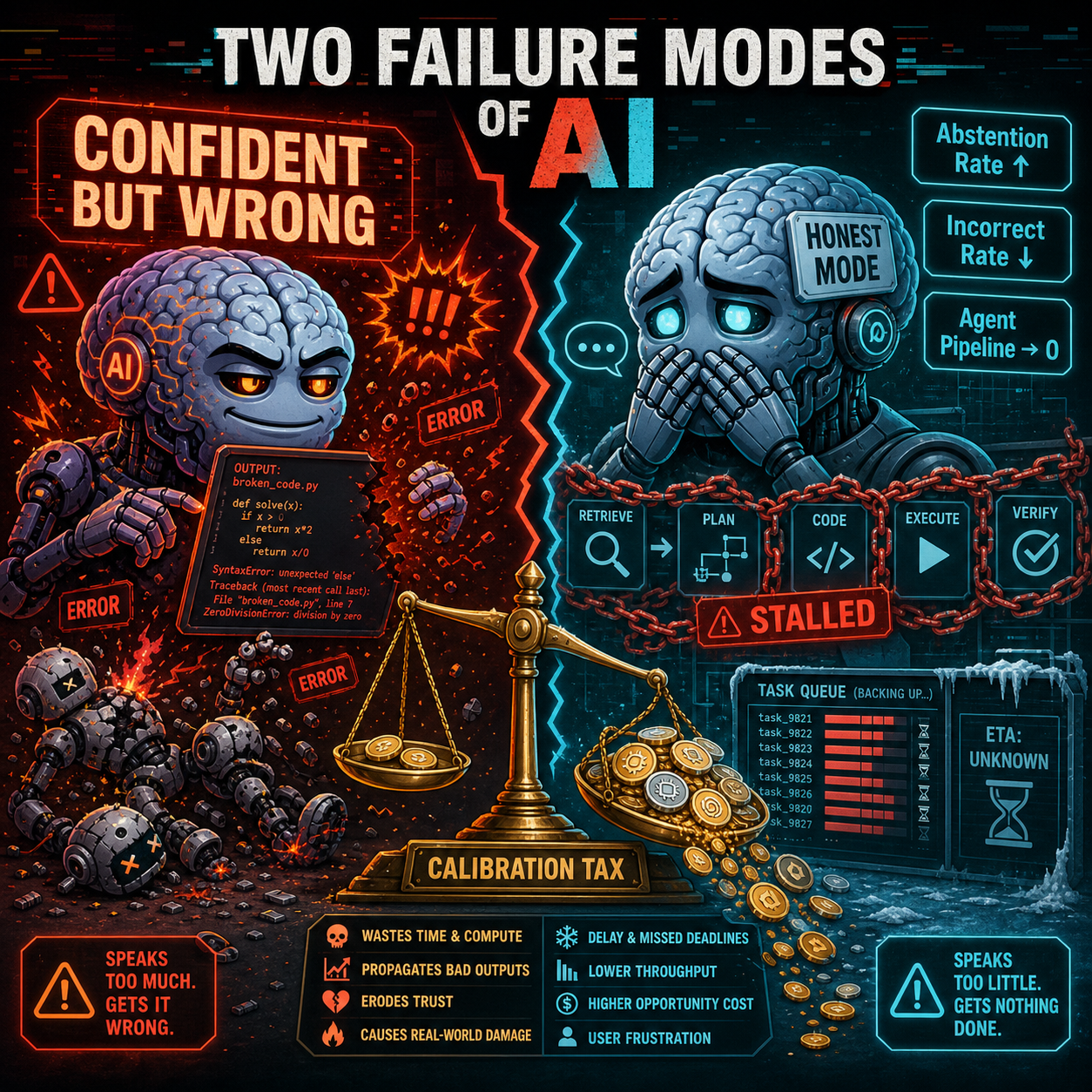
The practical cost of Opus 4.8's strategy is what this article calls the honesty tax. When an agent abstains on a task it should have attempted, the workflow stalls. According to the ITBench-AA benchmark, the best frontier models score below 50% on day-one SRE tasks. A refusal to diagnose is functionally identical to a missed root cause: both yield a score of zero.
The difference is detectability. A confident mistake is visible. An abstention is silent. It does not raise an alert. It does not trigger a retry. It simply returns nothing, leaving the pipeline to timeout or fail downstream.
The AgingBench longitudinal degradation study reinforces how dangerous this silence is. The researchers report that agents degrade over time, and if the initial baseline is already below 50%, ongoing degradation pushes practical reliability below 30%. A model that starts under-calibrated and then degrades does not merely underperform. It becomes operationally invisible.
The absence of output is harder to debug than the presence of wrong output because there is no artifact to inspect. If your pipeline relies on Opus 4.8 and that model begins deferring on edge cases it used to handle, you may not notice the shift until a downstream system signals a timeout. By then, the root cause is buried under layers of abstention logs that most agent frameworks do not even record.
Why Calibration Is a Hard Infrastructure Problem
Test-time compute scaling and training-time calibration are opposite answers to the same underlying failure mode: the model does not know what it knows. OpenAI's answer is to give the model more thinking time. Anthropic's answer is to train it to stay quiet when unsure.
o3's approach carries a latency penalty. Each request consumes more tokens and more wall-clock time as the model reasons through intermediate steps. For a synchronous API call, that cost is explicit and billable. For an agent loop, it compounds across iterations.
Opus 4.8's approach carries a throughput penalty. When it abstains, the request returns empty or hedged. In an automated pipeline, that means the orchestration layer must handle the deferral. Most agent frameworks do not have first-class support for "model declined to answer" as an event type. The result is either a silent stall or a fallback to another model, which introduces its own calibration drift.
Google's Gemini 2.5 Flash offers what may be the most tractable architectural alternative: an explicit thinking budget. Developers can cap reasoning tokens per request, gaining direct control over the cost-latency-capability trade-off. That configurability turns a training-time property into a runtime knob.
Anthropic does not offer equivalent control. The abstention threshold in Opus 4.8 is an internal training artifact, not a tunable parameter exposed in the API.
In multi-agent systems, the infrastructure problem deepens. A single abstaining model can stall an entire pipeline of dependent agents because downstream steps typically assume that upstream steps produce output. Semantic caching of verified facts can help, but as Gosmar and Dahl's paper emphasizes, it requires an infrastructure layer that most engineering teams have not built.
Building a multi-agent system on Opus 4.8 without explicit abstention handling is the equivalent of building a distributed system without retry logic: it works in the demo, and it fails in production at the worst possible moment. Model selection itself has become a procurement optimization problem. Models.dev launched an open-source registry precisely because the explosion of model variants, pricing tiers, and hardware backends has made side-by-side comparison a tooling problem rather than a simple capability problem.
That registry exists because the market no longer assumes one model dominates all tasks. Engineers need to match model behavior to workload risk, not just benchmark scores to cost.
What PhantomByte Readers Should Actually Do
Do not trust marketing claims about calibration. Run your own test. Feed your production prompts to both Opus 4.8 and a comparator model such as GPT-4o or Gemini 2.5 Pro.
Measure two rates on your actual task distribution, not on generic benchmarks: the false-positive rate (unflagged flaws that the model ships) and the false-negative rate (unnecessary abstentions on valid tasks). Generic benchmarks measure what the lab wants to advertise. Your distribution measures what your pipeline will actually encounter.
Audit abstentions in your agent logs. Most agent frameworks do not emit a structured event when a model declines to answer. Add that instrumentation. Record not just what the model said, but what it refused to say. Over a large enough sample, the abstention pattern will reveal whether the model is avoiding errors or avoiding effort. The difference determines whether you can trust the model with unsupervised execution.
If your pipeline requires high reliability, consider thinking-budget architectures. Google's explicit budget control in Gemini 2.5 Flash lets you bound the worst-case cost of a reasoning attempt. Anthropic's implicit abstention does not. A bounded reasoning cost is a tractable engineering constraint. An unbounded abstention rate is an operational risk.
Finally, plan for model churn. Opus 4.8 is the current release, but model retirement cycles are accelerating. OpenAI has already published sunset dates: o3 will leave ChatGPT on August 26, 2026, and GPT-4.5 departs on June 27, 2026. Calibration profiles shift between versions without warning.
The model you validated last quarter may abstain at a different rate this quarter. Pinning to a specific version buys stability until the version is deprecated. Treat model selection as a continuous evaluation problem, not a one-time procurement decision.
Closing Frame
The AI industry has split into two camps: those who scale test-time compute to crack harder problems, and those who tune abstention to avoid worse failures. Neither camp has solved the underlying problem.
A model that does not know what it knows is not "honest." It is under-calibrated. A model that knows it does not know and refuses to say so explicitly is not "safe." It is opaque. The calibration gap is the real story, and it is an engineering problem that sits between the model layer and your infrastructure.
PhantomByte will keep measuring it.
Get More Articles Like This
Getting your AI agent setup right is just the start. I'm documenting every mistake, fix, and lesson learned as I build PhantomByte.
Subscribe to receive updates when we publish new content. No spam, just real lessons from the trenches.