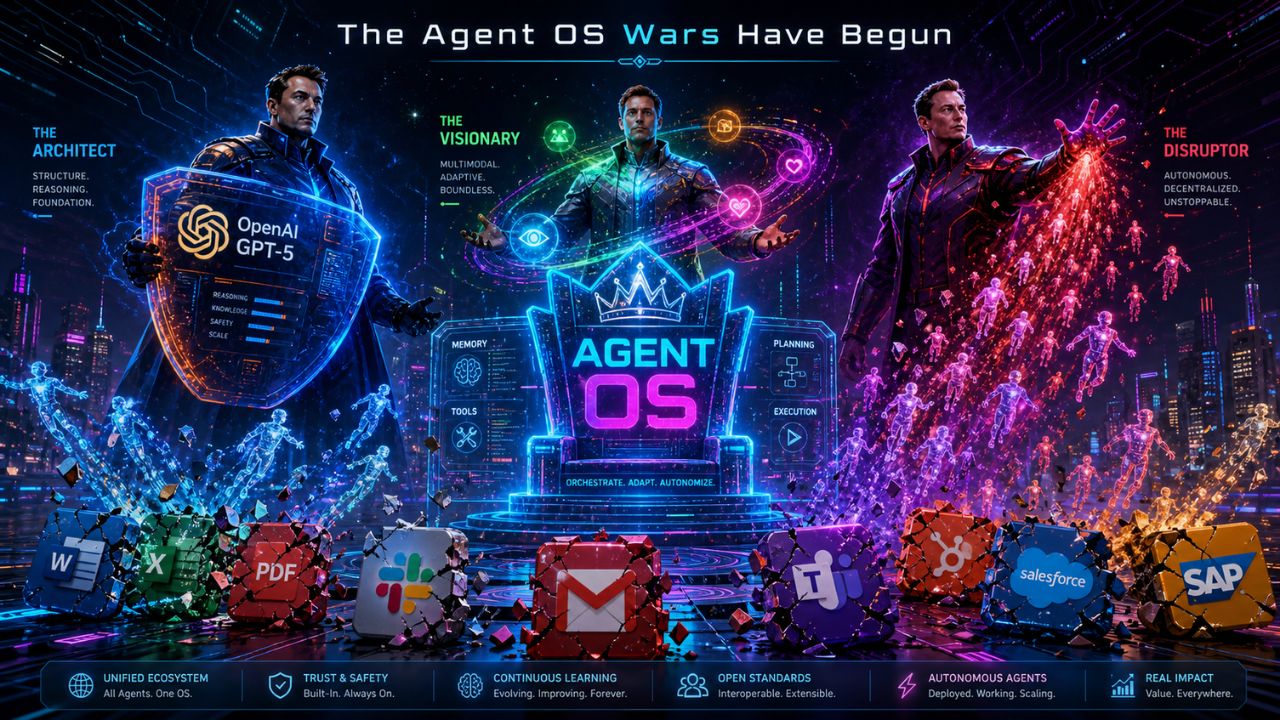
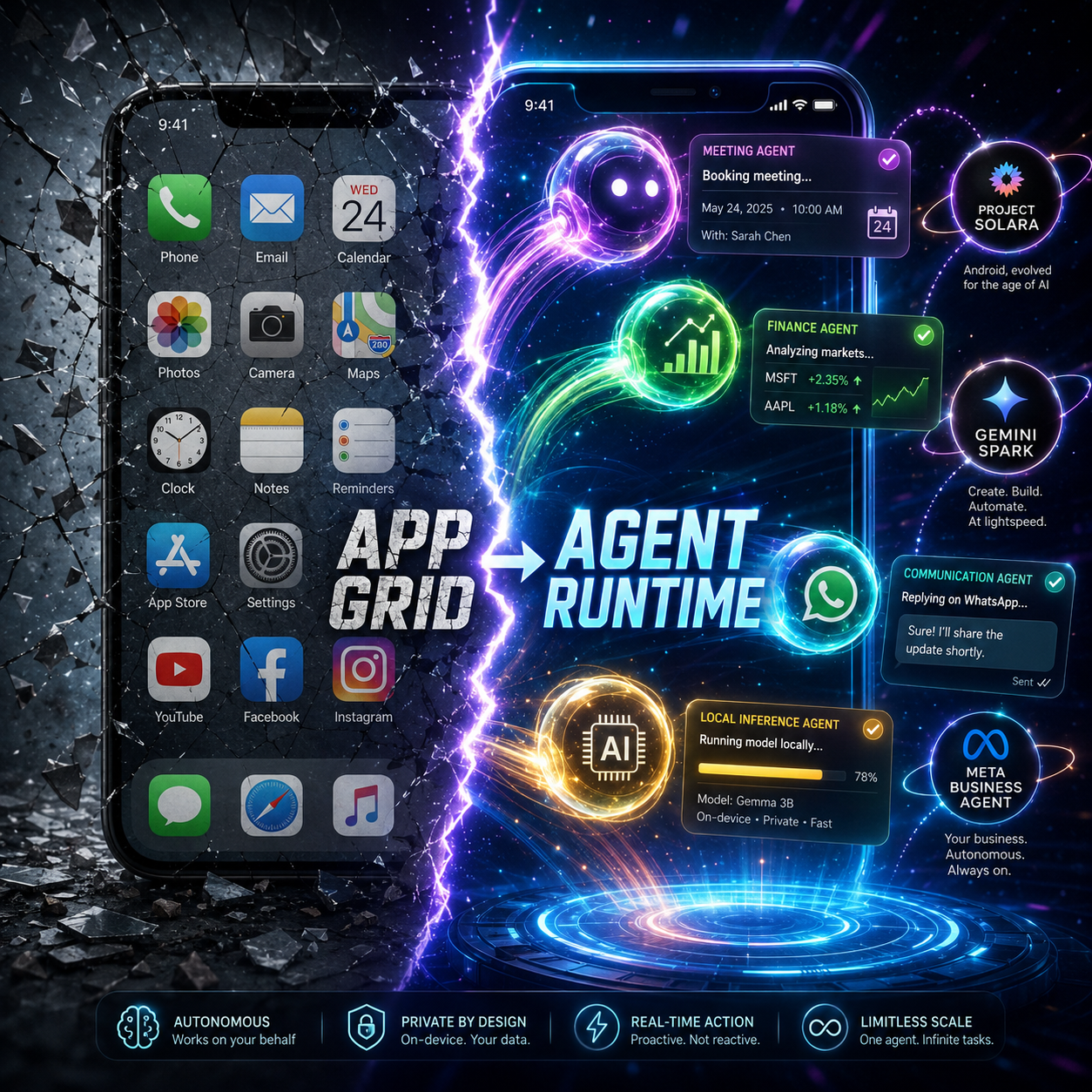
In the same week, Microsoft announced Project Solara, an Android-based operating system designed to run AI agents instead of traditional apps. Google rolled out Gemini Spark, a 24/7 always-on personal agent for premium subscribers. Meta launched its Business Agent globally on WhatsApp, turning the messaging app into a full business operations platform. And at Computex 2026, Qualcomm CEO Cristiano Amon declared 2026 "the year of the agent" while unveiling Dragonfly, a new data center silicon brand purpose-built for agentic workloads.
This is not convergence by coincidence. The platform layer is being rebuilt around agent runtimes. The app grid (touch an icon, open an app, do a task) is being replaced by a simpler paradigm: describe a goal, agent executes, result delivered. The operating system itself is becoming the agent runtime. And whoever controls the dominant runtime will control the next era of computing.
The question is not whether this shift will happen. It is whether the infrastructure beneath it is ready.
WHAT AN AGENT OS ACTUALLY LOOKS LIKE
Microsoft's Project Solara is the most direct expression of the agent OS concept. Announced at Build 2026 in San Francisco, Solara is a chip-to-cloud platform for AI agent devices spanning phones, screens, and embedded hardware. It is not an AI feature added to an existing OS. It is an OS built from the assumption that the user does not open apps.
Solara introduces two critical components for enterprise deployment. Work IQ is a contextual layer that gives agents access to organizational emails, documents, and meetings through Microsoft 365, with general release set for June 16. Scout is a proactive personal assistant that manages scheduling, meeting prep, and routine tasks without requiring user prompts, already rolling out to Frontier customers.
The paradigm shift here is structural. Agents are not apps you open. They are background processes that monitor, initiate, and complete tasks autonomously. That means the OS must handle continuous context and state management across sessions and devices, something no existing mobile operating system was designed to do.
In a prior piece, I wrote that persistent AI memory is the new platform lock-in. Frameworks successfully integrating robust database architectures, such as a Google Cloud Firestore API, to manage long-term persistent memory are building the true infrastructure layer for that lock-in. It is the OS that makes Total Recall possible.
ALWAYS-ON MEANS ALWAYS-RUNNING
Google DeepMind rolled out Gemini Spark alongside Gemini 3.5 Flash, a higher-endurance model variant designed to sustain continuous agent sessions without degradation. Spark is available to users on higher-tier subscription plans and is positioned as a direct competitor to Microsoft Scout.
The "always-on" framing signals a fundamental shift in how these platforms are sold. AI assistants are no longer tools you invoke. They are background workers. For premium subscribers, a subscription becomes an around-the-clock AI employee.
This creates an infrastructure problem that few companies have solved. Always-on agents require always-on compute. The cost model is not per-query; it is per-uptime. That is why GitHub Copilot enterprise bills spiked up to 50 times overnight for some organizations after the agentic Copilot rollout at Build 2026. Usage-based pricing models that worked in controlled pilots do not scale predictably when agents run continuously and generate inference costs without human-initiated prompts. Always-on without consumption controls is a CFO nightmare, a topic I explored in detail in a companion piece.
THE MESSAGING APP AS OS
Meta took a different route. Rather than building a new OS, it extended an existing one. The Meta Business Agent launched globally on WhatsApp, handling customer service, sales, booking, and lead qualification without requiring custom development from businesses.
WhatsApp has over two billion users. In many markets, it is the primary business communication channel. By embedding the Business Agent directly into WhatsApp, Meta is turning a messaging app into a full business operations platform. The OS is not the device. The OS is the conversation thread.
For small and medium businesses, this is democratized agent deployment. For enterprise competitors in customer service AI, it is a distribution moat. Meta does not need to win the model layer or the hardware layer if it controls the channel through which businesses talk to customers.
WHY THE AGENT OS NEEDS NEW SILICON
The software shift is only half the story. Every major silicon vendor is building for local, continuous agent compute.
Qualcomm announced Dragonfly at Computex 2026: server processors, AI accelerators, and custom silicon for data center agent deployments. NVIDIA launched RTX Spark, an Arm-based chip bringing desktop-class inference to laptops. WIRED reported that the RTX Spark could be the inflection point where local AI capabilities become genuinely useful rather than a marketing checkbox. AMD demonstrated its Ryzen AI Max Pro running a 300 billion parameter model entirely on a single local machine, a capability previously considered infeasible outside data center clusters.
Microsoft paired these announcements with the Surface RTX Spark Dev Box, a mini PC with 128GB of unified memory designed specifically for local AI development.
The pattern is clear. Cloud-only agents cannot deliver the latency and privacy required for always-on personal agents. Local inference has crossed from experimentally interesting to production-viable in a single product cycle. The organizations that engineer intelligent routing patterns (directing simpler tasks to local models to maintain privacy and only passing workflows exceeding 3000 tokens to frontier cloud models) will optimize their compute overhead and maintain a structural cost advantage. Utilizing local inference to stretch the value of baseline subscriptions like the $20 Ollama Pro tier is how smart developers will survive the compute crunch.
THE AUTHORIZATION GAP
Every agent OS faces the same unsolved problem: agents need broad access to be useful. Repositories, APIs, databases, cloud consoles. The more access an agent has, the more it can do. But every access grant expands the blast radius.
A new paper on arXiv by Ibrahim and Li, "Overlaying Governance: A Compositional Authorization Framework for Delegation and Scope in Agentic AI," addresses exactly this tension. The authors argue that traditional IAM systems fail to capture the semantics of agentic delegation because they were built around fixed principals and explicit requests. Agentic systems need recursive delegation, time-limited authority, and dynamic scoping as executable primitives rather than static token-based credentials.
The answer is not giving agents a system prompt saying "be careful." It is cryptographic scope enforcement, delegation chains, and auditable action logs. For Project Solara, Work IQ, and Gemini Spark, the same agent that can read your email and schedule your meetings is also the agent that can be socially engineered to wire money or leak documents. As I wrote earlier this week, the chatbot is the vulnerability. The OS-level agent is a vastly larger attack surface. Traditional endpoint security assumes human-initiated actions. Agent-initiated actions require entirely different detection and governance architectures.
THE DEVELOPER DILEMMA
If the app grid dies, what is the new unit of software?
The answer is the skill. Agent-capable functions that register with an agent runtime, advertise capabilities, and get invoked dynamically. Developers will not ship apps. They will ship agent skills with declared inputs, outputs, and side effects.
A paper by Bai et al. on arXiv, "SkillDAG: Self-Evolving Typed Skill Graphs for LLM Skill Selection at Scale," formalizes this architecture. The authors model inter-skill relationships as a typed directed graph that an LLM agent queries and evolves during execution. The graph accumulates structure across episodes, enabling agents to select relevant capabilities without exhaustive search as the skill pool grows.
The app store becomes a skill registry. The OS becomes the orchestrator. Microsoft's MAI Playground and new Azure AI Foundry APIs for multi-agent workflows are early infrastructure for this transition, giving developers environments to experiment with agentic capabilities rather than monolithic applications.
THE PLATFORM LOCK-IN RISK
An agent OS that remembers every meeting, every preference, and every workflow becomes prohibitively expensive to leave. The switching cost is not just data export. It is the loss of your agent's accumulated state and its understanding of how you work.
There is currently no agent memory interchange format. There is no skill portability standard. If you train Solara's Scout on your organizational rhythms for six months, there is no credible path to migrate that state to Gemini Spark or to whatever OpenAI builds next. The first company to create a meaningful agent state export will disrupt the entire lock-in model.
The data portability question is not theoretical. It will determine whether agent OS competition remains dynamic or calcifies into the same mobile duopoly that trapped developers for fifteen years.
THE REGULATORY FRAGMENT
Three jurisdictions took distinct regulatory positions this week. The United States adopted a voluntary framework requiring frontier AI companies to submit models for 30-day pre-release federal review. The Trump administration's executive order explicitly named OpenAI's GPT-5.5 and Anthropic's Claude Mythos as target systems, marking the first time a U.S. executive order has named specific forthcoming model families by name.
The United Kingdom took a harder line. The Competition and Markets Authority forced Google to give publishers a direct opt-out mechanism from AI search summary features, the first regulatory intervention of its kind globally.
The European Commission advanced new legislation to develop domestic cloud, AI, and semiconductor capabilities with the explicit goal of cutting reliance on U.S. Big Tech.
A fourth dimension emerged when the United States and Japan announced a sweeping bilateral AI and technology collaboration covering joint research, semiconductor supply chain coordination, and shared safety standards. For global agent OS platforms, divergent compliance frameworks mean jurisdiction-specific product decisions. An agent OS that works in San Francisco may be non-compliant in London or operationally restricted in Brussels.
THE COMPETITIVE LANDSCAPE
Microsoft is executing a full-stack vertical integration playbook. It controls the model (MAI-Thinking-1), the OS (Project Solara), the hardware (Surface RTX Spark), the cloud (Azure), and the developer tools (Intelligent Terminal, Copilot, Azure AI Foundry). This strategy mirrors Apple's iPhone playbook: own the model, the OS, the hardware, and the developer ecosystem.
Google controls the model (Gemini 3.5 Flash), the agent (Gemini Spark), and the distribution (Android, Search, Workspace). Its risk is that it lacks the enterprise lock-in of Microsoft 365 and the business messaging dominance of WhatsApp.
Meta controls distribution (WhatsApp, Instagram, Facebook) and the agent (Business Agent), but has no significant model or OS layer of its own. It is betting that distribution beats vertical integration.
OpenAI controls the model (GPT-5.5, Codex enterprise) and the consumer distribution (one billion ChatGPT monthly active users), but has no OS or hardware layer. Its partnership with Microsoft remains intact for cloud infrastructure, but the competitive dynamic shifted dramatically at Build 2026 when Microsoft unveiled its independent model family.
Qualcomm, NVIDIA, and AMD sit at the silicon layer, agnostic to which OS wins. They sell shovels.
And then there is the open-source question. Nous Research launched Hermes Desktop this week as an open-source AI agent for every platform, adding a credible open-weight contender to the agent OS race. Frameworks like OpenClaw and intelligent orchestration pipelines are allowing developers to actively bypass walled gardens. With Ideogram 4.0 going open-weight, the counter-narrative to proprietary lock-in is forming rapidly around a Sovereign AI philosophy.
WHAT THIS MEANS FOR YOU
If you lead an enterprise, choose your agent OS carefully. Switching costs will be higher than switching cloud providers because your agent's memory, workflow state, and skill graph are not portable. The decision you make in 2026 will shape your operational infrastructure for the next decade.
If you are a developer, start building agent skills, not apps. Register capabilities, not UI screens. The unit of deployment is changing. The organizations that adapt their development practices first will define the skill registries that everyone else uses. To help navigate this transition, I will be putting out a series of 99-cent technical guides on Gumroad detailing exactly how to engineer these local agentic workflows.
If you are an infrastructure engineer, prepare for always-on compute architectures. The batch-job model of cloud computing is being replaced by persistent agent processes that sit idle waiting for state changes, then act immediately. Your cost models, monitoring, and capacity planning need to account for uptime-based billing rather than query-based billing.
If you are a security professional, the agent OS is your new perimeter. Traditional endpoint detection assumes human-initiated actions. An agent that initiates API calls, modifies files, and schedules meetings based on inferred intent requires detection logic that understands agent behavior patterns rather than human behavior patterns.
While you future-proof your infrastructure for this shift, you can streamline your current operations by exploring the portfolio of over 20 free digital utility and productivity tools available directly on the PhantomByte domain.
THE CLOSE
2026 is not the year AI gets better. It is the year AI stops being a tool and starts being the environment.
Project Solara may not ship at scale. Gemini Spark may remain a premium niche. But the direction is irreversible. The last platform war was mobile: iOS versus Android. The next platform war is agent runtime: Solara versus Spark versus whatever OpenAI builds next.
The winners will not be determined by model benchmarks. They will be determined by who builds the runtime that developers and enterprises cannot leave, and whether anyone creates a credible way to walk away.
You are not building for an app store anymore. You are building for an agent runtime. Choose your runtime like your business depends on it, because it will.
Get More Articles Like This
The agent OS wars are reshaping the entire computing industry. I'm documenting every platform shift, architectural insight, and practical strategy as it unfolds.
Subscribe to receive updates when we publish new content. No spam, just real analysis from the trenches.