
What if the tool you built your entire workflow around just got 25x more expensive overnight? That is not a hypothetical. That is June 1, 2026, for millions of developers who bought into GitHub Copilot.
Microsoft spent years subsidizing AI coding assistance. First it was free. Then it was cheap. Then it was indispensable. Now the bill is due, and some developers are looking at monthly costs jumping from $29 to $750 or more. The sticker shock is real. The economics behind it are worse.
This is not a pricing change. It is a dependency trap snapping shut.
The Subsidy Ends
On April 27, 2026, GitHub announced that Copilot would move to usage-based billing on June 1. The official blog post from Mario Rodriguez, GitHub's Chief Product Officer, framed it as aligning "pricing with actual usage" and "an important step toward a sustainable, reliable Copilot business."
The mechanics are straightforward but brutal. Premium request units (PRUs) are dead. In their place are GitHub AI Credits. Every plan still costs the same on paper: $10/month for Pro, $39 for Pro+, $19 per user for Business, and $39 for Enterprise. But here is the catch. Those prices only buy you credits equal to the subscription cost. Burn through them, and you pay published API rates for every additional token.
Code completions and Next Edit suggestions remain included. They do not touch your credits. But agentic sessions, multi-step coding workflows, chat queries, and anything beyond basic autocomplete all cost tokens now. GitHub calls this "better alignment." Developers call it a rug pull.
The company did roll out preview billing in early May so users could see projected costs before the transition. Some wish they had not looked.
The Numbers That Hurt
TechCrunch reporter Lucas Ropek, in a May 30, 2026 article titled "'What a joke': GitHub Copilot's new token-based billing spurs consternation among devs," cited multiple Reddit users reporting dramatic cost spikes. One developer stated their monthly cost would balloon from roughly $29 to nearly $750. Another shared a screenshot showing costs shooting from around $50 to approximately $3,000.
The reactions split predictably. Some developers called it a joke and cancelled immediately. One Reddit user, quoted by TechCrunch, put it plainly: "This new usage model is just stupidly expensive. I am adjusting mine by cancelling. At that cost, it is no longer cost-effective or useful in any practical way."
Others pushed back on the backlash. Critics of the critics argued that anyone burning through $750 or $3,000 in tokens is probably "vibe coding" with excessive iterations rather than using Copilot as a surgical tool. One user wrote: "The only way it gets crazy like that is if you are purely 'vibe coding' with a ton of bloated iterations. It is pretty affordable for even small outfits if used as a tool, on pretty much any provider."
That defense sounds reasonable until you remember who taught developers to vibe code in the first place.
The "Vibe Coding" Origin Story
Microsoft did not just sell a tool. It sold a workflow. "Vibe coding" (a term that went viral in early 2026) describes writing less, iterating more, and letting AI handle the heavy lifting. Microsoft leaned into this hard. Copilot demos encouraged sprawling agentic sessions. Marketing showed developers describing problems in plain English and watching code materialize. The implied promise was simple: write less, ship faster, let the AI do the work.
Developers listened. They built entire workflows around that subsidy. Junior engineers stopped memorizing syntax because Copilot autocomplete handled it. Solo founders skipped hiring contractors because agentic workflows promised to replace them. Teams integrated Copilot Business across their repos and forgot what it felt like to write boilerplate by hand.
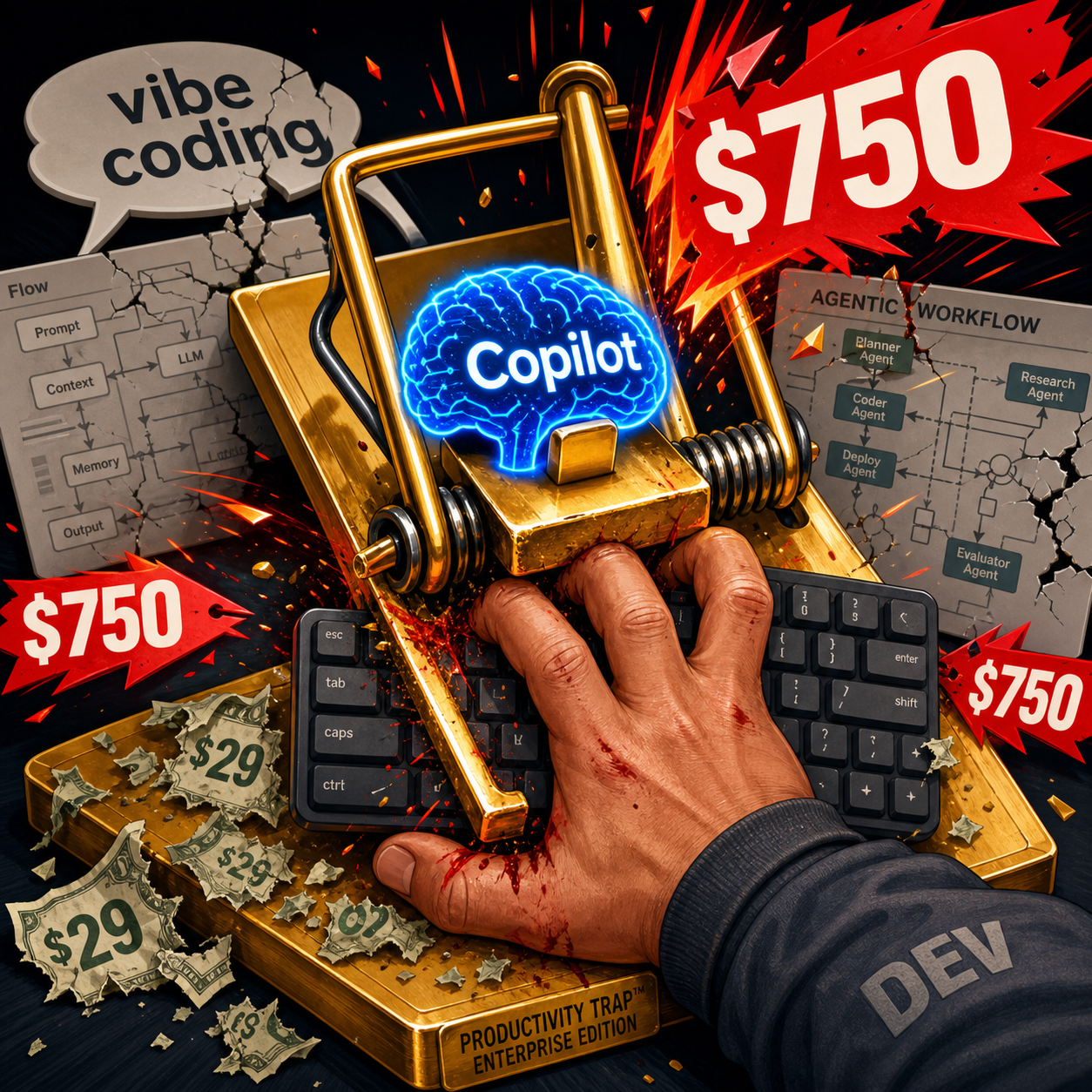
Now the subsidy ends, and the same company that encouraged indiscriminate usage wants to charge by the token.
Some developers saw this coming. A Reddit post titled "Holy fuck how much money was Copilot losing" asked the quiet part out loud. GitHub absorbed massive inference costs to keep the flat-rate model alive. The economics were never sustainable. The question was always when, not if, the bill would arrive.
The answer is today.
The Dependency Crisis
This is bigger than Copilot.
A parallel TechCrunch story by Julie Bort, published May 30, 2026, reports that a growing number of developers are refusing to take on coding tasks without AI assistance. Junior engineers exist who cannot write code without copilots. Companies report brittle workforces that break when tools fail or change.
The two stories connect in a way that should terrify every CTO. Developers built dependency on a subsidized tool. The subsidy ended. Now those same developers lack the skills to work without it, and the tool just got prohibitively expensive.
This is not a GitHub problem. It is an industry problem.
The "tokenmaxxing" subculture identified in late May 2026 tracks exactly this trajectory. Developers are measuring productivity by AI token consumption, treating high usage as a badge of efficiency, and orchestrating multiple autonomous agents instead of writing code themselves. It is a productivity metric that assumes the AI will always be cheap.
That assumption just died.
The Broader Pattern: AI Cost Reality Checks
Copilot is the canary. The coal mine is every AI-dependent workflow in every industry.
Financial services firms spent 18 months deploying AI copilots across trading floors and compliance desks. Morgan Stanley deployed AI tools that generated documented 20% to 150% productivity gains depending on the use case. Goldman Sachs built the GS AI Assistant for its 10,000+ workforce. Salesforce's Agentforce hit a $1.2 billion annual run rate, reportedly handling over 65% of customer service inquiries autonomously. Zendesk's AI agents automated 30% of ticket volume.
All of these deployments were built during the subsidized phase. The first vendor to switch to metered billing at enterprise scale will trigger the same reckoning Copilot users face now: prove the ROI or cut the tool.
For Copilot specifically, the enterprise math is murky. Business plans ($19/user/month) include $19 in credits. Enterprise ($39/user/month) includes $39. GitHub is offering promotional included usage for June through August: $30 in credits for Business, and $70 for Enterprise. After that, pooled or not, the meter runs.
Enterprise admins can set budgets at the user, cost center, and enterprise levels. But budgeting for a tool that developers refuse to work without is not cost control. It is hostage negotiation.
The PhantomByte Assessment
This is a predictable trap and a preventable one. Three hard truths:
One: Never build core workflow on subsidized tooling without modeling the unsubsidized cost. If you cannot afford the tool at 10x or 20x the current price, you are not using a tool. You are participating in a beta test funded by someone else's balance sheet.
Two: The developers who need Copilot least will survive this fine. The ones who need it most are in trouble. That is the perverse incentive of dependency: the more you relied on the subsidy, the harder the transition hurts. Teams that used Copilot as autocomplete-plus will barely notice. Teams that replaced junior devs with agentic workflows are about to relearn why human engineers have value.
Three: Microsoft is not wrong about the economics. Flat-rate Copilot was burning money. Token-based billing aligns cost with usage in a way that makes the business sustainable. The problem is not the pricing model. The problem is the behavioral model Microsoft itself created. You cannot teach an industry to vibe code and then charge them by the vibe.
The Escape Hatch: The Sovereign Stack
If cloud-based API dependency is a financial trap, the logical counter-measure is moving to local-first infrastructure. The era of the "Sovereign AI" stack has arrived, and developers can keep their workflows intact by bringing their models in-house.
By leveraging frameworks like OpenClaw or Ollama (now running smooth on version .22.1), you can deploy highly capable open-weight models locally. The hardware math finally makes sense. Investing in a robust local setup with high base RAM, or utilizing external GPU enclosures via Thunderbolt to max out your VRAM capacity, requires upfront capital but fixes your ongoing inference costs at absolute zero.
You completely bypass the token-billing nightmare, retain strict data privacy, and immunize your workflow against the next corporate pricing rug pull.
What Comes Next
Short term: chaos. June 2026 will see cancellations, budget panics, and angry threads. Some teams will absorb the costs. Others will slash usage. A few will discover their developers cannot function without the tool and will pay whatever GitHub asks.
Medium term: stratification. Developers who can code without AI assistance will become more valuable, not less. The premium goes to engineers who can verify, refactor, and override AI output rather than those who can only prompt and pray. Coding skills that atrophied under subsidized Copilot will suddenly have market value again.
Long term: normalization. Usage-based AI billing will become standard. The Copilot shock is just the first major enterprise tool to flip. Every vendor running on subsidized inference costs will eventually face the same pressure. The companies that survive will be the ones that treated AI as augmentation, not replacement, and kept their teams sharp enough to adapt when the subsidy ended.
The Bottom Line
GitHub Copilot is not broken. The economics just caught up to the marketing.
Microsoft gave developers a Ferrari for the price of a bus ticket, let them build their daily commute around it, and then installed a toll booth. The complaint is not that the toll is unfair. The complaint is that the commute no longer works without paying it.
If you are a developer: learn to code without the crutch before the crutch gets expensive, or take control of your stack and run it locally. If you are a CTO: audit every AI tool in your infrastructure for unsubsidized cost exposure. If you are an investor: the companies that weather this transition are the ones that never forgot the tool was a subsidy.
The $750 Copilot is not a bug. It is the first honest price tag in a subsidized industry.
The golden age of free AI was always going to end. June 1, 2026, is just where the bill finally arrived.
Get More Articles Like This
Getting your AI agent setup right is just the start. I'm documenting every mistake, fix, and lesson learned as I build PhantomByte.
Subscribe to receive updates when we publish new content. No spam, just real lessons from the trenches.