
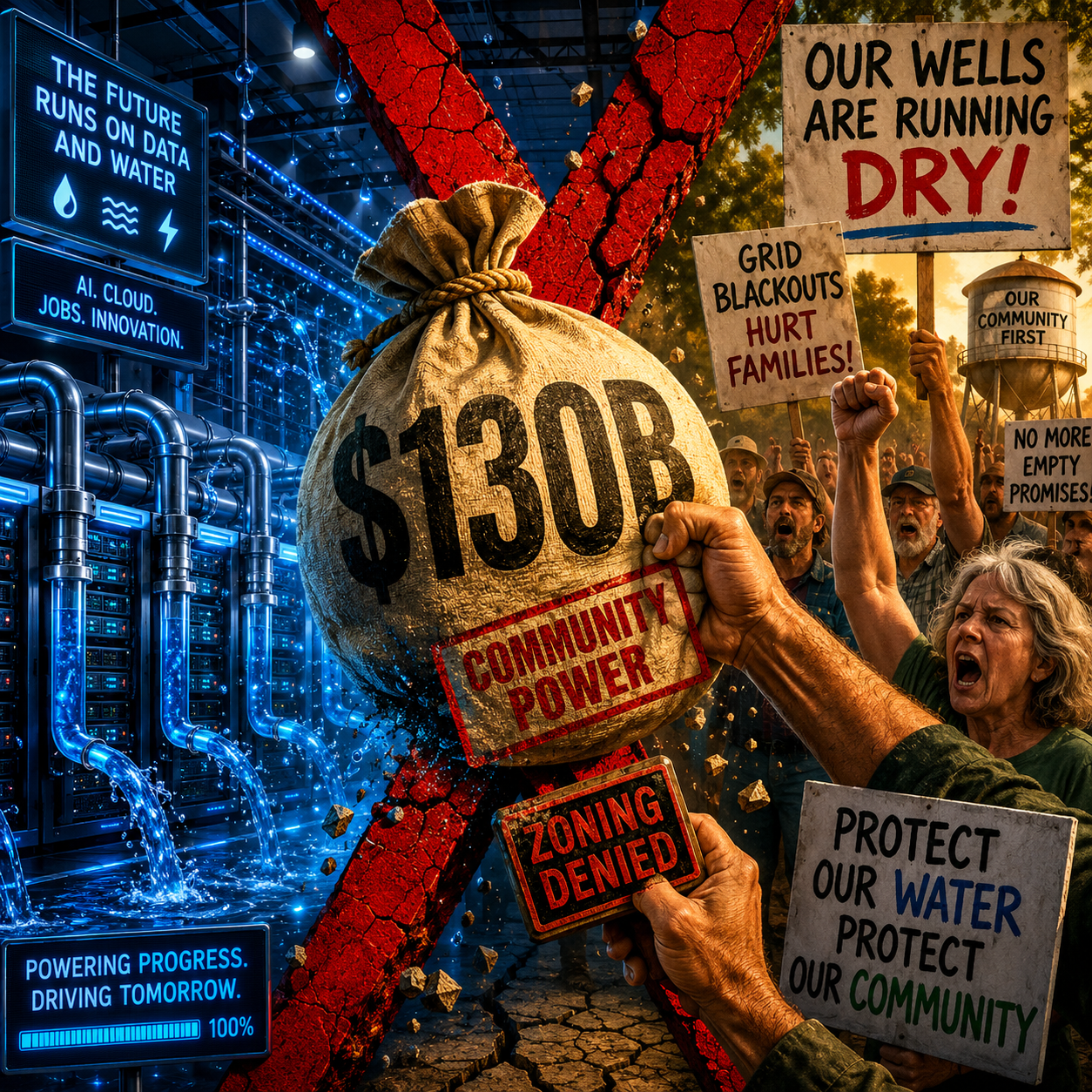
$130 billion in data center projects have been blocked by community protests in 2026 alone. Not by regulators. Not by supply chains. By neighbors with lawn signs.
Ars Technica reported the number this week, citing Data Center Watch, a project from AI intelligence firm 10a Labs that tracks opposition nationwide. The figure covers the first quarter of 2026: 75 projects blocked or delayed across 49 states, with active opposition groups more than doubling to 833. Researchers called it a "structural shift," not a cyclical spike. Communities have internalized an opposition playbook, legislative sessions have introduced formal regulatory uncertainty, and the fight is reshaping elections.
WIRED investigated the claim — pushed by GOP lawmakers, tech investors, and even OpenAI — that Chinese interference is behind the opposition. Their finding: it is just NIMBY. Communities do not want the noise, the water consumption, the grid strain, or the property value impact. No foreign conspiracy required.
This is not a sideshow. This is the defining bottleneck of the AI buildout. And nobody in the AI commentary ecosystem is covering it from the community angle.
The 30-Second Answer
AI's biggest infrastructure problem is not chips, power generation, or cooling technology. It is permission to build. National necessity is colliding with local rejection, and local rejection is winning. Google is now announcing community investments in Virginia to de-escalate. Seattle officially enacted a one-year data center moratorium in June 2026. Amazon just disclosed 2.5 billion gallons of annual water consumption for its global data center operations. The cost of entry is not just financial anymore. It is social.
Kill the Wrong Mental Models First
Wrong model #1: "Data center opposition is a supply chain problem."
Wrong. The hardware exists. The capital exists. The land exists. What does not exist is community consent. PJM Interconnection, the grid operator for the mid-Atlantic and the largest RTO in the United States, needs 15 GW of new power generation to meet data center demand — roughly fifteen nuclear plants' worth. But local zoning boards do not care about national AI competitiveness. The federal government can declare data centers critical infrastructure all it wants. The county board still votes on the permit.
Wrong model #2: "This is a temporary friction that money solves."
Wrong. $130 billion is not a rounding error. That is more than the annual GDP of most countries. In the first quarter of 2026 alone, protestors blocked or delayed 75 projects worth about $130 billion — the most in any three-month period since tracking began in 2023. If money solved this, it would be solved. The opposition is structural, not financial. Communities have legitimate environmental and quality-of-life concerns that cash payments do not fully address. A $2 billion facility promising 50 jobs does not fix a well that is running dry.
Wrong model #3: "China is behind the protests."
Wrong. WIRED's investigation found no evidence of foreign manipulation driving the anti-data-center movement. The framing is convenient for an industry that does not want to confront the fact that communities simply do not want these facilities. Conspiracy theories delay the harder conversation about actual local impact. Sociologist Tressie McMillan Cottom, who has spent time with organizers in North Carolina, wrote in the New York Times that people are "passionate enough to attend political education sessions about water rights, land use, and thermodynamics." That is not foreign influence. That is civic engagement.
Analogy That Sticks
Imagine building a highway. The federal government says it is critical infrastructure. The state agrees. The county sees the tax revenue. But the neighborhood where the interchange goes says no. They cite noise, traffic, property values, and water runoff. They organize. They vote. They win. The highway does not get built.
That is data center opposition in 2026. The project is nationally important. The opposition is locally powerful. And local power, in American land-use politics, usually wins.
How It Works: The Three Fronts
Front 1 — Water
Amazon disclosed that its global data center operations consumed 2.5 billion gallons of water in 2025. The disclosure came after Seattle officially enacted a one-year data center moratorium — a policy that some Amazon employees had publicly advocated for. Amazon reported a water usage effectiveness (WUE) of 0.12 liters per kilowatt hour, which it claims is better than Microsoft's 0.27 and the industry average of 0.84. But the comparison misses the point. Data centers are a drop in the bucket nationally but a crisis locally. A single hyperscale facility can consume as much water as a small city, and that consumption is concentrated in specific watersheds already under stress. The opposition is not abstract environmentalism. It is "my well is running dry."
Kerry Person, an AWS vice president overseeing data center operations, pushed back on coverage he said overstated the industry's impact: "If you look at the press right now, the data center industry is apparently consuming all of the water in the world. When you actually look at the data and look at the details, nothing could be further from the truth." Maybe so at the national level. But local residents do not live at the national level. They live next to the facility.
Front 2 — Power Grid Strain
PJM, the grid operator for the mid-Atlantic and Midwest, needs 15 GW of new power generation to meet data center demand. President Trump and 13 state governors called for an emergency capacity auction earlier this year. The proposal includes pushing more than $15 billion toward reliable baseload power generation. But the existing grid cannot absorb the load without major transmission upgrades, which take years and face their own permitting battles. Meanwhile, existing residents see their electricity reliability degrade as capacity is diverted to new facilities. PJM's summer peak load is projected to grow 3.6 percent annually to about 222 GW by 2036, driven predominantly by data center growth. The AI industry treats power as a procurement problem. Communities treat it as a shared resource problem.
Front 3 — The Zoning Battle
Google announced a $9 billion investment across Virginia through the end of 2026, including new data center campuses and what it calls "responsible digital infrastructure" built through "collaborative construction and investment in the local community." The company also convened the Virginia Grid Innovation Summit with state energy officials to discuss cutting-edge solutions. Multiple tech companies are navigating zoning battles that add months to years of delay. At least 25 planned data centers were canceled in 2025 following community resistance — nearly four times as many as in 2024. The opposition spans environmental groups, property value advocates, and simple quality-of-life concerns about industrial noise and traffic. The $130 billion figure represents not just blocked projects but delayed ones, renegotiated ones, and abandoned ones. The industry is learning that data center siting is now a political campaign, not a real estate transaction.
Before and After: What This Looks Like in Practice
Before: A hyperscaler identifies a rural county with cheap land, abundant water, and proximity to transmission infrastructure. They announce a $2 billion facility promising 50 jobs and tax revenue. The county board approves in six months. Construction starts. The community reads about it in the local paper after groundbreaking.
After: The same hyperscaler announces the same facility. Within two weeks, a Facebook group forms with 800 members. Local environmentalists file a water-impact challenge. Property owners organize a "No Data Center" petition with 2,000 signatures. The county board, facing a primary election, delays the vote. The project sits in review for 18 months. The hyperscaler eventually relocates to a less-optimal site with weaker grid connectivity and higher latency. The AI model training schedule slips. The cost of compute rises.
Vinny's Actual Workflows
I run a portion of my AI stack on a local dual-GPU setup, a direct result of fatigue with cloud dependency. Over the next few months, I'm scaling this into a dedicated system engineered specifically for local agent orchestration. However, local inference isn't a total escape; frontier models still require cloud fallback, and that fallback relies on the very data centers currently under protest. When Amazon discloses 2.5 billion gallons of water consumption, it isn't an abstract statistic. It is the physical infrastructure my agents depend on every time they route to Claude or GPT-5.6.
I am not a data center operator. But my work depends on data centers existing, scaling, and staying online. The NIMBY war is my problem whether I acknowledge it or not.
Address the Emotional Objections
"Communities are just being selfish."
Maybe. But their water consumption, property values, and grid reliability are real. Dismissing legitimate concerns as selfishness is how you lose elections and planning votes. The AI industry needs to treat opposition as a design constraint, not an obstacle to overcome.
"This is just an American problem."
Wrong. Mistral AI is raising approximately 3 billion euros, reported by The Decoder, partly to build sovereign data centers in France and Sweden because European governments want AI infrastructure they control. The opposition pattern is different — more regulatory, less NIMBY — but the bottleneck is the same. Permission to build is the global constraint.
"Small modular reactors or geothermal will solve this."
Maybe in 2030. The models training today need power today. Next-generation energy is not a near-term fix for a near-term crisis. The industry cannot promise future technology to communities experiencing present-day impact.
Quick Win: Understand Your Dependency Chain
- Map where your AI workloads run. Which regions? Which providers?
- Check if those regions have active data center opposition or moratoriums. Virginia, Oregon, Arizona, Washington, and parts of Texas are flashpoints.
- Evaluate your latency tolerance. Can you shift workloads to regions with less opposition? The answer affects your architecture.
- If you are building local AI infrastructure, factor community opposition into your siting strategy. Engage early. Share data. Be transparent about water and power use. The companies doing this well are winning permits. The ones treating it as a real estate deal are facing $130 billion in losses.
Escalation Path
Phase 1 (this week): Pull up your cloud bill. Every region your workloads touch, check against the 833 active opposition groups. If you are running in Loudoun County, Arizona's Maricopa, or Washington's Grant County, you have exposure you haven't modeled. Map it before your provider tells you.
Phase 2 (this quarter): Stop treating regions as interchangeable cost centers. Add opposition risk to your latency budget. A region that takes 18 months to permit instead of 6 is not a cheaper region. Factor the delay into your architecture decisions before you commit to a buildout.
Phase 3 (this year): If you build infrastructure, you are now in the politics business whether you hired a lobbyist or not. The companies winning permits today are the ones that started community engagement before the first bulldozer. Share your water numbers publicly. Attend the zoning board meetings. Answer the hard questions before the Facebook group forces you to.
The AI industry spent the last three years solving technical problems. The next three years will be about solving social problems. $130 billion says the technical problems were the easy ones.
The Uncomfortable Question
Your model trains on the best chips in the best facility. But what if the facility never gets built?
Get More Articles Like This
The AI infrastructure bottleneck is just the beginning. I'm documenting every lesson learned as I build PhantomByte’s sovereign AI stack.
Subscribe to receive updates when we publish new content. No spam, just real insights from the trenches.