
It is 11:47 PM. A developer has been going back and forth with Claude Code for 45 minutes when the AI stumbles onto something critical: a constraint buried in the authentication layer that will define the entire architecture moving forward. The developer makes a mental note. The session ends.
Three weeks later. Same project. New session. Same constraint. The AI has no idea.
Forty-five more minutes. Same discovery. Same cost. This is not a bug report for Anthropic or OpenAI. This is a missing architecture layer in every AI coding assistant on the market. And a formal paper published today quantifies exactly how much it costs you: $66 to $90 per rediscovery event.
That number sounds small until you multiply it. Multiply it by every developer on your team. Every session they run. Every project they touch. Every week of the year. The industry is hemorrhaging productivity through a hole nobody is building to patch: persistent, cross-session memory for AI coding assistants.
Call it session amnesia. Your AI has it. Every AI has it. The companies building these tools have done exactly nothing about it. And today, we have the receipts.
The Anatomy of Session Amnesia
What is Session Amnesia in AI Coding?
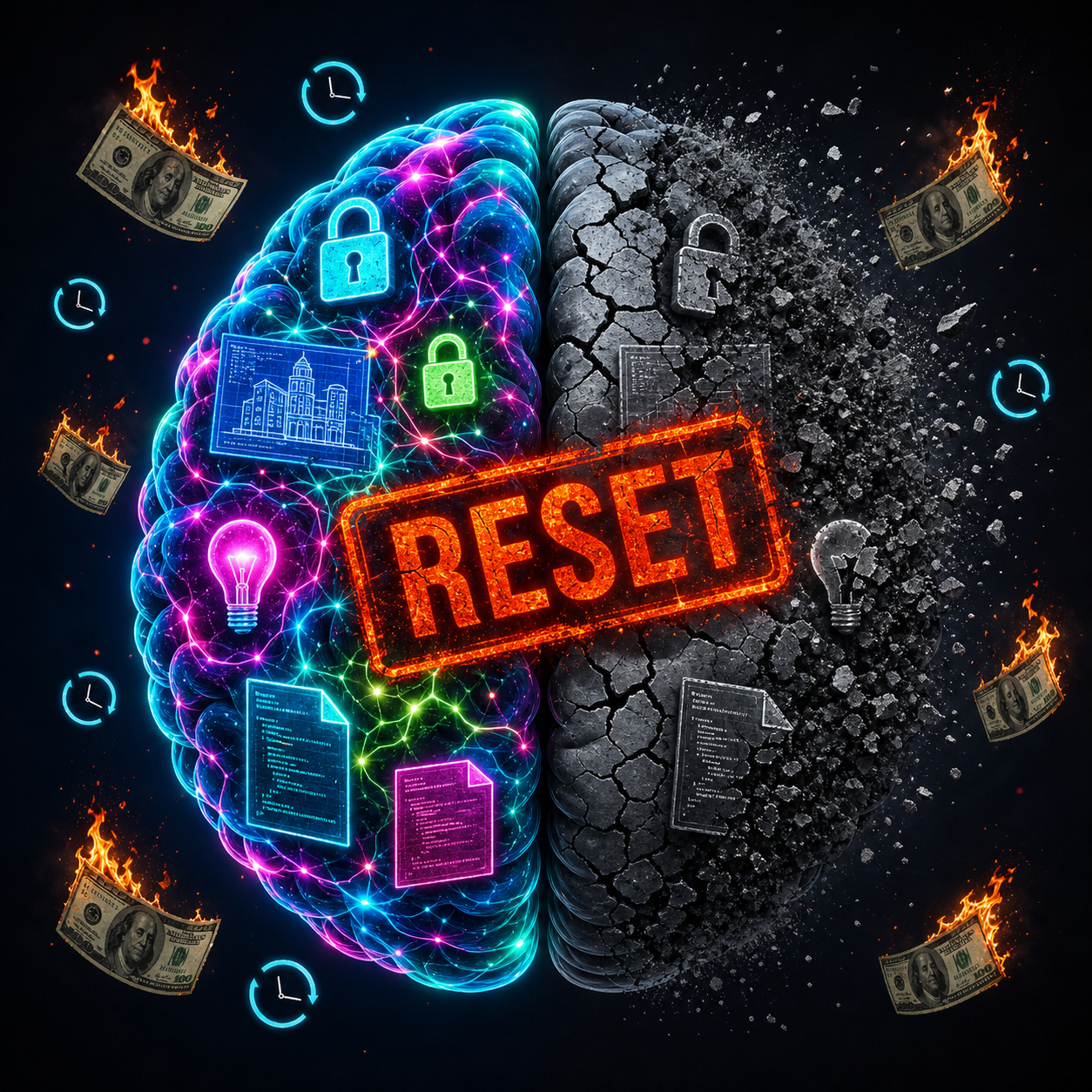
Session amnesia is the structural limitation where AI coding assistants start every session from zero. They retain no memory of lessons learned, decisions made, or constraints discovered in previous sessions.
This is NOT the context window problem.
Context windows define how much the AI can see right now.
Session memory defines what the AI should already know before you even start typing.
Every tool in 2026 has solved the context window problem. Zero tools have solved the session memory problem. They are not the same thing.
In a paper published today on the iSterna blog, Yanbing Li identifies three distinct failure modes. First, there is no persistent memory layer. The AI's "brain" is wiped clean every session. There is no database of lessons learned. Second, there is no lesson-capture workflow. Even when a developer manually writes down what they discovered, there is no structured pipeline to inject that lesson into future sessions. Third, there is no cross-session context inheritance mechanism. The AI cannot look at its own prior reasoning about a project and bootstrap from where it left off.
The existing "solutions" are theater. CLAUDE.md files are manually maintained, fragile, and immediately stale. They are a sticky note on a nuclear reactor. Prompt templates are static, do not evolve with the project, and require you to remember to use them. Context stuffing is expensive, hits limits fast, and the AI still does not know which of those 100 dumped files actually matters. Checkpoint systems like CrewAI exist for agent pipelines, not for developer-to-AI coding sessions. Different problem entirely.
Case Study 1: The $66 to $90 Rediscovery
The paper from Yanbing Li at iSterna LLC, titled "Session Amnesia: The Hidden Cost of Stateless AI Coding Assistants," documents a specific incident. A developer using an AI coding assistant discovered a critical project constraint in one session. The constraint was not captured in any persistent form. Weeks later, the same developer encountered the same constraint in a new session. The AI had no memory of it. The constraint had to be fully rediscovered, costing $66 to $90 in LLM review cycles.
The paper's central principle is simple and devastating: "The code fix is the last step, capture the lesson first." Every AI coding session should produce two artifacts: the code changes and a structured lesson record. The lesson record outlives the session and feeds every future session. Nobody builds this way. Nobody ships this way.
And one constraint times one developer times one project is a rounding error. Multiply it across an organization of 200 developers running 5 sessions a day and the annual cost enters the millions before you finish your coffee.
Li proposes a five-layer framework to fix this: lesson detection, structured capture, persistent storage, relevance retrieval, and context injection. More on that in a moment.
Case Study 2: The 126K-Line Android App
A developer with 18-plus years of experience and zero Kotlin knowledge built a 126,000-line Android application across 398 files with 45,000 lines of tests. Four months. Zero lines of Kotlin written manually.
The project was documented in a Hacker News Show HN post in May 2026. The key insight is not that AI wrote the code. The key insight is that the developer had to build a manual session memory system because none exists natively.
His workaround included a CLAUDE.md file that grew with every mistake made, a custom start-session command that loaded all relevant project documents, and a custom end-session command that saved every lesson learned, every architectural decision made, and every constraint discovered. He treated each session as a learning cycle, not a transaction.
His own words from the post tell the story: "Vibecoding at this scale isn't possible, you need structured specifications, project rules that compound over time, and a state management strategy that prevents each session from starting from zero."
Read that again. These are not the words of someone who dislikes AI coding tools. These are the words of someone who shipped a real product with them and walked away with one conclusion: the tools need a memory layer they do not have. So he built his own. That is the indictment of the entire category.
Case Study 3: Relentless Code Optimization
Damir Bulic at Spectral Core published a blog post today titled "Relentlessly Optimizing Code with AI." The results are staggering: SQL parser speed doubled. Binder performance improved 100x. Memory consumption reduced 60x. A 2.7 million-line Oracle schema translated to Postgres in 20 seconds.
Bulic had known about these optimization opportunities for years. He simply never had the time or energy to implement them. AI removed the activation energy barrier.
But here is the session amnesia angle the tech press will miss: if Bulic had to re-explain the parser architecture to a new AI session every time, these multi-session optimization campaigns would have been impossible. The AI's ability to maintain context across multiple sessions of the same optimization work was the difference between shipping and not shipping.
And here is the uncomfortable question: what happens when the AI forgets the architecture mid-optimization and breaks something subtle? What happens when you are not lucky enough to have Bulic's 15 years of domain knowledge filling the gaps the AI leaves? The Spectral Core post mentions running 27,000 tests as a safety net. Most projects do not have a 27,000-test suite. Most projects ship the bug.
The pattern across all three cases is undeniable. Developers are inventing ad-hoc, fragile, human-dependent workarounds for a problem that needs an architectural solution. The tools are not missing a feature. They are missing an entire system layer.
Four Structural Reasons Nobody Has Built This
Cause 1: The Chat Paradigm Was Never Meant for Development. AI coding assistants inherited the chat UX from consumer LLMs. Chat sessions are fundamentally transactional: ask, answer, done. Software development is not transactional. It is a campaign. It spans days, weeks, and months. The state of the project evolves. The AI needs to evolve with it. The entire interaction model is wrong for the use case, and nobody is reconsidering it.
Cause 2: The Economic Incentives Are Misaligned. AI companies sell tokens, not productivity. Every rediscovery event is revenue for them. A developer re-explaining architecture is billable API calls. There is no financial incentive for OpenAI or Anthropic to make their coding assistants remember things between sessions. Session amnesia is a profit center. This is not a conspiracy theory. It is a structural observation. Companies optimize for what they measure, and what they measure is token consumption, not developer productivity.
Cause 3: The Architectural Complexity Is Genuinely Hard. Persistent cross-session memory is not a "just add a database" problem. It requires automated detection of what to remember because not all context is equal. It requires structured representation of lessons learned, not just text dumps. It requires relevance retrieval at session start because which of 500 prior lessons actually apply to this task? It requires conflict resolution because what if a lesson from last month is now wrong? It requires decay and cleanup because when is a lesson no longer relevant? This is a genuine R&D problem. Nobody has put serious resources behind it.
Cause 4: The Research Is Fragmented Across Disciplines. Relevant work exists, but nobody is connecting the dots. APEX-MEM achieves 88.88 percent accuracy on persistent agent memory tasks. Synthius-Mem exceeds human memory performance in agent retention tests. But these are for multi-agent orchestration, not human-developer-to-AI sessions. The Solvita paper, published on arXiv just four days ago (May 14, 2026), shows graph-structured knowledge networks with reinforcement learning updates from outcome signals applied to competitive programming, not general development. SDOF, published April 2026, shows state-constrained dispatch with precondition and postcondition validation, but for multi-agent orchestration, not the developer-agent interface. SkillSmith, published May 12, 2026, demonstrates 57 percent token reduction through boundary-guided skill compilation, directly applicable to the injection layer. The pieces exist. Nobody is assembling them into a coding assistant memory architecture.
The Five-Layer Fix
The framework from Li's iSterna paper is the blueprint the industry has been missing:
Layer 1: Lesson Detection. Not every exchange in a coding session is a lesson. Most is noise. Pattern-based triggers flag architectural decisions ("we are using Hexagonal Architecture"), constraint discoveries ("this API requires auth token rotated every 24 hours"), bug root causes ("the race condition happens because the mutex is acquired in the wrong order"), and failed approaches ("tried approach X, abandoned because Y"). A lightweight classifier model running locally could flag candidate lessons for developer confirmation. The key property: it must take less than 5 seconds to capture. If it takes more, developers will not do it.
Layer 2: Structured Capture. Not a text dump. A structured schema with fields for lesson ID, project ID, category (constraint, decision, bug pattern, architecture, tooling), context, the actual insight, relevant code snippets, affected files, timestamp, confidence level, and links to prior lessons this one supersedes or contradicts. The Solvita connection: each lesson is a node in a graph. Outcome signals (did applying this lesson help or hurt?) update the node's weight via reinforcement learning mechanisms.
Layer 3: Persistent Storage. Must be local. This is project intellectual property. Use SQLite with a vector extension (sqlite-vec) for zero-setup portability, or project-local JSON/YAML for human readability and git-trackability, or a hybrid: structured database for machine query plus human-readable export for git diffs. Must survive machine reboots, project moves, and team handoffs.
Layer 4: Relevance Retrieval. A project might accumulate 500 captured lessons. Which 5 are relevant to the task at hand? Semantic similarity can embed the developer's first prompt and retrieve lessons with the closest vector distance. File-path routing retrieves all lessons tagged to files the developer opens. Dependency graph traversal follows imports to retrieve transitive lessons. Task-type classification routes "bug fix" queries to bug pattern lessons and "new feature" queries to architecture lessons. The SDOF connection: state-constrained dispatch means the AI knows what phase of development it is in and retrieves the appropriate rule set.
Layer 5: Context Injection. Not all at once. That is context stuffing and it is expensive. Just-in-time injection delivers the top 3 highest-relevance lessons into the system prompt at session start. On-demand retrieval lets the AI query its own lesson store during the session when it encounters something it vaguely remembers. Trigger-based injection auto-loads file-tagged lessons when the AI touches a specific file. The SkillSmith connection: pre-compiled skill packages instead of raw lessons in every reasoning step yield 57 percent token reduction.
From MVP to production: a developer could build the SQLite plus structured JSON capture plus manual trigger plus keyword retrieval version in a weekend. Add semantic retrieval, auto-detection triggers, file tagging, and basic graph structure in a month. Add reinforcement learning lesson weighting, conflict detection, cross-project knowledge sharing, and a plugin system in a quarter.
The blueprint is public. Nobody has shipped it.
The Competitive Landscape
Everyone is using ad-hoc solutions. CLAUDE.md, COPILOT.md, and CURSOR.md files are dead simple and git-trackable, but they are 100 percent manual, stale immediately, and have no retrieval intelligence. Prompt libraries are reusable and composable but static, with no lesson learning built in. Context stuffing is comprehensive but expensive, slow, and the AI drowns in noise.
The research front is adjacent but misapplied. Solvita's graph-structured knowledge networks with reinforcement learning from outcomes is the breakthrough architecture, but it was built for competitive programming benchmarks, not real development sessions. ICRL (Internalized Critique Reinforcement Learning) shows agents that internalize self-critique across queries because the lesson was trained into behavior, not just stored as context. APEX-MEM and Synthius-Mem proved persistent agent memory works, but for multi-agent orchestration. SkillSmith's 57 percent token reduction through boundary-guided compilation is directly applicable to the injection layer. Nobody has assembled these pieces.
The tooling gap is absolute. Claude Code has no cross-session memory. CLAUDE.md is manual. OpenAI Codex has no persistent project memory. Sessions are stateless. Cursor has project context indexing (codebase awareness) but no lesson persistence across sessions. It indexes source files, not developer-AI interactions. Copilot has workspace awareness but no structured lesson capture. Windsurf, PearAI, Continue, all in the same boat.
The open-source opportunity is sitting in plain sight. An MCP server that implements the five-layer framework would be compatible with every coding assistant supporting the Model Context Protocol (Claude, Codex, Continue, and others). A developer could ship an MVP of this today with SQLite plus an MCP server wrapper plus Claude Code integration.
The first project to do this well becomes the "Redis for AI memory." Infrastructure so essential it becomes invisible. Anthropic is best positioned. They have the most-used coding assistant, the MCP protocol, and the research talent. They are not shipping it. OpenAI has Codex and funding, but is distracted by the hardware play. JetBrains and Cursor have the IDE integration to make lesson capture zero-friction, but have not shown interest.
The indie developer is the one to watch. This is a zero to ten million dollar ARR opportunity in plain sight. Build an MCP server. Open source it. Charge enterprises for team-wide lesson sharing and analytics.
The Stakes
Gartner and Forrester projections put AI coding assistant adoption at 75 percent of professional developers by the end of 2026. If every developer is losing 10 to 15 percent of their AI-assisted productivity to rediscovery, the aggregate cost across the industry is in the billions annually. This is not a rounding error. It is a structural tax.
Session amnesia does not just cost time. It costs correctness. A constraint forgotten and not rediscovered means a bug shipped. An architectural decision forgotten means a system built on inconsistent foundations. The AI is confidently wrong about something it "knew" last week, and the developer does not catch it. This already happens. You have probably already shipped one of these bugs.
The current paradigm of AI-assisted development is prompt, code, review, ship. Stateless. The next paradigm is the AI as a persistent team member who accumulates institutional knowledge about the codebase, the architecture, the team's preferences, and the project's constraints. You cannot reach that paradigm without solving session amnesia. This is the difference between "AI that helps me code" and "AI that is part of my engineering team."
And then there is sovereignty. If lesson memory lives in a proprietary cloud on Anthropic or OpenAI servers, you do not control your engineering knowledge. If the provider changes pricing, deprecates features, or cuts you off, your AI's memory of your project evaporates. The memory layer must be locally owned, stored, and portable.
This aligns with everything PhantomByte has written about sovereign AI infrastructure. The same argument we made for local models and self-hosted agents applies here: your AI's knowledge of your codebase is your intellectual property. Do not give it to a vendor.
What Happens Next
For builders, the five-layer framework IS the blueprint. An MCP server that implements it is a weekend project for the MVP. The market is every developer using an AI coding assistant. That is tens of millions of people by year's end. Ship it open source. Charge for team features (shared lesson stores, analytics, conflict resolution). This is a real business.
For users, demand persistent memory from your AI coding assistant vendor. It is not a "nice to have." It is a missing layer in the architecture. In the meantime, build your own manual system: structured CLAUDE.md files, lesson-capture discipline, session start and end rituals. The 126K-line Android app developer proved this works at scale. Start treating your AI sessions as learning cycles, not transactions.
The difference between a 10x developer and a 2x developer in the AI era is who builds the feedback loop. Session amnesia is not a bug report for Claude or Codex. It is a missing architecture layer in the entire paradigm of AI-assisted development. Every session starts from zero. Every lesson must be re-learned. Every constraint must be re-explained.
And we are all paying for it in compute, time, and shipped bugs. The company that builds the memory layer for AI coding assistants will own the next decade of developer tooling. Nobody has shipped it.
The window is open.
Get More Articles Like This
Session amnesia is the silent productivity killer nobody is talking about. I'm tracking every development in AI coding infrastructure—from memory architectures to sovereign tooling—as it happens.
Subscribe to receive updates when we publish new content. No spam, just real analysis from the trenches.