Texas just stopped approving new data center permits. Not a court order. Not a rate case. Not a lawsuit from a utility. Governor Greg Abbott ordered the Texas Commission on Environmental Quality to pause new data center permits until a full audit of water and electricity consumption is complete.
The fastest-growing AI build state in the country put a hard stop on its own pipeline while it decides what a data center is allowed to cost its neighbors.
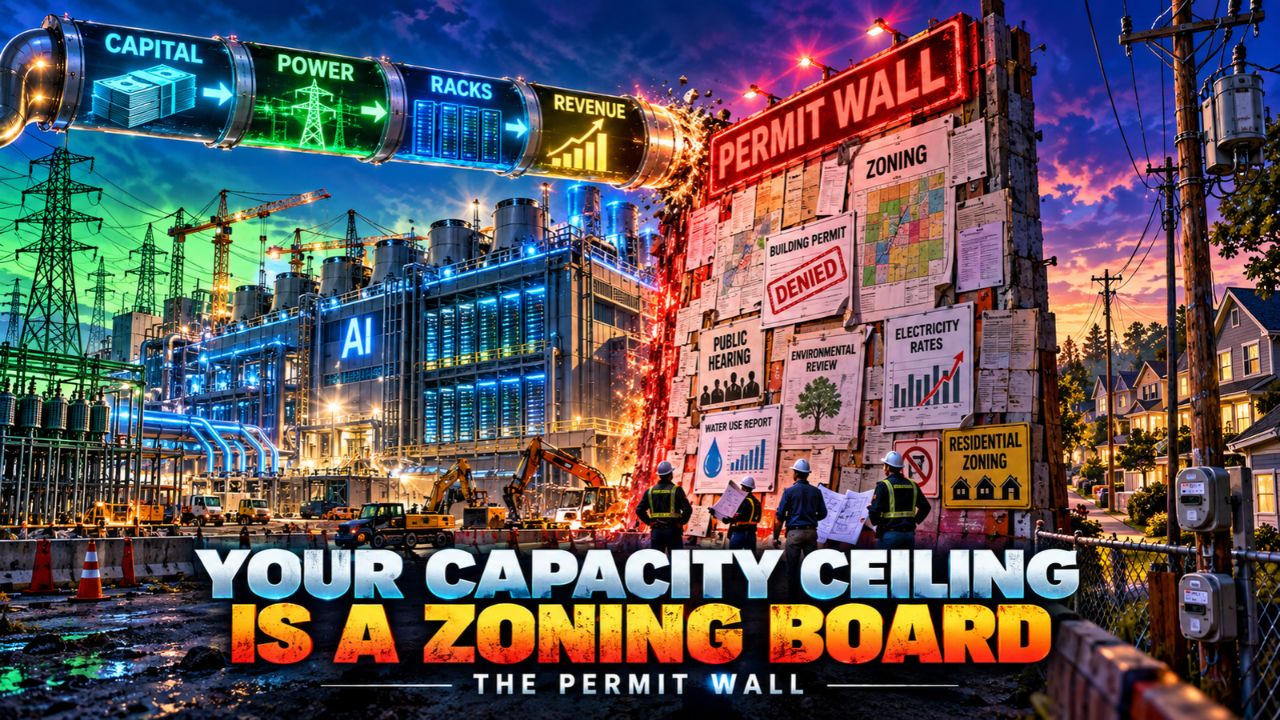
Every capacity forecast in your planning deck assumes the same chain. Capital converts to megawatts, megawatts convert to racks, racks convert to revenue. This week the largest build state in the union told you that chain is broken at the link you never modeled.
Palm Beach County, the county that contains Mar-a-Lago, voted unanimously for a moratorium on new hyperscale AI data centers the same week, citing environmental impact and the effect of large new loads on residential electric bills. Blount County's planning commission passed a resolution restricting AI data centers and forwarded it to the county commission for adoption. New Britain Township in Pennsylvania started drafting purpose-built data center rules. Residents in Ahwatukee, in Phoenix, are organizing against a project planned next door over continuous mechanical noise, evaporative water use in a desert city, and tax incentives they read as one-sided.
Here is the part that should worry you more than any single vote. Resident groups in different states are now sharing ordinance language, legal strategy, and noise and water data with each other. That is why moratoria are spreading between jurisdictions that have no connection to one another, and it is why the diffusion is faster than any state framework can react to. You are not fighting a county. You are fighting a distributed template.
So let me name the thing, because an unnamed constraint cannot be planned for. The binding constraint on AI capacity stopped being silicon and stopped being power. It is a zoning board. Call it the Permit Wall, and treat it as a first-class term in capacity planning rather than a communications headache.
THE AI DATA CENTER PERMIT WALL IS NOT A PR PROBLEM
Three structural facts from this week.
- The Texas pause is not narrow. The order reaches permitting, environmental compliance, noise standards, light pollution, project financing transparency, and the use of state incentives granted earlier. ERCOT and the Public Utility Commission are running the technical side of the audit, with peak summer demand projected to approach 85 gigawatts in coming years. Attorney General Ken Paxton opened a separate investigation into hundreds of Texas data centers over their water use reporting, an inquiry expected to run through the end of the year. Abbott's stated guardrails are blunt. Projects must not consume water or grid power that communities need, must not raise residents' electric bills, and must not be built inside rural residential neighborhoods. Read those as acceptance criteria, because that is what they are. They are the conditions a project now has to satisfy before it can be approved, and none of them are about your engineering quality.
- The loophole you have been leaning on is closing. Ordinary commercial zoning categories let hyperscale facilities in as of right, with no hearing on power, water, or noise impact. That is exactly the gap Blount County's planning commission moved to close, and it is the same realization driving New Britain Township's drafting process. Planning commissioners are arguing that an AI campus is a distinct land use class with externalities that existing codes were never written to capture. They are right about that. A 300 megawatt campus with on-site generation is not a warehouse, and a code written for warehouses says nothing useful about it. Once a jurisdiction writes that down, your parcel stops being commercial land and becomes a discretionary approval. Discretionary approvals are not bought with a lease option.
- Enforcement is already live, and it is not theoretical. New Jersey fined the operator of one of the East Coast's largest planned data centers 1.1 million dollars for installing and running gas generators in violation of the state's Air Pollution Control Act. The case came out of an investigation by The Guardian and Floodlight News that used thermal drone footage to show 45 of 62 generators running. None of the units held the permits required for generators at 37 kilowatts or above, despite operating at 1,982 kilowatt capacities. State officials noted the emissions include carbon dioxide, nitrogen oxides, and carbon monoxide, which worsen asthma.
Sit with that sequence. A community group with a consumer drone produced a better compliance audit than the regulator did. If your backup generation plan assumes nobody is counting, the Permit Wall says somebody is counting, from the air, with thermal imaging, and they are publishing what they find.
WHY MONEY DOESN'T CLEAR IT
This is the uncomfortable economics, and operators keep skipping it.
Tuscaloosa County approved a 3 billion dollar AI hub this month, which makes Alabama one of the few Southern jurisdictions to say yes while others were saying no. That approval did not come free. It came after a contentious public process, with concessions negotiated against organized resident opposition covering water use, local hiring, and tax treatment. The project still has to explain the incremental power cost to existing ratepayers over the next two years, and how the county handles that question decides whether other jurisdictions copy the approval or the fight.
The international version of the same story is in Andhra Pradesh. The Guardian reported from a village where land was acquired for a hyperscale campus on terms residents say were never honored, with promised jobs and infrastructure that never materialized.
The pattern in both cases is identical, and it is the thing your financial model cannot express. When the resource burden of land, water, and power falls on a community that captures little of the upside, approval stops being a price and starts being a vote. You cannot buy a vote the way you buy a turbine. You cannot discount it, accelerate it, or syndicate it. You either arrive with something that reduces the burden, or you lose the hearing.
Money does not clear the Permit Wall for a second reason, and it is the one that catches well-funded developers. The supply chain behind power is fragile even in jurisdictions that have already said yes. Crusoe, the Denver AI data center builder that recently raised 3.9 billion dollars, ended its plan to use Boom Supersonic's stationary natural gas power plants, a program worth 1.25 billion dollars. Boom's Superpower turbine shares roughly 80 percent of its parts with the Symphony engine it is developing for the Overture supersonic jet. Boom's CEO said the stationary plants are no longer in Crusoe's near-term plans, which leaves Boom looking for a first customer.
Crusoe had been that first customer. So the exit is a setback for the turbine program specifically, and a signal about the wider supply chain. A permit is not a power plant. A power contract is not a turbine on a pad. The Permit Wall compounds an execution risk you were already carrying.
HOW TO MODEL PERMIT RISK LIKE AN ENGINEER
Here is the teachable core, and it is the reason this article exists.
Municipal ordinance language is standardizing across jurisdictions. Blount County, New Britain Township, and Ahwatukee are converging on similar definitions of what a hyperscale data center is and what review it triggers, and resident groups are accelerating that convergence on purpose by sharing drafts. Standardization is bad news for anyone hoping to shop for a friendly county, but it is good news for anyone who wants to plan. A predictable blocker is a plannable blocker.
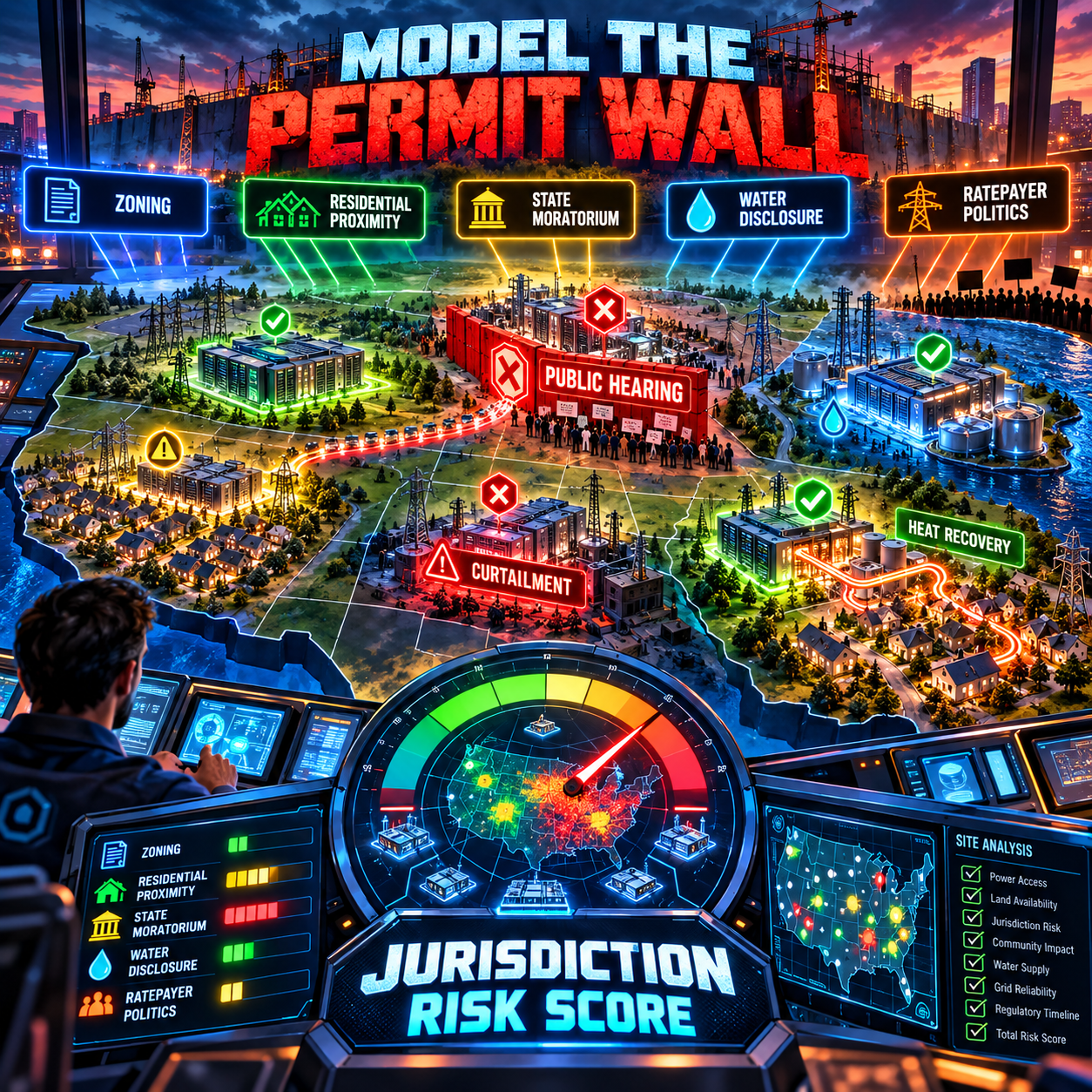
So build the term and put it in the model. Score every candidate site on five inputs, the same way you score interconnect lead time.
- Does the jurisdiction already have a purpose-built data center ordinance, or is one in drafting, and does it name hyperscale separately from ordinary commercial use.
- Does the parcel sit adjacent to residential land, and does current zoning trigger a public hearing for the load you intend to draw.
- What is the state's moratorium and investigation posture. Texas is under an active audit with a parallel attorney general inquiry running through year-end, which means the ordinance language that comes out of Austin is the language other states will copy.
- What is the water disclosure regime. Paxton's investigation covers hundreds of sites over water use reporting, so assume consumption figures will be public and compared against residential supply.
- Is there a live political vehicle for ratepayer-bill objections, meaning an elected body with a vote in front of it and a constituency that shows up.
Call it the Jurisdiction Risk Score. Score high and cheap to serve. Score low and either price the delay into the program or drop the site before you sign the option. This is the same discipline you already apply to interconnect queues, and it deserves the same line in the forecast.
Which brings me to a point I have made before and will keep making. In "Your Cluster Is Interconnect-Bound, Not Compute-Bound" I argued that your queue position, not your GPU count, sets your schedule. That was correct and it was incomplete. Interconnection is one gate. The Permit Wall is the gate before it. A site that cannot be approved never reaches the queue, and no amount of capital moves it forward. "Your 503s Aren't a Bug: They're a Power Shortage Symptom" made the same point from the failure side, that your users experience your power economics as downtime. Now add the jurisdictional layer on top of both.
THE EXECUTION RISK YOU ALREADY HAVE
Oracle invoked force majeure on its New Mexico Stargate site over power delivery delays, and its shares slid roughly 3 percent on the disclosure. That matters because the 165 billion dollar program is now the cleanest public test of whether contracted AI capacity can actually be delivered on schedule. A large share of Oracle's remaining contract backlog is AI infrastructure that has not been built yet, and every delayed site pushes revenue recognition further right.
Analysts reading the disclosure are asking the right question: was force majeure a one-off site problem, or a signal that the underlying power and interconnection assumptions across the portfolio were optimistic.
The Permit Wall changes the shape of that risk. A delayed interconnect plus a hostile jurisdiction does not add. It multiplies. One delays your schedule. The other can cancel the site outright, and it can do it after you have spent the money. The Wall Street Journal's framing of the build-out as the largest capital commitment in American economic history comes with the dependency list attached: power, land, water, permits, and credit all have to cooperate simultaneously. Any one of them failing at scale changes the arithmetic for the entire program. Permits are on that list, and permits are the one entry on it that no balance sheet can fix.
THE CREDENTIALED OPERATOR'S COUNTER-PLAYS
Two are live this week, and both are worth studying because neither is charity. They are permit currency.
Google is repositioning its data centers as grid partners rather than pure loads, using on-site storage and flexible workload scheduling to modulate demand, and accepting demand-response obligations as a condition of interconnection. The technology is not novel. The willingness to sign the obligation is. A facility that can curtail is easier for a utility commission to approve than one that cannot, and that directly answers the objection driving moratoria from Texas to Palm Beach.
The United Kingdom is pushing to expand district heating schemes that recover waste heat from data centers and pipe it into nearby homes. The obstacles are real, including distribution infrastructure, the temperature mismatch between what a facility rejects and what a heating network needs, and the geographic mismatch between where data centers sit and where housing density exists. The political logic is compelling anyway, because heat recovery converts a facility's single largest local liability into a local benefit.
The decision rule is simple and it is the most useful thing in this article. Every moratorium fight is really a fight about who absorbs the externalities. Arrive holding something that reduces them, and you are negotiating. Arrive holding a tax abatement request, and you are the problem statement.
WHAT CURTAILMENT DOES TO YOUR RUNTIME
There is a layer in this that software architects have not absorbed yet, and it lands on them, not on the site selection team.
A demand-response obligation is a contract that says the grid can ask your facility to shed load on short notice. Operators sign it because it clears approvals. The moment it is signed, curtailment stops being an abstract grid concept and becomes a runtime event your scheduler has to handle. A cluster that drops from full draw to a fraction of it does not pause politely. In-flight inference requests fail, training jobs lose their step, and checkpoint intervals sized for hardware failure get tested by a power event on a schedule nobody on the software team controls.
So the Permit Wall pushes architecture in three specific directions.
Geo-distributed agent clusters. If one region can be curtailed by a utility commission, a single-region agent stack now carries a class of availability risk it was never designed around. Agent orchestration spreads across regions so a curtailment event drains a zone instead of stopping the product.
Dynamic multi-region inference routing. Routing logic built to optimize latency and cost needs a third input: whether the destination region is currently under a curtailment instruction. That is a live signal from grid or facility telemetry, not a static weight in a config file, and it belongs in the same control plane as your load balancer.
Fault-tolerant checkpointing. Training runs and long-running agent workflows need checkpoint intervals that assume the interruption arrives from outside the data center rather than from a failed card. Shorter intervals, resumable state, and the discipline to exercise a curtailment path the way you already exercise a node failure.
None of this is exotic engineering. It is the fault tolerance work you already do, extended to a fault source that lives in a county zoning file. That is the real bridge between permitting and software, and it is why the operator who reads a curtailment clause as a legal footnote will be the one explaining an outage that was scheduled by a utility commission.
WHAT TO DO TODAY
- Pull every site in your five-year plan through the Jurisdiction Risk Score this month, before the next lease option is signed.
- Read the actual zoning text for each parcel. Do not assume the word commercial means cleared for hyperscale loads, because that assumption is the loophole and the loophole is closing.
- Add a permit-risk line to capacity forecasts, placed directly next to power and interconnect lead time, and own the number in front of your own leadership.
- Prepare the demand-response and heat-recovery offers before the public hearing, not after the vote. Once the vote is lost, the offer costs twice as much and buys half as much.
- Assume community-side drone and thermal audits of your generators. Get the permits first.
- Track the Texas audit and the Paxton investigation. The ordinance language that comes out of them will diffuse nationwide, and you can read it before it reaches your county.
THE UNCOMFORTABLE QUESTION
Your data center's power draw lands on somebody's residential electric bill, and this week the people holding those bills stopped a 3 billion dollar project in one county and passed it in another with conditions attached. When your next site hearing happens, are you the operator arriving with a curtailment plan and a heat offtake agreement, or are you the one explaining to a room full of ratepayers why their bill went up so your queue times could go down?
Get More Articles Like This
Getting your AI agent setup right is just the start. I'm documenting every mistake, fix, and lesson learned as I build PhantomByte.
Subscribe to receive updates when we publish new content. No spam, just real lessons from the trenches.
Build Real AI Infrastructure
PhantomByte teaches you to build real AI infrastructure yourself: local AI stacks, autonomous agents, multi-agent orchestration, web scraping, and custom tools. Step-by-step PDF tutorials you download, follow, and deploy. No subscriptions. No fluff. Just skills that ship.