
SpaceX disclosed a binding commitment for roughly 40 billion dollars of GPU financing, and the leases behind it run five to five and a quarter years from the delivery of each tranche. The hardware those leases describe will be two generations behind the part you would want before the last payment clears. Somebody signed that on purpose, and it was not a mistake.
In the same 48 hours, Broadcom organized a 63 billion dollar bank loan so Anthropic can buy Google TPUs, Meta moved to raise 95 billion dollars in stock, and Moody's warned that AI borrowing is feeding private credit growth while refinancing risk builds across the market.
This stopped being a capex story. It is a capital structure story, and capital structure is a deployment decision. The Compute Illusion: Where the Other 16 Million GPUs Actually Live asked where the GPUs physically are. The Data Center War Nobody Is Winning: $130 Billion Blocked, NIMBY Won, and What Happens When AI's Infrastructure Can't Get Built asked who is allowed to build. This note asks who holds the paper, because the paper is what your capacity depends on.
Agentic workloads are where that gap bites hardest. A chat session asks one question and waits, but an agent runs dozens of tool calls and reasoning turns per task, so every lease expiration and every refinancing shock upstream arrives at your token bill multiplied by the number of turns you never see.
THE THREE PAPERS STACKED ON ONE MACHINE
Four deals landed in one week, and they are four different claims on the same depreciating asset.
Meta is the equity layer: 95 billion dollars, split as a 35 billion dollar underwritten offering and a 60 billion dollar at-the-market program, with 3 billion of it from Nvidia. CNBC reports Nvidia, AMD and Broadcom were interested in buying up to 5 billion dollars of shares. The vendor is funding its own customer so the customer can buy more of its product.
Anthropic is the structured bank debt layer. A special purpose vehicle, a bankruptcy-remote shell that holds an asset and owes the debt on it, borrowed 63 billion dollars from Bank of America, Blackstone, Citigroup and Morgan Stanley under the code name Project North Star. Broadcom engineered the deal and is providing residual value support equal to the first lien portion, which means the vendor, not the bank, eats the loss if the chips are worth less than the loan says.
SpaceX is the sale and leaseback layer. An Apollo-managed entity buys the chips and the server hardware and leases them back to SpaceX instead of lending against them. That keeps the obligation off the balance sheet the way a loan would not, and ties the payment schedule to silicon that will be obsolete long before the lease ends. Apollo said the money helps deliver Nvidia's next-generation Vera Rubin chips.
Argentum AI is the fourth layer, and it is the honest one. The neocloud is in talks for 5 billion dollars of financing secured against the chips themselves rather than against a building, per Reuters. Nowhere to hide there: the collateral is the thing that loses value fastest.
Now put the S-1 on the stack. Anthropic reported 16.3 billion dollars of revenue in the first half of 2026, up from 1.2 billion a year earlier, with a 693 million dollar operating loss and an 80.7 billion dollar net loss driven almost entirely by noncash convertible debt adjustments. Against that it carries 417 billion dollars in compute commitments and 6.2 billion dollars of debt, and it concedes that some planned sites will run on natural gas turbines fired on site.
Read those together. The company is borrowing against compute it has promised to buy, and admitting the power for it is not fully solved.
THE MISMATCH: 18-MONTH ASSETS, FIVE-YEAR PAPER
Here is the number the whole market is underwriting against. The working assumption in compute finance is roughly 18 months of economic life per GPU, against lease and loan paper that matures in five to seven years.
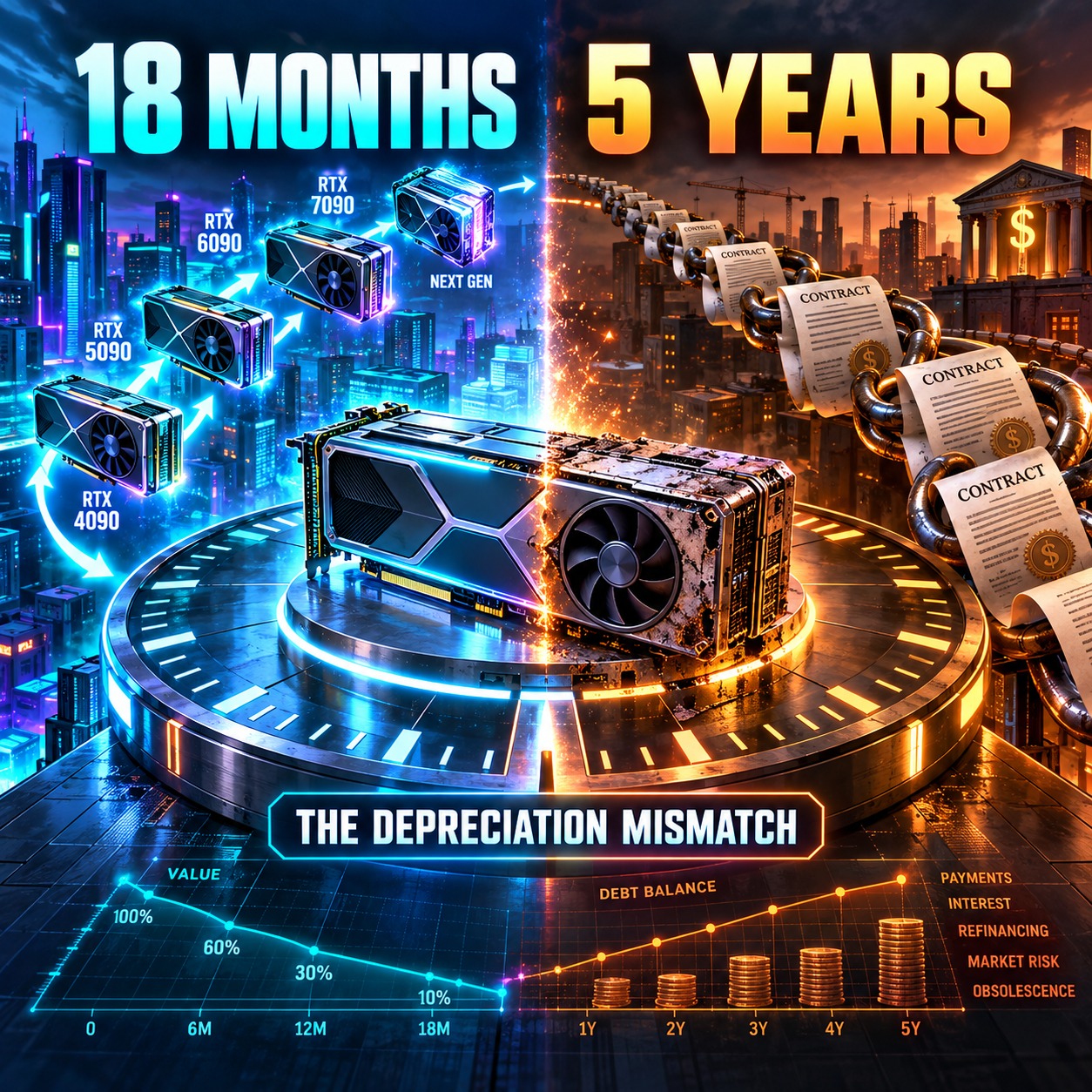
The cadence backs it up. Hopper shipped in 2022. Blackwell in 2024. Rubin is the 2026 generation, and Meta is already contracting for Vera Rubin systems. A five-year GPU lease is not a purchase being amortized over its useful life. It is a replacement schedule that somebody else owns, and the rent is priced on hardware the lessor expects to still be earning in year four.
Name the rule and use it. The Lease-Below-Depreciation Rule: never sign compute paper that matures slower than the silicon degrades. If the term on the paper outlives the useful life of the asset behind it, the final years of that contract are a bet on a refinancing, not a bet on a machine.
Moody's points at the rollover. AI-linked borrowing is growing the private credit channel, which prices outside public markets and marks less often, and more of this debt now needs rolling rather than repaying from operating cash.
Ajay Banga of the World Bank put the same problem from the other side. Capital availability is, in his words, not really an issue. The constraint is grid queues, permits and skilled labor. The cheapest money in the system is chasing the slowest part of it, and the paper gets signed long before the interconnect gets energized.
WHY THE VENDORS ARE SIGNING TOO
The supply side is signing five-year thinking because the bottleneck moved away from the die.
Nvidia signed multi-billion dollar agreements with six suppliers across substrates, advanced packaging, testing and optical engines, with roadmaps running through 2028. It is buying 2.5 times its current dedicated substrate capacity over three years with Ibiden, Unimicron and Samsung Electro-Mechanics, targeting a 300 percent increase in interposer wafer capacity with Amkor by the end of 2028, and it paid 1.1 billion dollars to reserve test capacity at KYEC and double its test throughput by 2027.
TSMC is reportedly weighing a 20 percent price increase on CoWoS, the packaging step that joins logic dies to high-bandwidth memory, and equipment lead times have stretched to as long as eight months. Rubin and Rubin Ultra reportedly take three to four times longer to test than Hopper, with Rubin possibly needing seven times longer. TSMC's deputy co-COO Cliff Hou said in July that expected equipment needs had reached 1.9 times the original estimate.
Test time is the tell. When a part occupies a tester four times longer than the last generation, capacity stops being a function of wafers and becomes a function of hours. That is why the chain prices time rather than parts, and why a supplier signs through 2028 to hold a slot.
THE THREE QUESTIONS THIS GIVES YOU
You will not see these structures from outside. You will see them in the terms of the inference contract somebody hands you.
Ask what the lease or debt maturity is on the hardware serving your tokens, and what replaces that fleet when it depreciates. If the vendor cannot answer, your capacity depends on a refinancing you are not party to.
Ask what the power contract behind the pod is. Grid interconnect or on-site turbines. Anthropic's filing names on-site gas turbines as a risk factor, and grid queues are the constraint Banga named. A pod with a signed interconnect and a pod with a generator permit are different products at the same price.
Ask what the customer concentration is. Anthropic reports 11,900 accounts spending 100,000 dollars or more a year, 1,900 above a million, and roughly 250 above 10 million. If your provider's revenue looks like that, your price is subsidized by a handful of accounts, and it changes the quarter one of them leaves.
WHAT TO DO TODAY
- Read your inference contract for the hardware refresh clause before the price clause. Ask when the fleet under your SLA gets replaced, in writing.
- Ask any GPU cloud vendor one question: who holds the paper on your fleet, and when does it mature. Silence is an answer.
- Model your capacity plan against lease maturity dates rather than model roadmaps. The roadmap tells you what will exist. The maturity date tells you what your vendor can still afford.
- If you are signing a multi-year commit, price the exit. What is the fleet worth in month 19, and who eats the difference if you leave.
- Watch the 2027 windows: SpaceX's first lease payments begin, and the first Broadcom-financed TPU tranches deliver. That is when this paper gets its first real test.
THE UNCOMFORTABLE QUESTION
The industry borrowed against hardware that loses its edge in about 18 months, on paper that comes due in five years, and it did that at record size in a single week. If your entire capacity plan depends on that paper rolling over on schedule, be honest about what you are running. Are you an AI company, or are you a landlord for a bank.
Get More Articles Like This
Getting your AI agent setup right is just the start. I'm documenting every mistake, fix, and lesson learned as I build PhantomByte.
Subscribe to receive updates when we publish new content. No spam, just real lessons from the trenches.
Build Real AI Infrastructure
PhantomByte teaches you to build real AI infrastructure yourself: local AI stacks, autonomous agents, multi-agent orchestration, web scraping, and custom tools. Step-by-step PDF tutorials you download, follow, and deploy. No subscriptions. No fluff. Just skills that ship.