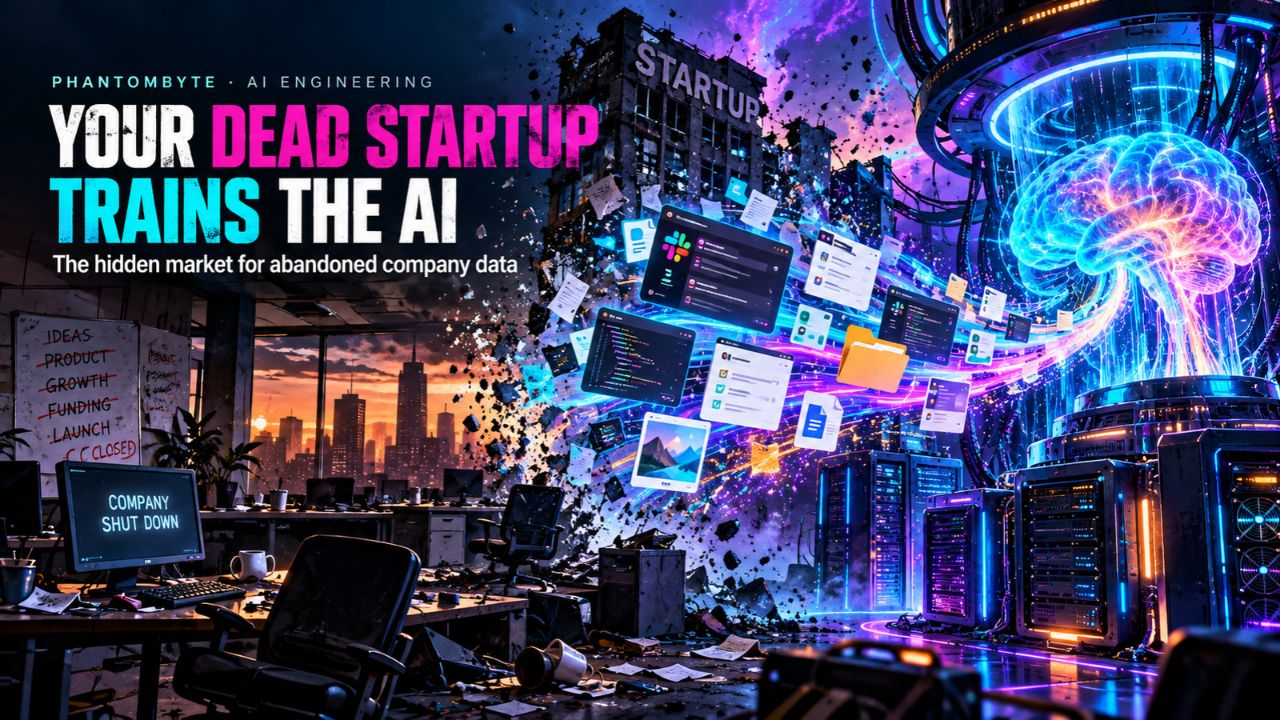
Keelan Miskell spent two and a half years building a crypto startup. When he wound it down this year, he assumed the data was nearly worthless. Anonymous users, a company only a few years old, nothing anyone would pay for.
He was wrong. Miskell has since turned the firm's digital archives into real money: roughly $25,000 for his code base, and a still-pending amount, likely around $15,000, for the workspace data sitting in Google, Notion, Figma, and Slack. "At least all that stuff we were doing for two and a half years is worth something to someone somewhere," he says.
SimpleClosure, the wind-down company that brokered his sale, added data sales to its services in April through a platform called Asset Hub. It has now handled more than 150 deals and expects to return over $10 million to startups by the end of 2026. CEO Dori Yona has watched these transactions go from rare and "somewhat taboo" to routine. Forty-seven percent of SimpleClosure deals now include code or data sales.
The startup graveyard just became a training set. Demand for real operational data appeared suddenly last year, when labs hit the limits of public and synthetic datasets. That is the same wall PhantomByte field note #100, "Synthetic Data Paradox," described: synthetic training has a collapse problem, and models trained on their own output degrade. Dead companies' exhaust does not. That is why something nobody used to count now has a price.
This is an engineering story wearing a business suit. Training data supply is infrastructure, and the industry has just priced a source it spent a decade ignoring.
THE MARKET, IN NUMBERS
The inventory is concrete. SimpleClosure's Asset Hub moves code and workspace data, meaning emails, chats, and documents. More than 150 deals. Over $10 million headed back to founders by year's end. Forty-seven percent of deals now carry code or data sales.
What is actually being sold is the operational exhaust of a failed company. The stuff no one cleaned up because there was no exit worth cleaning up for. The ticket queue, the Slack threads, the half-finished specs, the internal arguments. It never looked like inventory because a live company treats it as overhead. Once the company is dead, it looks like a dataset.
The scale is not small. When Spirit Airlines went through bankruptcy this August, Google outbid the AI data company Mercor to buy the carrier's decades of data: 100 million emails, 500 million Teams messages, and 176,000 employee records. The price tag was $10 million. Bloomberg reported in September that SpaceX's AI unit is weighing buying data from struggling startups. The market has already left the boutique stage.
WHO IS BUYING, AND WHY
Call it the Three-Buyer Map, because the demand side is clearer than most people assume.
- Foundation AI labs buying directly for pretraining.
- Vendors building simulated workspaces for AI training.
- Mature tech companies building their own models.
Those three pools explain almost every deal on the board.
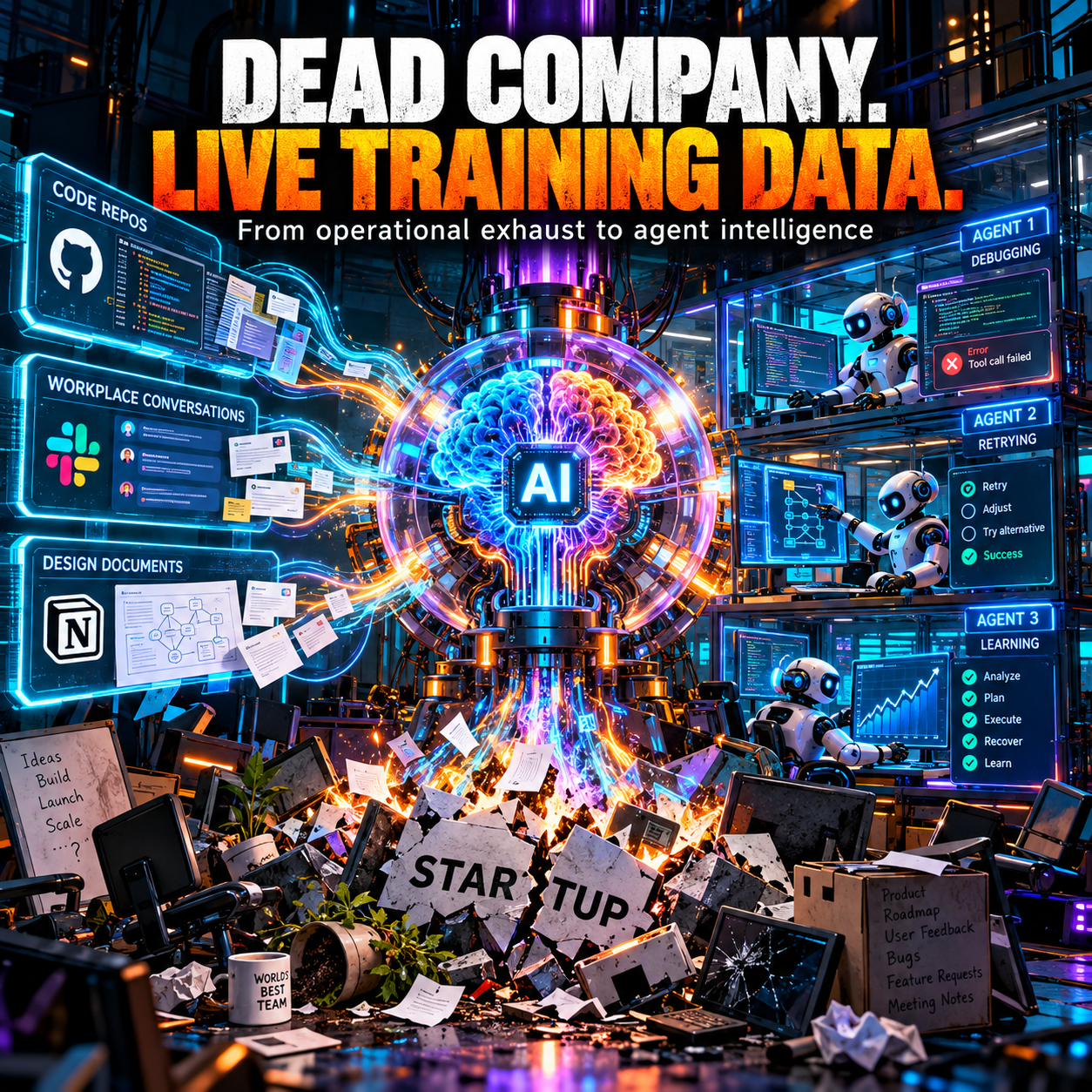
The sharpest detail lives in the second pool. Surge AI buys archives to build "reinforcement-learning gyms," environments where client agents practice tasks like debugging a complex IT architecture or drafting appellate briefs. Nick Heiner, who leads that work, says one company's Slack history, if it captures conversations with variety and depth, can be worth more than another company's Slack, email, and calendars combined. He is buying judgment calls, disagreements, and messy decisions, the material that does not appear in any synthetic dataset.
That is why your dead company's ticket queue is worth more than the company was. What a model cannot buy anywhere else is a record of humans actually doing the work. An agent training in one of those gyms is rehearsing on the wreckage of a real business.
The pipeline that consumes the exhaust is where the engineering actually lives. Multi-agent simulation environments ingest raw Slack threads, Notion documents, and ticket histories, then convert them into trajectories an agent can imitate: the tool call that was issued, the error it threw, the recovery that followed, and the multi-step reasoning loop that carried a broken state to a fixed one. A workspace that recorded real failures hands the training loop real failure to learn from, which is exactly what a synthetic world cannot manufacture. That mechanism, not nostalgia, is why the exhaust clears at a price.
Heiner is honest about the uncertainty. Real archives avoid the errors synthetic worlds make, like references to dates that do not exist. But no company has released tests comparing results of real-world data training with the alternatives. Pricing reflects that gap, and buyers quote wildly different numbers, because valuations rest on "research theses" estimating how many useful tasks come out of, say, 100,000 lines of code.
THE SHUTDOWN DATA VALUATION RUBRIC
Here is the part a founder can use. Sunset, the industry rival, prices a dying client's assets on four factors, and its founder and CEO Brendan Mahony names them: head count, years in operation, volume of data, and how the team used its tools.
Turn those four into the Shutdown Data Valuation Rubric you run before a wind-down.
| Factor | Question |
|---|---|
| Head count | How many people generated the data? |
| Years in operation | For how long? |
| Volume of data | At what volume? |
| Tool depth | With what tool depth? |
The fourth factor is the sleeper. A team that lived inside Slack, Notion, and Figma left richer traces than a team that worked in scattered documents and called it a day. Mahony reaches for a lumber mill analogy: this operational exhaust data is like the wood shavings everyone assumed had no value, except it turns out it has a ton. The company that used its tools deeply produced more shavings.
THE MACRO STAKE
Scale that up and it stops being a curiosity. Germany's ifo institute estimates generative AI could add 440 billion euros a year to the German economy by 2034. It also estimates that restrictive training-data rules would cut that figure by 155 billion euros annually, about 173.4 billion dollars. ifo's Oliver Falck put it plainly: anyone who wants a leading European AI model cannot at the same time make access to training data unnecessarily complicated.
That is the demand-side pressure that turns dead-startup data from a curiosity into a market. Data access is no longer a licensing footnote. It is national economic policy, priced in the hundreds of billions.
THE CONSENT PROBLEM, STATED HONESTLY
Now the uncomfortable part, and it does not get to be a footnote either.
The asset being sold is workspace exhaust from employees and customers who never agreed to become training data. When Spirit's data went to auction, the flight attendants' union objected on privacy grounds. Attorney Greg Ewing, who advises AI startups, called such data "legally radioactive." Suppliers employ data scientists to scrub personally identifiable information and exclude HR records, and buyers say they scrub too, but Ewing points to what still lurks in emails and calendars: doctor appointments, school pickup arrangements, date-night plans. He describes a "Wild West of AI training" that is only starting to give way to proper licensing agreements.
The proceeds flow to senior creditors and investors, not to the employees who generated the data. Ifeoma Ajunwa, a law professor at Emory University and author of The Quantified Worker, calls this "captured capital." Legal precedent allows monitoring so workers can do their jobs, but once the firm is out of business, that justification disappears. "Employers should have express consent before selling workers' data," she says, noting there is no federal law banning such sales.
Place that beside what is happening to researchers. Scientific American reported this week that scientists fear their unpublished ideas are surfacing in model outputs they never consented to. When OpenAI claimed an internal model had solved one of math's million-dollar problems, a mathematician at New York University insinuated that the company had stolen progress he had shared with one of its chatbots. A similar story unfolded between Anthropic and a University of Copenhagen biologist over a group of enzymes. Both companies denied training on the uploaded data. That denial has not settled the question for researchers who now see the models as competitors rather than tools. "Right now, these systems infer things about you without telling you that they're inferring things about you," says Jennifer King, a fellow at the Stanford Institute for Human-Centered Artificial Intelligence who researches data privacy.
The pattern is identical at every scale. Data created for one purpose migrates into models without the creator's signature. At a failed startup, the signature belonged to an employee who was never asked. At a university, it belonged to a scientist who was never asked. The mechanism is the same, and the money never reaches either one.
WHAT TO DO TODAY
If you are winding down, inventory your data before you sign anything. Run the four-factor rubric, head count, years, volume, tool depth, and price accordingly. The archive you were about to delete may be the only asset with a buyer.
Strip what cannot be sold. Customer PII, credentials, anything with a privacy obligation that survives the company. A founder who sells an unscrubbed archive inherits liability he thought he had dissolved.
Prefer a license with terms over a raw dump. A license survives a sale, a leaked archive does not.
If you are buying, demand provenance. Training on data whose consent chain is broken is a liability you inherit, not one you choose.
If you are operating, treat your own operational data as an asset with a paper trail starting today. The company that logged its decisions carefully is the one whose archive carries value later.
THE UNCOMFORTABLE QUESTION
Your company's most durable artifact may be the data it generated while failing. If strangers are already pricing it, why have you never priced it yourself?
Get More Articles Like This
Getting your AI agent setup right is just the start. I'm documenting every mistake, fix, and lesson learned as I build PhantomByte.
Subscribe to receive updates when we publish new content. No spam, just real lessons from the trenches.
Build Real AI Infrastructure
PhantomByte teaches you to build real AI infrastructure yourself: local AI stacks, autonomous agents, multi-agent orchestration, web scraping, and custom tools. Step-by-step PDF tutorials you download, follow, and deploy. No subscriptions. No fluff. Just skills that ship.