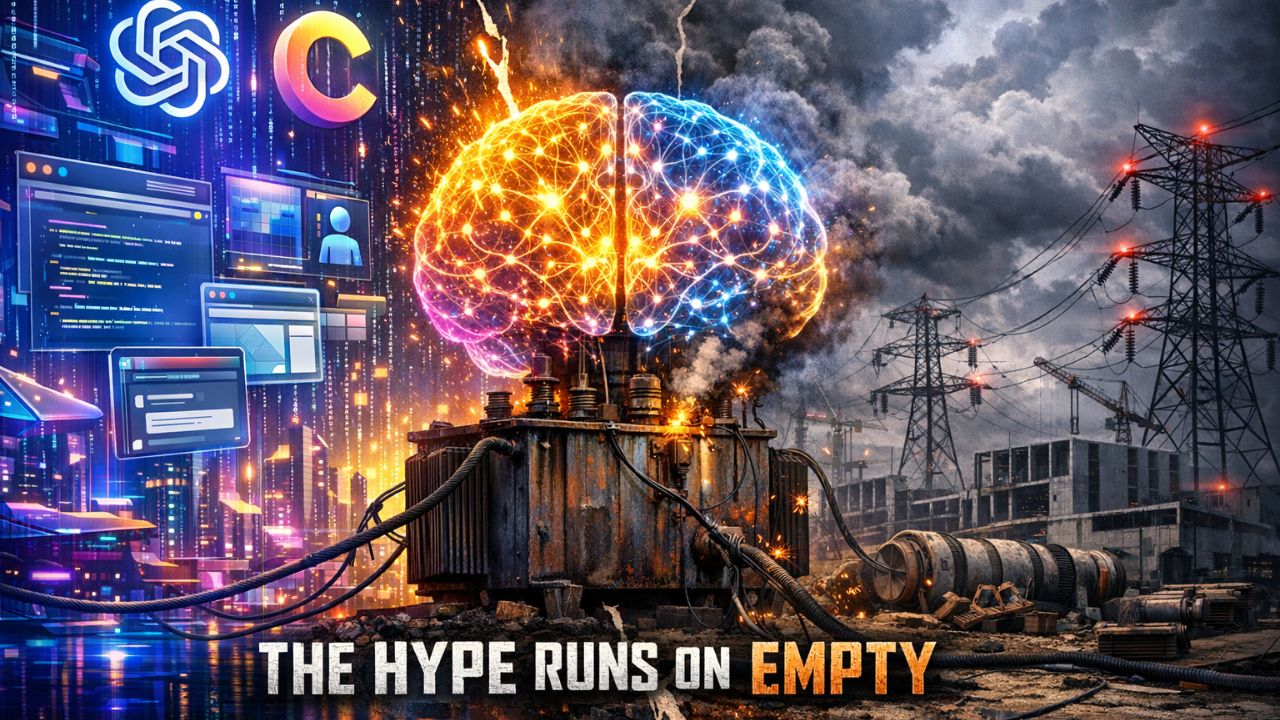
On the morning of April 10th, the tech industry did something they've gotten very good at: they made AI look easy.
Anthropic's Claude Design launch felt like watching a magic trick. The demo promised an AI that could remember everything about your project, including your design history, your rejected iterations, and the color palettes you abandoned three versions ago. It was seamless, polished, and for a moment, you could forget the sheer computational mass required to make a language model recall the context of your Figma file.
That same week, OpenAI dropped their Agents SDK with memory systems, sandboxed execution, and the kind of infrastructure orchestration that used to require a team of DevOps engineers. Everything just worked.
But while the demos were playing out on stage, I was tracking something else entirely. Satellite imagery doesn't lie. And those satellites showed something the keynote streams conveniently omitted: four out of ten data centers under construction in the United States are now projected to miss their 2026 completion dates. This isn't marketing fluff. This is concrete, steel, and transformers that aren't arriving on schedule.
This is the AI infrastructure gap, and it's not a bug. It's the story.
The Polished Product Hype Cycle
I need to give credit where it's due. The launches this spring have been genuinely impressive.
What Anthropic pulled off with Claude Design is technically marvelous. Persistent memory across design sessions, context-aware suggestions, and the ability to iterate without losing your history are not incremental features. They represent a fundamental leap in how AI interfaces with creative work. The model doesn't just understand what you're asking. It remembers every design decision you've ever made with it.
OpenAI's Agents SDK went even deeper. They built sandboxed execution environments, multi-step agent orchestration, and observability hooks that make it possible to actually deploy autonomous systems without flying blind. The memory systems they've implemented aren't just token tricks. They are genuine architectural improvements that let agents maintain state across sessions.
Then there's Cursor. After hitting a $50 billion valuation (not billion, but $50 billion) people started asking the obvious question: how is a code editor with AI features worth that much? The answer isn't in the features. It's in the unit economics.
I saw the data. Cursor achieved profitability through cost optimization rather than just growth. In an industry where every other AI company is burning cash faster than they can raise it, Cursor figured out something important: efficiency scales better than features. They built caching systems, smart token management, and infrastructure that doesn't treat every keystroke like a nuclear reactor's worth of compute. The $50B valuation isn't for the AI. It is for the margins.
But here's what none of these companies want to talk about. The infrastructure beneath their magic exists at the mercy of a physical reality that is cracking under the load.
The Physical Reality: Breaking News from the Dirt
I've been saying for months that your 503 errors aren't bugs. They are physical constraints. That article aged well. Satellite data released last week confirmed what the power grid operators have already been screaming: 40% of US data centers scheduled for 2026 completion will miss their dates.

The reasons are all physical:
- Labor shortages in electrical construction
- Power infrastructure bottlenecks that nobody saw coming
- Tariffs on transformers that have doubled costs and extended lead times from 12 weeks to 52 weeks
But here's the headline that should have dominated the news cycle: The PJM Interconnection, the regional grid operator serving thirteen states from Virginia to Illinois, is projecting a need for 15 gigawatts of new power generation specifically for data centers. That is 15,000 megawatts. To put that in perspective, that is roughly equivalent to fifteen full-scale nuclear plants' worth of power, and it needs to come online in the next few years.
PJM already runs one of the world's largest electricity markets. They're not amateurs. They've been managing grid stability for decades. And they are telling developers that the power simply isn't there yet. NIMBY opposition is blocking transmission line projects. Environmental reviews are adding years to approval timelines. And the transformer manufacturing base, which already struggled to recover from pandemic-era supply chain issues, is now overwhelmed by a flood of orders it can't fill.
This is the AI infrastructure gap in its rawest form. It is the space between what the software promises and what the hardware can deliver.
The Cost Story Nobody's Talking About
This physical scarcity at the grid level is exactly what is driving the localized unit economics crisis at the application layer.
Remember the caching bill story I broke a few weeks back? The one where a developer's Redis costs jumped from $12K to $38K overnight because their AI application's token throughput was higher than their caching layer could handle?
That story is everywhere now. The $50K token bomb isn't a one-off problem. It is a structural reality. AI companies are discovering that the marginal cost per user session is higher than their unit economics can support. The AI infrastructure gap isn't just about power plants and transformers. It's about the fundamental misalignment between how AI products are priced and what they actually cost to run.
And here's where Cursor's story gets interesting again. While everyone else was chasing model performance, Cursor chased efficiency. They reportedly achieved their profitability not by charging more, but by caching smarter, batching better, and building infrastructure that didn't require a dedicated data center for every thousand users.
This is the pattern emerging. The companies winning in the AI infrastructure gap aren't the ones with the best models. They are the ones with the best cost architecture.
How the Builders Are Adapting
If you're paying attention, you can already see how the market is adjusting to the AI infrastructure gap.
Railway's $100 million raise last week tells the story. They abandoned Google Cloud entirely and are building custom data centers specifically optimized for AI agent deployment. The pitch? One-second deployments for AI agents. But the subtext matters more. They couldn't get the cost structure they needed from hyperscale providers, so they are building it themselves.
This is the infrastructure response to the AI infrastructure gap. When the public cloud can't deliver the economics or the power availability, companies are going back to first principles: direct control of hardware, custom-optimized environments, and vertical integration that Silicon Valley spent the last decade telling us was obsolete.
Then there is the sovereign AI surge I wrote about, the $900 per month sovereign AI trend. When centralized infrastructure becomes a bottleneck, the incentive to distribute becomes overwhelming. Companies are running inference on-device, on edge servers, and on smaller models they can actually afford to operate. The AI infrastructure gap is forcing a localization movement that looked like a privacy story but is actually a physics story.
Physical Intelligence just announced their π0.7 robot brain achieving compositional generalization, a breakthrough that suggests robots can soon learn new tasks by combining familiar skills. The implications are massive. We are looking at AI that can operate in physical environments without massive cloud connections. When the infrastructure can't support the cloud vision, the edge becomes inevitable.
What the Smart Money Sees
The private market data this week reads like a mood ring for the AI infrastructure gap.
Factory hit a $1.5 billion valuation for multi-model AI coding. Railway raised $100 million to build data centers. Alibaba entered the physical AI race with their Happy Oyster world model. These aren't feature plays. They are infrastructure bets.
But the signal I'm watching most carefully is the one that looks like a joke: Allbirds pivoting to GPU-as-a-Service.
When a shoe company thinks it can make money renting compute, you know the AI infrastructure gap has created market distortions that can't last. Upscale AI hitting a $2 billion valuation with no product isn't hype. It is a bet that in a world of scarce infrastructure, the companies that can secure compute will print money.
The agent wars have escalated. This week proved it. The production AI infrastructure is exploding, and agent orchestration, observability, and deployment speed are becoming the defining battlegrounds. The reason is simple. When the underlying compute is constrained, efficiency and speed of deployment become the only moats that matter.
The Question That Matters
I keep coming back to the contrast from two weeks ago.
While Anthropic was showing Claude Design's perfect memory, construction crews were idling at data center sites waiting for transformer shipments that wouldn't arrive for another nine months. While OpenAI was demoing seamless agent orchestration, PJM was quietly warning developers that their 2026 power allocations might not materialize.
The AI infrastructure gap isn't a temporary glitch. It is the defining constraint of this technological wave. The companies that recognize this and really internalize it are already adapting. The ones that don't will have beautiful products they can't afford to run.
So here is my question: If you're building on AI right now, have you done the math on what your product actually costs to deliver at scale? Not what it costs today with your beta users. What it costs when your caching layer hits saturation, when API rates spike, and when the data centers you assumed would exist simply don't get built.
The AI infrastructure gap favors the paranoid. And the paranoid are realizing that true resilience means taking direct control of your hardware, decentralizing your agents, and optimizing your local orchestration before the grid decides for you.
Get More Articles Like This
Infrastructure-first AI tutorials delivered to your inbox. No fluff, just production patterns that ship.