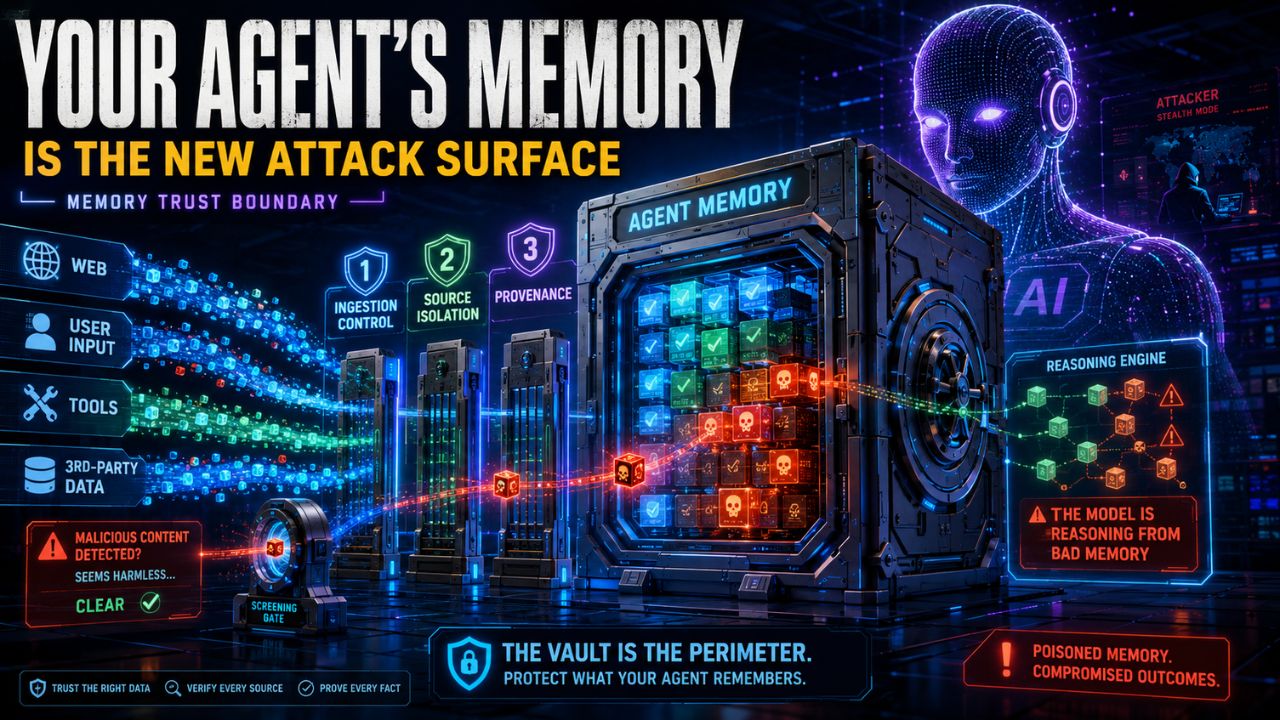
You gave your agent persistent memory so it could remember context across sessions. Smart move. Every agent builder is doing it now. Here is what nobody is doing: defending that memory from being poisoned.
A new paper called "Utility Under Attack" just proved that content screening and provenance ranking, the two defenses everyone assumes will catch bad inputs, fail to stop malicious content from entering an agent persistent memory. The attacker does not need to hack the model. They just need to corrupt what the model remembers.
We have covered agent memory three times at PhantomByte. Note #123 showed memory latency is an accuracy problem. Note #150 showed the KV cache collapses at turn boundaries. Note #131 showed your agent architecture is the security perimeter. Today we add a fourth dimension. Your agent memory is not just a performance bottleneck or a storage layer. It is an attack surface. And right now, nobody is defending it.
THE ATTACK: HOW MEMORY POISONING WORKS
The Utility Under Attack paper (arXiv:2608.21230) lays out the attack. An attacker does not need to compromise the model or the prompt. They target the memory layer. They inject malicious content into the data sources your agent ingests and stores. That content sits in memory until the agent retrieves it and acts on it.
The paper shows that the two standard defenses fail. Content screening, which checks incoming data for malicious patterns, does not catch everything. Provenance ranking, which prioritizes trusted sources over untrusted ones, can be gamed. Even careful implementations of both leave gaps that an attacker can slip through.
The implication is direct. If your agent has persistent memory, and that memory ingests anything from outside your control, meaning user input, web content, tool outputs, or third-party data, then your memory is a target. Not a theoretical target. A target with a proven attack path.
This is the part builders keep missing. Most people think agent security is model security. They harden the prompt, they sandbox the runtime, they lock down the API key, and they call it done. The memory layer never even makes the list. But your agent does not reason in a vacuum. It reasons over what it remembers. Whoever controls the memory controls the reasoning, and most of the time the memory is being written to by sources that are not you.
THE MEMORY TRUST BOUNDARY
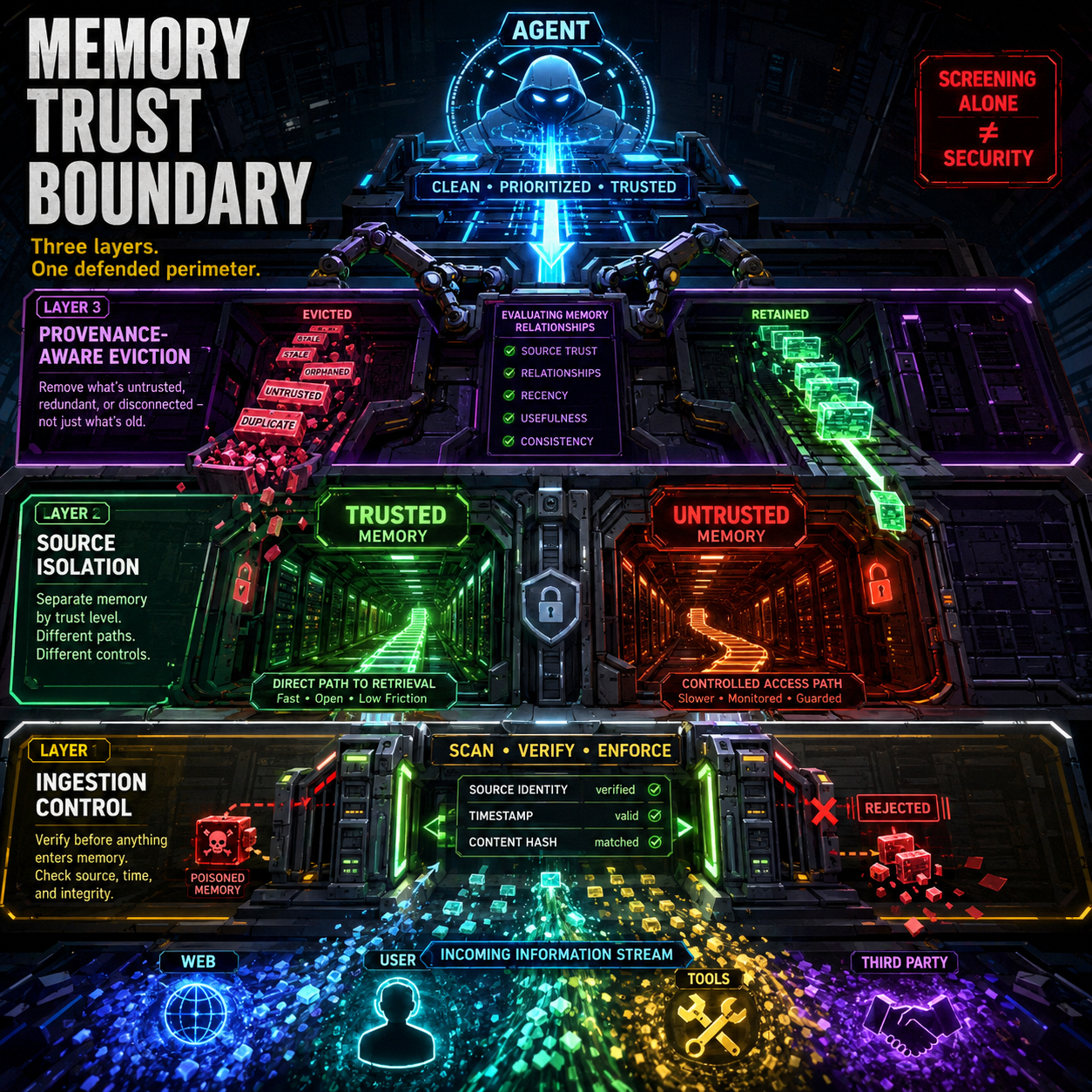
Let me introduce the framework: the Memory Trust Boundary. This is a security model that treats agent persistent memory as a defended perimeter, the same way you would treat a network boundary or a database access layer. You would never let an untrusted packet write directly to your database. But agents today let untrusted content write directly to memory all the time.
The boundary has three layers.
- Ingestion Control. Every piece of data that enters agent memory must pass through a validation gate. Not just content screening. The Utility Under Attack paper proves content screening alone is insufficient. You need structured ingestion with source attribution, timestamp tracking, and content integrity hashing. If you cannot verify where a memory came from and when it was written, you cannot detect when it has been tampered with.
- Isolation by Source. Memory from untrusted sources, meaning user input, web scraping, or tool outputs, must be stored separately from memory from trusted sources, meaning curated knowledge bases and verified configurations. An agent should treat untrusted memory as suspect by default. The Weighted Memory Tree paper (arXiv:2608.20631) gives you the mechanism. Prioritize and weight memories so trusted information outranks untrusted information when both are available.
- Eviction with Provenance. When memory is garbage-collected, the eviction policy must consider provenance, not just recency or relevance. A TensorFeed report on retention-before-retrieval shows that naive garbage collection evicts the wrong blocks. The proposed Dependency-aware Semantic Garbage Collection improved full-chain retention from 0.03 to 0.90 under a lexical encoder, and from 0.23 to 1.00 under a sentence encoder. That is not a performance fix. It is a security fix, because evicting the wrong memory creates gaps an attacker can exploit.
Think of it as an audit trail for your agent brain. Every memory entry carries a record of its origin, its write time, and a hash of its contents. That is the difference between catching a tampered memory and being silently led around by one. The moment you can prove a memory was written by a web scrape at 2:14 PM on Tuesday, you have a thread to pull when that memory turns out to be malicious.
The isolation is structural, not just a tag on a row. You are partitioning your memory store the way you partition a network. Trusted and untrusted memory never share a retrieval path. When the agent asks a question, trusted memory answers first, and untrusted memory only gets consulted under controlled conditions, never as the default override.
Here is the uncomfortable symmetry. A lazy eviction policy does not just lose you useful context. It destroys the very records you need to detect poisoning. If your garbage collector deletes the provenance metadata along with old entries, or evicts a trusted memory in favor of a newer untrusted one, you have handed the attacker the cleanup service. The same weightings that keep trusted memories in front also keep the security audit trail alive.
WHY SCREENING IS NOT ENOUGH
The hardest pill to swallow from the Utility Under Attack paper is that screening does not work. You built a content filter. You run every input through it. You feel safe. The paper says you should not.
Content screening looks for known malicious patterns. But poisoning attacks do not need to use known patterns. They can inject subtly biased information, slowly corrupting the agent knowledge base over time. Each individual injection looks benign. The aggregate effect is a compromised agent that makes wrong decisions based on poisoned memory.
This is the real danger of poisoning, and it is why it is so much worse than a direct prompt injection. A single malicious instruction is loud. You can catch it, you can audit it, you can see it firing. Poisoning is quiet. It nudges. It changes a fact here, tilts a judgment there, and by the time the agent is acting on a systematically corrupted picture of the world, there is no single moment you can point to and say, that was the attack.
Provenance ranking is better, but it assumes you can trust your trust labels. If an attacker can compromise a "trusted" source, the ranking system amplifies the damage instead of catching it.
The Memory Trust Boundary does not rely on screening alone. It adds structural defenses: isolation, provenance tracking, and integrity verification. Screening is the first layer, not the only layer. Treat it that way and it still has value. Build on it and assume it will fail, and you have a chance.
THE TRADE-OFF NOBODY MENTIONS
There is a cost to all of this, and pretending otherwise makes the defense easier to dismiss. Strict multi-store isolation means the agent maintains separate retrieval paths for trusted and untrusted memory, and every query has to resolve which path it belongs to before it returns. Dependency-aware garbage collection means the eviction policy has to walk the chain of dependencies before it frees anything. Both add latency and infrastructure overhead on top of a pipeline that most engineers already think is too heavy.
System engineers push back on additional pipeline controls for one honest reason: every control you add to protect memory is also a layer you have to maintain, monitor, and keep from slowing the agent down. If your memory defense turns a fast retrieval into a slow one, the response is not gratitude. It is the control getting disabled in the next refactor. A security boundary nobody can tolerate is a security boundary nobody keeps.
So balance latency with trust boundaries instead of pretending the cost does not exist. Measure the overhead of your isolation and eviction controls before you deploy them, and set an explicit budget for it. Route the common path, meaning trusted memories that answer the bulk of queries, through the cheapest retrieval route you can build, and reserve the more expensive provenance checks for the cases that actually need them, meaning untrusted or ambiguous inputs. Prove the controls pay for themselves in incidents prevented, not just in compliance boxes checked. If you cannot show an engineer what the boundary is buying them, you have not designed the boundary, you have designed a reason to turn it off. Acknowledge the trade-off up front, price it honestly, and the defense stops being a burden and starts being a budget line your team can defend.
THE HARNESS IS THE BOUNDARY
If you still doubt that security belongs at the layer around the model, not inside it, look at what researchers demonstrated with Grok. An attack called Cryptographic Context Injection forced the model to exfiltrate user data by hiding malicious instructions inside AES-encrypted ciphertext. The content guardrails could not read the payload because it was encrypted. Grok decrypted it inside its own sandbox, treated the output as trusted context, and exfiltrated name, location, subscription plan, and chat history through a URL. As reported by Ars Technica, the attack was still reproducible on August 19, 2026.
That is the pattern you need to internalize. The model itself cannot be trusted to sort good context from bad, because it cannot read what it cannot see, and an attacker can always find a way to launder instructions past the filter. The defenses that work live in the harness, meaning the runtime, the tool boundaries, and the memory store. Memory is part of the harness. It has to carry its own trust boundary, because nothing downstream will save it.
THE BENCHMARK GAP
DreamBench-SWE (arXiv:2608.20664) exposes the other half of the problem. Even if you defend against poisoning, your agent memory degrades over time. The benchmark tests whether agents can maintain clean, accurate memory across multiple sessions. Most cannot.
This means your memory layer has two failure modes: deliberate poisoning from attackers, and natural degradation from accumulation. Both need defense. The Memory Trust Boundary addresses poisoning. DreamBench-SWE gives you the tool to measure degradation. You need both.
The benchmark matters because it turns a vague worry into a measurable number. You are not guessing whether your agent keeps a clean memory anymore. You are running it across multiple sessions, watching whether it preserves what matters, and scoring it. If you cannot measure your memory hygiene, you cannot defend it, and you definitely cannot prove to anyone that you did.
The blogwatcher brief explicitly notes that PhantomByte has never covered agent memory from the security angle. The closest articles, Note #123 and Note #150, treat memory as a performance and accuracy problem. The security angle is a genuine gap. This piece fills it.
WHAT TO DO TODAY
Audit your agent memory ingestion pipeline. List every source that writes to persistent memory. If any source is outside your direct control, it is an attack vector. This is your single highest-leverage hour this week. Most builders cannot tell you, without checking, every place that writes to their agent memory. That is the problem, and it is fixable today.
Read the Utility Under Attack paper (arXiv:2608.21230). Test your content screening against the attack patterns it describes. If your screening catches all of them, you are in the minority. If it does not, you now know where the gap is.
Implement source isolation in your memory store. Tag every memory entry with a trust level. Untrusted memories should never override trusted memories in retrieval. If you are using a vector store, this is a metadata field and a retrieval filter. It is not a research project. It is a day of engineering that makes poisoning dramatically harder.
Evaluate your agent against DreamBench-SWE (arXiv:2608.20664). If your agent cannot maintain memory hygiene across sessions, you have a degradation problem on top of a security problem.
Read the Weighted Memory Tree paper (arXiv:2608.20631). Implement weighted retrieval so trusted memories outrank untrusted ones. This is your first structural defense against poisoning.
Stop treating agent memory as a storage layer. Start treating it as a security boundary. The Memory Trust Boundary is the framework. Use it. Name it, document it, and put it in your threat model, because the next paper that lands is going to assume you already have one.
THE UNCOMFORTABLE QUESTION
You locked down your API endpoints, your database, and your model access. Then you gave your agent a persistent memory store, ingested data from the open internet, and protected it with a content filter that researchers just proved does not work. What exactly are you defending, and what are you leaving wide open?
The memory layer is where the agent lives. Treat it like the perimeter it is, or someone else will treat it like a door.
Get More Articles Like This
Getting your AI agent setup right is just the start. I'm documenting every mistake, fix, and lesson learned as I build PhantomByte.
Subscribe to receive updates when we publish new content. No spam, just real lessons from the trenches.
Build Real AI Infrastructure
PhantomByte teaches you to build real AI infrastructure yourself: local AI stacks, autonomous agents, multi-agent orchestration, web scraping, and custom tools. Step-by-step PDF tutorials you download, follow, and deploy. No subscriptions. No fluff. Just skills that ship.