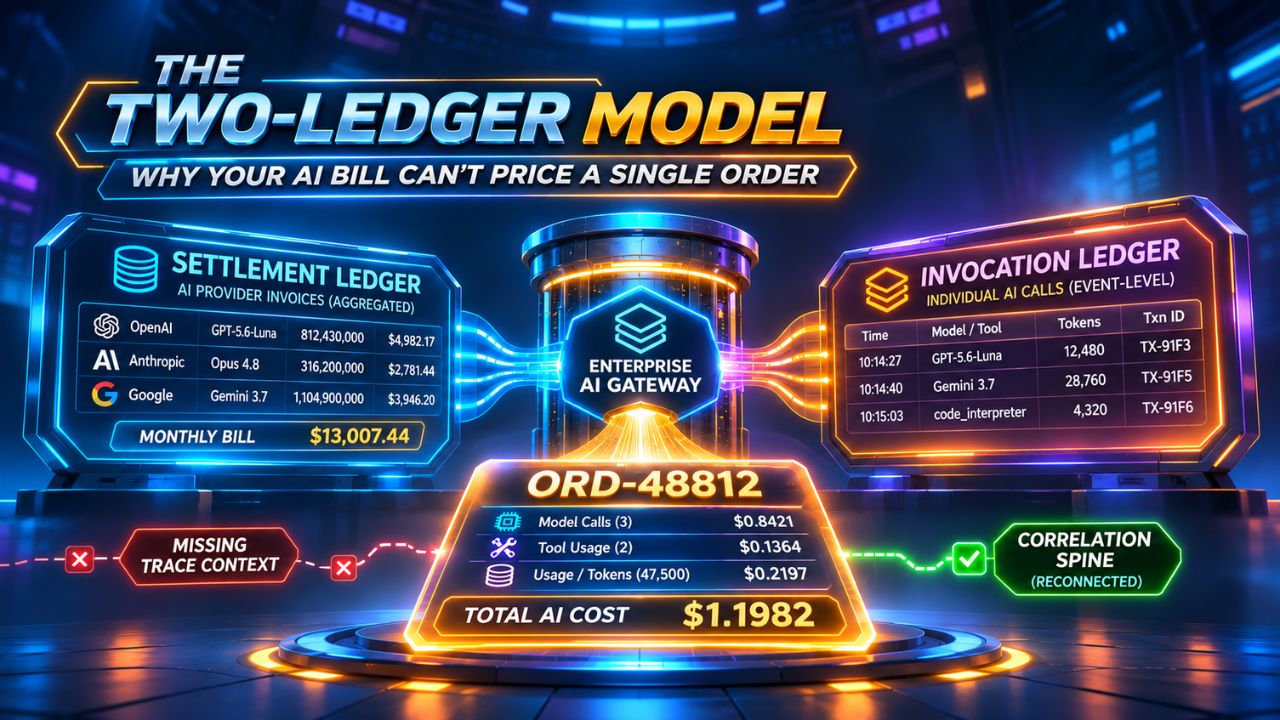
Your CFO does not ask what the company spent on AI in October. She asks what AI cost on the Johnson refund dispute. The dispute, not the month.
The billing export has one row per model SKU per day and no column for the dispute. The provider that wrote it never saw a transaction. It saw tokens.
So the honest answer is not that the question is hard or expensive. It is that the record which would answer it was never written. That gap has a name and a published architecture, and the architecture is instrumentation, not procurement.
A paper submitted November 4 by Vivek Acharya, an independent researcher in Dallas, calls it the grain mismatch and proposes the Two-Ledger Model: a settlement ledger of FOCUS-conformant billing joined to an attribution ledger of invocation-grain usage records on OpenTelemetry GenAI telemetry. Your AI cost is settled at the wrong grain, and the fix starts with span attributes you can add this week.
We showed you the downstream failure in "Your Agent's Retry Is a Ledger Problem: Idempotency, Reconciliation, and the 42/42 Contract." This is the layer beneath it. Without an invocation-grain record you cannot see the retry that double-charged you.
THE GRAIN MISMATCH, NAMED
Settlement grain is the grain bills are written at: cost per SKU per charge period, aggregated by the provider. Invocation grain is the grain work happens at: one record per model call, written when the call happens, carrying tokens, model, caller, and the business key it served.
Finance holds the first. Engineering holds traces with the second but no price. The transaction, the unit the business actually accounts for, exists in neither. Acharya walks it through an order-to-cash flow across CRM, SAP, Oracle Fusion, and ServiceNow, each agent calling a different vendor's model, the CFO asking what order ORD-48812 cost. Billing cannot answer because the settlement record never contains the business transaction identifier. Telemetry cannot answer because it holds no negotiated rate, no commitment amortization, no invoice.
FOCUS is real progress and it is not the fix. The FinOps Open Cost and Usage Specification gives billing one schema across clouds, SaaS, and AI vendors. Version 1.4 is current, ratified in June 2026. Version 1.5, targeted for December 2026, is scoped to add AI model and token cost visibility, a price sheet dataset, and cost attribution to people and agents. Even when it lands it stays settlement grain. FOCUS tells you what you bought, not why, because the provider never receives the order number.
The paper derives seven requirements, R1 through R7. The four you can act on: every attributable invocation maps to exactly one transaction with the method and confidence recorded; fan-out, delegation, tool calls, retries, and failed attempts are captured and classifiable; negotiated rates, commitments, cache tiers, and per-call tool fees are reflected; and an estimate exists at transaction close, corrected at period close.
THE TWO LEDGERS
Ledger one is the settlement ledger: FOCUS-conformant billing and vendor invoices, normalized, gated on finality flags, tying to cash. Nothing in it is novel. Its job is completeness.
Ledger two is the attribution ledger: one row per model invocation and per metered tool call, written at runtime on the OpenTelemetry GenAI conventions, priced on write by a versioned rate card.
Billing is the payee's truth. Telemetry is the payer's truth. Neither becomes the other, because each is produced by a party that cannot see the other's boundary.
Acharya's argument is an accounting argument and the sharpest line in the paper. A general ledger cannot answer sub-ledger questions, and no company runs accounts receivable out of the general ledger. FOCUS is the general ledger of technology spend. Transaction cost is a sub-ledger problem, so it gets built where transactions are visible.
That is why the metering point is an enterprise LLM gateway routing every call from every harness and provider. The ledger becomes a side effect of normal operation instead of a per-team instrumentation project, and bypass becomes an exception you detect. Where a gateway is impossible, an SDK or sidecar emits the same rows and usage APIs backfill at lower confidence.
It is also why "Your Cost Curve Just Broke. Harness Efficiency Now Decides Your AI Bill." only becomes auditable here. A cheaper harness you cannot price per transaction is a claim, not a number.
THE CORRELATION SPINE
Two ledgers are useless if a row in one cannot join a row in the other. The join is the correlation spine, four layers in descending order of trust.

L1 is W3C traceparent plus baggage carrying the business transaction identifier. It holds inside an instrumented estate and dies at an opaque SaaS boundary.
Async handoffs break that layer by design. When an agent enqueues work for a background worker pool, a durable workflow orchestrator, or a state machine that resumes hours later, the parent trace context is usually detached and the resumed step starts a new trace root with nothing attached to it. The business key has to be persisted in the workflow state payload itself, not merely carried in active memory or baggage, so the worker can re-attach it to that new root.
L2 is protocol metadata, the same identifier in A2A task metadata and MCP call context. It covers agent and tool seams and fails when a peer strips it.
L3 is business-key correlation: order, case, and invoice numbers against system event time windows. Forty years of integration practice applied to cost, and the only deterministic layer that survives a system-of-record boundary.
L4 is probabilistic matching over temporal proximity, agent identity, tenant, and workload fingerprint, emitting a confidence between 0 and 1. Rows below the floor drop into a pooled cost object, never silently onto a transaction.
Then the number that sells it. In the simulation, 20,000 transactions and 109,792 model invocations across seven systems of record, with trace propagation falling from 100 percent to zero. Trace-only attribution collapses to zero. The spine's cost-weighted coverage holds at 99.8 percent. Accuracy falls from 100 percent to 95.6 percent, misattributed spend reaching 4.44 percent. You lose precision, not the answer.
One caveat the author states and I repeat: this is an architectural argument plus a simulation on synthetic data with known ground truth, not a field study. The parameters are chosen, not measured, and a field pilot is next.
WHY THIS IS AN ENGINEERING PROBLEM, NOT A FINANCE PROBLEM
Finance cannot fix grain. By the time a record reaches the ledger the boundary is gone, and no query recovers what was never written. Only the platform team emits it.
The cheap part is span attributes, and it is where to start. On every GenAI span carry the business key and type, model and provider, input, output, cached, and reasoning tokens, caller identity, harness, and retry status. The paper maps each to an OpenTelemetry attribute and a FOCUS column, so one vocabulary serves both grains. Its privacy line is deliberate: tokens, identities, timings, status, never prompt or response content.
Read that line as a compliance decision, not a technical limit. Keeping content out of the telemetry pipeline keeps personal data, regulated records, and prompt-borne secrets out of a cost system that never needed them, which is the version of this architecture a CISO can approve. Usage metadata answers the cost question completely. Content adds risk without adding an answer.
The rule worth quoting: if the business key is not on the span, the cost never happened, financially speaking.
The reconciliation residual makes it pay. At close you tie both ledgers to the invoice, decompose the variance into rate drift, timing, pool idle, and unmetered spend, and read the last line. In the paper's example, a 7.4 percent variance on one provider splits into 1.1 percent drift, 0.8 percent timing, 1.5 percent idle, and 4.0 percent unmetered, a team calling a vendor on a corporate card. That 4.0 percent is shadow AI, produced by subtraction instead of audit.
The same ledger runs a control loop. In the simulation, a forecast gate pausing transactions at a 0.5 breach probability cut p99 cost per transaction by 61 percent and total spend by 9.3 percent, catching 74 percent of runaways while pausing 4.1 percent that would have finished inside budget. Engineering should own that trade.
WHAT TO DO TODAY
- Inventory your AI spend: providers, SKUs, and whether any FOCUS exports exist. None is a baseline.
- Add business-key attributes to every GenAI span in one service, as the pilot. One service, not the estate.
- Stand the attribution ledger up as a plain event log first. The rate card can be a YAML file with a version column.
- Keep rate card history instead of editing the file. When a tiered commitment is drawn down or a discount is renegotiated, the version column lets you reprice only the rows the new version governs and post the difference as a period adjustment at close, rather than rewriting a ledger you already reported.
- Run one month, reconcile the two ledgers, read the residual. That number is your shadow AI.
- Take the residual, not the total, to finance. Unexplained spend is the only number that starts meetings.
THE UNCOMFORTABLE QUESTION
If a tenth of your AI spend is invisible to your accounting system today, which is worse, the money you are wasting, or the fact that no one can prove where it went?
Get More Articles Like This
Getting your AI agent setup right is just the start. I'm documenting every mistake, fix, and lesson learned as I build PhantomByte.
Subscribe to receive updates when we publish new content. No spam, just real lessons from the trenches.
Build Real AI Infrastructure
PhantomByte teaches you to build real AI infrastructure yourself: local AI stacks, autonomous agents, multi-agent orchestration, web scraping, and custom tools. Step-by-step PDF tutorials you download, follow, and deploy. No subscriptions. No fluff. Just skills that ship.