
DeepSeek is planning a cluster of 160,000 Huawei processors (the Ascend 910B/910C generation or its successor series) in Inner Mongolia. If it is built, it would be the largest known Huawei chip cluster in the world and one of the largest AI training facilities anywhere.
No Nvidia. No Western supply chain. No workaround. That is not a model release. That is a bet that domestic silicon can carry frontier training at scale.
We covered the sovereign software stack in "The Non-Western AI Silk Road" (Note #63). The hardware layer was the missing half. It is not missing anymore.
WHAT 160,000 PROCESSORS ACTUALLY MEANS
Let me put the number in engineer terms. A cluster here means coordinated training across a single fabric, not a pile of rented cloud instances. You are not spinning up 160,000 independent jobs. You are wiring 160,000 processors so they act as one machine, moving gradients and activations across a network fast enough that the whole thing trains a single model. That is a different engineering problem from scaling out a web service, and it is the hardest part of the buildout.
The Inner Mongolia siting is not an accident. The region has land, cheap power, and cooling economics that cloud providers chase when they hunt for stranded energy. The same logic that pushes Western operators toward hydro and wind sites pushes China toward the steppe. Power is the constraint that decides where frontier compute lives, and Inner Mongolia has it in volume.
This would be one of the largest training facilities in the world. Not one of the largest Chinese facilities. One of the largest, period.
THE COMPUTE INDEPENDENCE LADDER
Here is the framework I want you to keep. Call it the Compute Independence Ladder. It measures how dependent your stack is on foreign silicon, and it has four rungs, from most to least dependent.
- Rung one is rented foreign compute. You call APIs and US cloud regions. You own nothing, and your access can be cut off with a policy change.
- Rung two is foreign silicon you own. You physically hold Nvidia GPUs. You control the hardware, but the supply chain that made it can be severed.
- Rung three is domestic silicon with foreign tooling. You run your own chips, but the software, the frameworks, the orchestration still come from abroad.
- Rung four is domestic silicon with domestic tooling. This is where the DeepSeek cluster sits. The chips are Chinese, and the stack that runs them is Chinese.
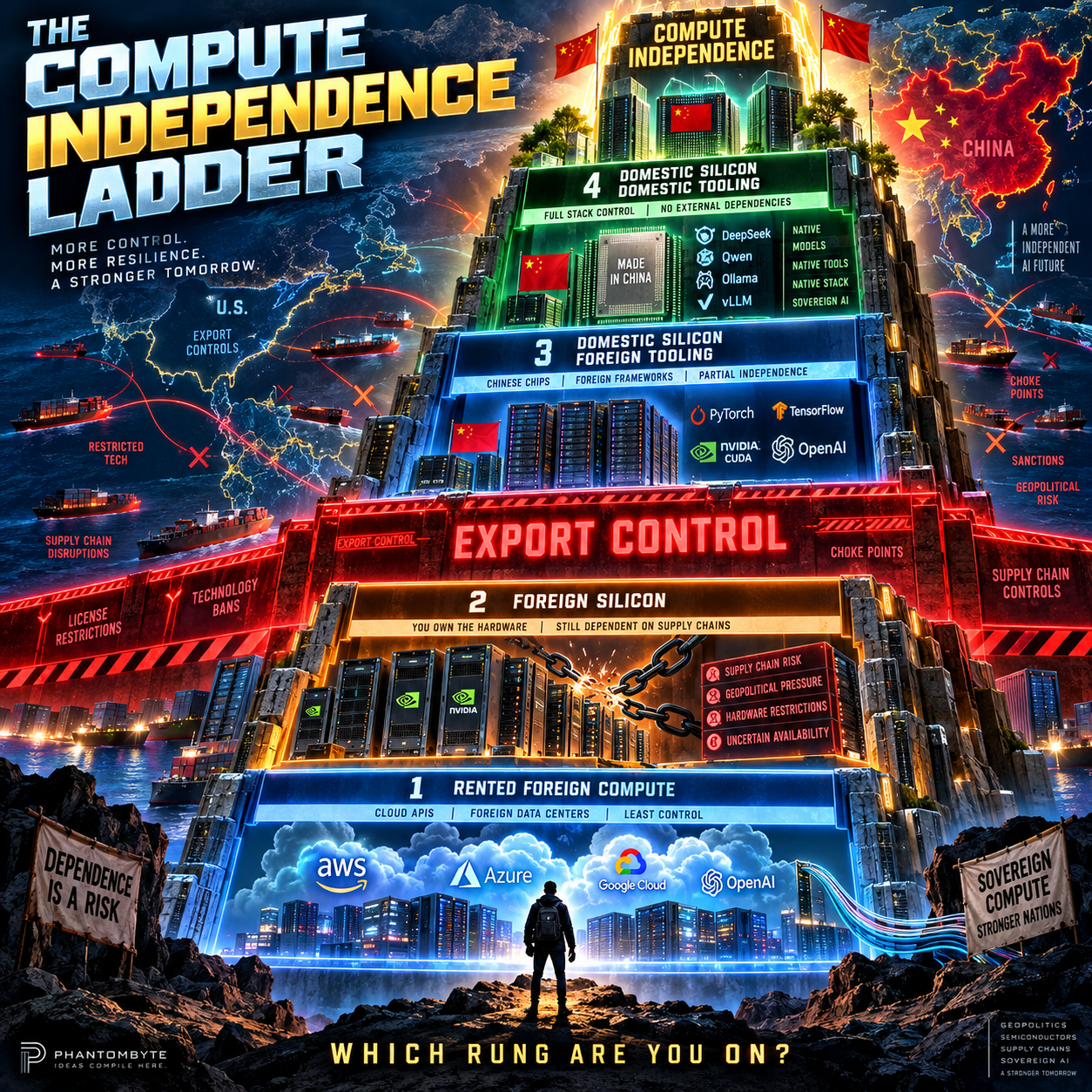
The decision rule is simple. Each rung up trades peak efficiency for insulation from export controls and tariffs. A rung-four cluster will not match a rung-two Nvidia cluster on raw flops per dollar today. What it buys is that no export control can touch it. That is the trade, and it is a real one.
Your position on this ladder is a policy decision whether you admit it or not. I made that argument in "Your AI Stack Is a Geopolitical Bet" (Note #139), and it applies here directly. If you build on US-model APIs, you are on rung one, and you are renting your compute independence from a country that treats compute as statecraft.
WHY THE BET IS CREDIBLE NOW
DeepSeek is not guessing. The same organization ships DeepSeek v4 Flash, a 284-billion-parameter mixture-of-experts model with 13 billion active parameters that runs locally on two DGX Spark units. That is a frontier-scale model you can hold in your own rack.
The company demonstrates both ends of the stack at once. Frontier training ambitions at home, open-weight distribution abroad. That combination is the strategy, not a contradiction. The open-weight releases build the ecosystem and the goodwill, and the domestic cluster builds the independence. You cannot separate the two halves and understand the bet.
THE POLICY COLLISION
Now ground this in the data, because the compute race is not staying in the data center. A US report urged consideration of military strikes to stop China achieving AGI first, reported by the South China Morning Post. That is not a trade dispute. That is a government treating a training cluster as a strategic target.
The chip tax proposal drew the industry's bluntest response yet, with critics calling it the "single dumbest way imaginable" to handle the problem, per Ars Technica. Taxing the thing you need more of is not a policy, it is a self-inflicted wound.
Japan's $550 billion economic pact now pivots on AI and chips, reported by The Next Web. International economic agreements are being written around semiconductor supply chains. And Australia's data-centre boom is colliding with its energy and water costs, per the BBC, which shows the same collision arriving in allied countries through a different door.
Every one of these stories treats compute supply as statecraft. That is the frame now. Not market share, not product cycles. Statecraft.
WHAT THIS CHANGES FOR YOUR PLANNING
Here are the decision rules for the operator.
- If you build on US-model APIs, your unit costs now move with trade policy, not just silicon cycles. A tariff, an export rule, a tax, and your inference bill changes overnight. Plan for that volatility.
- If you run open-weight models, you benefit from this buildout regardless of geography. More sovereign compute means more open-weight frontier releases, because the labs that build domestic clusters ship their models to the world. You are a downstream beneficiary of a bet you did not make.
- If you plan capacity, treat export controls as a permanent design constraint, not a news cycle. The era where you could assume uninterrupted access to the best silicon is over. Design for the rung you can actually hold.
WHAT TO DO TODAY
- Map your own stack against the Compute Independence Ladder. Write down which rung you sit on and what it costs you if the rung below you disappears.
- List every dependency in your inference path that crosses a border. Note which ones have a domestic alternative.
- If you run open-weight models, test one DeepSeek model in your pipeline this week. You are already a participant in this buildout.
- Read Note #63 and Note #139 back to back. This article is the hardware chapter of that story.
THE UNCOMFORTABLE QUESTION
If a training cluster that no export control can touch is being built right now, whose compute is actually independent, yours, or the country you rent it from?
Get More Articles Like This
Getting your AI agent setup right is just the start. I'm documenting every mistake, fix, and lesson learned as I build PhantomByte.
Subscribe to receive updates when we publish new content. No spam, just real lessons from the trenches.
Build Real AI Infrastructure
PhantomByte teaches you to build real AI infrastructure yourself: local AI stacks, autonomous agents, multi-agent orchestration, web scraping, and custom tools. Step-by-step PDF tutorials you download, follow, and deploy. No subscriptions. No fluff. Just skills that ship.