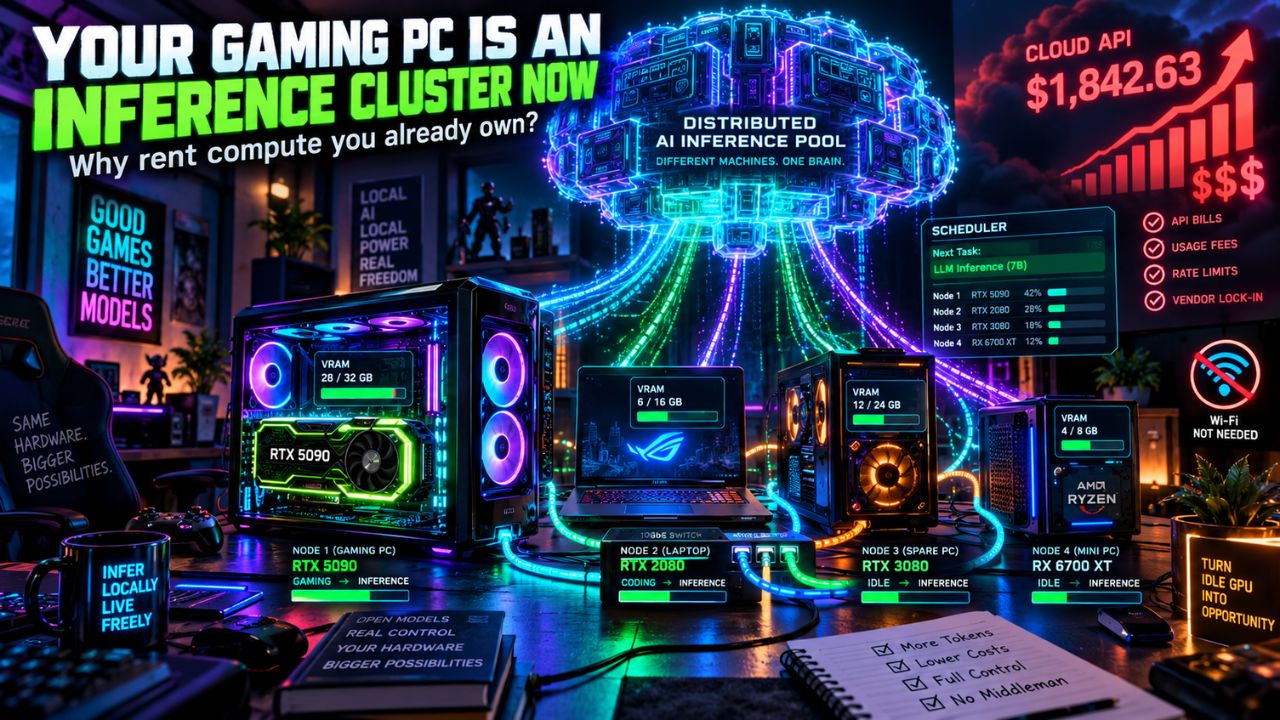
NVIDIA shipped a free tool this week that turns the computers you already own into a single AI cluster. It is called the Personal AI Router, and it syncs your home machines so tools like Ollama and LM Studio can pool their idle compute into one local inference pool. No cloud bill. No rate limit.
The same week, at IFA 2026 in Berlin, NVIDIA and Microsoft showed off faster inference and easier local agent setup, the first RTX Spark laptops and mini PCs came out positioned as true AI PCs, and Ugreen launched HomeAgent, a smart home hub that runs its AI locally with no monthly subscription. That is four separate product lines pointing at the same conclusion.
We said it in Note #147: idle hardware is sinking your AI operation. NVIDIA just took that thesis and handed it to the consumer. Inference is becoming a resource you own, not a service you rent.
Why the Cloud Burden Flips
The cost math that made cloud-only inference obvious is breaking. Every request you send to a frontier API is rented compute at rented prices, and Note #151 showed the real unit of AI economics is the joule, not the token. Your gaming PC already paid its joules. The GPU sitting idle twenty hours a day is stranded capacity, the same term we used in Note #164 for datacenter schedulers.
So name the decision rule and use it. Call it the Inverse Rent Rule. If a workload is latency-tolerant, repetitive, and private, local pooled compute wins on cost and control. If it is bursty, frontier-grade, and shared across a team, rent. Most people running agents today never run the rule. They default to rent, because that is the path of least resistance, and because the alternative used to mean buying a datacenter.
That is what changed. NVIDIA just shipped the tooling and the hardware that make local pooling a real architecture decision instead of a hobbyist's toy.
What PAIR Actually Does
Be precise about what the tool claims. PAIR links your home computers, works with Ollama and LM Studio, and pools idle compute for local inference tasks. For a newbie, frame it in one sentence: your laptop, desktop, and spare box appear to the model as one bigger pool of memory and compute.
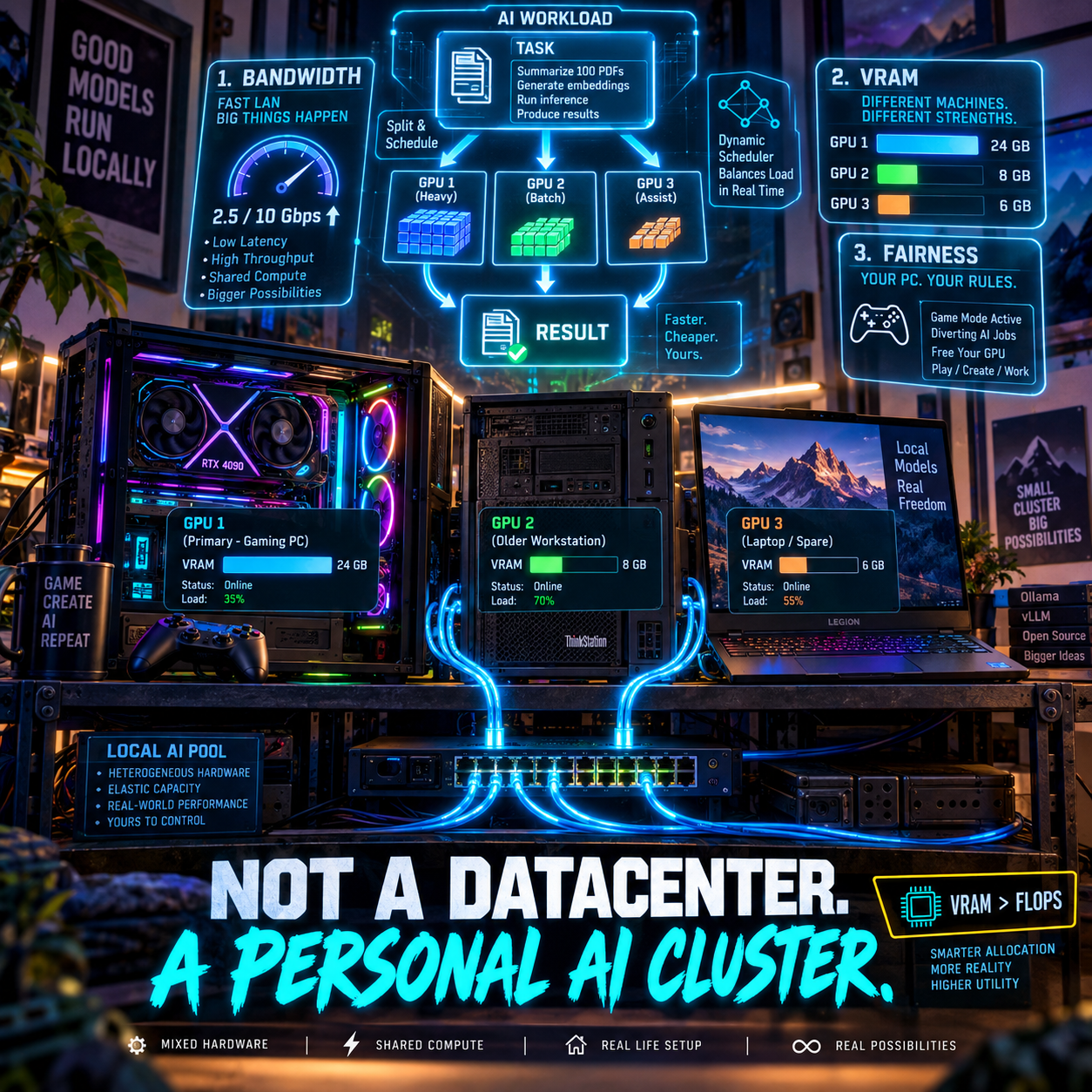
The mechanics matter more than the marketing. PAIR drops a proxy in front of your local front ends, then dispatches subtasks from the main node out to systems on your home network that have idle GPU cycles to spare. It discovers nodes over mDNS with an IP fallback, and it will even kick off model downloads on participating machines. Nodes do not need identical models to join the pool. One caveat if you are the type to complicate your home desk setup: on isolated subnets, VLANs, or Docker bridge networks, mDNS discovery can struggle to find nodes, so point the pool at a flat, routable network segment.
The engineering realities are where the depth lives, because these are the things that separate a demo from a cluster. Interconnect bandwidth between machines is the first wall. Consumer Wi-Fi will bottleneck you fast; wired Ethernet is the only honest option for moving tensors between nodes. And the PCIe slot generation on the motherboard is a quieter version of that same wall, because pushing tensor weights through stale PCIe 3.0 lanes is markedly slower than the 4.0 and 5.0 bandwidth newer boards allow, even on machines that are otherwise well matched. Heterogeneous GPU memory is the second. A pool built from an RTX 2080 and an RTX 5090 does not behave like a symmetric datacenter, because VRAM, not FLOPs, decides which models any given node can actually serve. Scheduler fairness is the third, because one of your nodes is also your daily driver.
Here is the honest framing. A cluster of mismatched consumer GPUs is not a datacenter. It is a hobby rack with aspirations. Both things are true, and the second one is not an insult. PAIR is elastic by design. It does not reserve capacity away from you, it takes what is spare and adapts when a node's owner wants their GPU back for gaming or creative work. That weakens any quality-of-service guarantee, and it is exactly right for long-running, deadline-flexible workloads.
The Latency and Sovereignty Payoff
The second-order benefits are the ones nobody prices. Local pooled inference keeps data in your house, which matters for anything you would not paste into a web form. It kills per-token anxiety, the thing that makes people under-use their own tools because every request feels like a meter running. And it makes your agent stack immune to the failure mode we watched this week.
ChatGPT, Claude, and Grok all went down at the same time. For hours, none of the three companies said why. Reports traced the trouble to shared infrastructure, a common edge network and cloud region sitting underneath three supposedly independent labs, and Gemini stayed up the entire time. That is not three separate failures. It is one shared point of failure wearing three logos.
Here is the theory, and it is a theory, grounded in what those reports actually show: the AI service layer only looks independent when a lot of it rides the same plumbing. If three frontier providers collapse in the same window, your diversification is an illusion. A local pool does not care about a shared edge or a shared cloud region. It sits on your desk.
This is the same argument as the Jetson rack note and the sovereign stack angle from this serial. You cannot be sovereign on rented endpoints. Data that never leaves your house is data that cannot be pulled, throttled, or held hostage by a vendor's capacity problem, and Note #167 spelled out why decode is memory-bound, which is exactly the constraint that favors pooling local VRAM over renting tokens.
What to Do Today
- Inventory the GPUs you already own, including the gaming rig. Write down the VRAM per card, because VRAM, not FLOPs, decides which models you can run.
- Install Ollama or LM Studio on each machine. Confirm a model runs locally before you try to cluster anything.
- Download PAIR and link two machines on the same wired network. Wireless clustering will disappoint you. Plug in the cable.
- Move one private, repetitive workload off the cloud API and onto the local pool. Run it for a week and compare cost and latency honestly.
- Keep one rented frontier API for the bursty frontier-grade work. That is the Inverse Rent Rule doing its job, not a failure of nerve.
The Uncomfortable Question
You have thousands of dollars of silicon sitting idle in your house right now, and you are still paying someone else by the token for the privilege of using your own data. Why?
Get More Articles Like This
Getting your AI agent setup right is just the start. I'm documenting every mistake, fix, and lesson learned as I build PhantomByte.
Subscribe to receive updates when we publish new content. No spam, just real lessons from the trenches.
Build Real AI Infrastructure
PhantomByte teaches you to build real AI infrastructure yourself: local AI stacks, autonomous agents, multi-agent orchestration, web scraping, and custom tools. Step-by-step PDF tutorials you download, follow, and deploy. No subscriptions. No fluff. Just skills that ship.