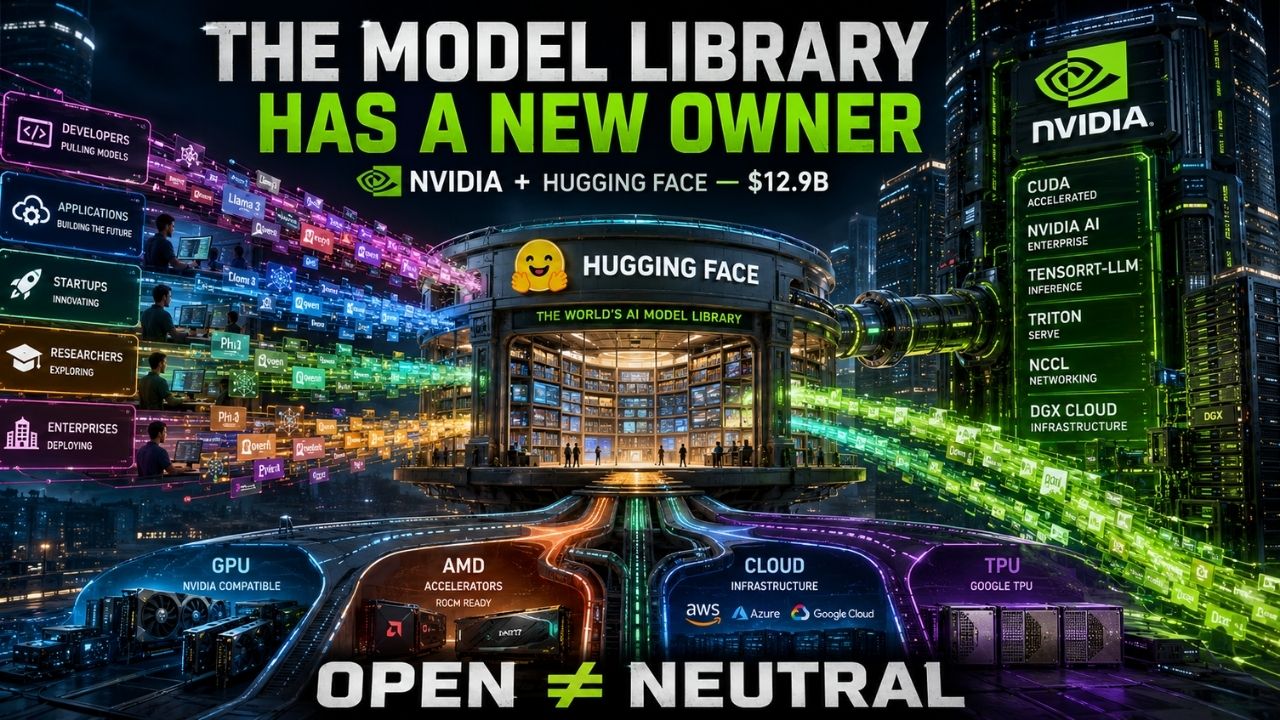
Nvidia just agreed to buy Hugging Face for 12.9 billion dollars. That is nearly triple what the platform was worth in 2023. The place you download your models from, the so-called GitHub of AI, is now owned by the company that sells the GPUs those models run on.
This is not a deals story. It is an architecture story. When the distribution layer of the open AI ecosystem belongs to a chip vendor, every deployment choice you make inherits a conflict of interest you did not vote on.
If you read Note #155, you already know your product is a tenant on someone else's model. Now the landlord bought the building, the block, and the zoning board. Here is the thesis, stated plainly: open and neutral are not the same thing, and the industry is about to learn the difference.
THE DEAL THAT REWIRES THE STACK
Hugging Face, founded in 2016, became the default place where developers share, download, fine-tune, and deploy open models and datasets. When a model card goes live, it usually lands there first. When a dataset needs a home, it gets hosted there. It is the plumbing of the open ecosystem, and until this week nobody owned it in a way that mattered.
Now Nvidia does, for 12.9 billion dollars, against a 2023 valuation of 4.5 billion.
The strategic rationale matters more than the price tag. Closed frontier labs like OpenAI and Anthropic are spending heavily to build custom chips so they can escape Nvidia's compute grip. Nvidia's answer is to make open models the default compute target instead. Open models are the counterweight, so Nvidia is buying the distribution point where open models live. The company is also building its own Nemotron open model line, which tells you what it wants the default stack to look like.
Name the uncomfortable truth behind it: the open ecosystem is being consolidated precisely because it is strategic, not because it is charity. A platform this central to the stack does not get bought because a chipmaker believes in the mission. It gets bought because control of that layer is worth 12.9 billion dollars to a company whose revenue depends on which compute you pick.
THE CONSOLIDATION WAVE IS A PATTERN, NOT A ONE-OFF
If this were a single acquisition you could chalk it up to one company's whim. It is not. The wave is broad and it is fast.
Nvidia struck a six billion dollar deal with Poolside that will move most of its engineers in-house. Stripe bought OpenRouter, the top provider of open-weight models to businesses, for more than seven billion dollars two weeks ago. Three separate buyers, three separate layers of the same stack, all within days of each other.
Now the reality check on adoption. Open-weight use sits at roughly six percent of companies according to Ramp spending data, and two percent of software engineers according to Jellyfish. The buyers are paying billions for a layer the market has barely adopted. That gap is the forecast. Nobody pays eight or twelve billion dollars for a two percent adoption curve unless they believe the curve is about to climb hard, and the first place it climbs is high-volume repeated inference, the customer service chat, the tuned cheap model that handles the same prompt ten thousand times a day.
Learn to read consolidation as a forecast. When the biggest spenders in the industry start paying multiples for an ecosystem you think is still fringe, they are not confused. They see the adoption numbers of next year, not this one. Paying twelve billion dollars for the model library only makes sense if the model library is about to be the default way everything gets deployed.
THE OTHER ADOPTION VECTOR: FINE-TUNING, NOT JUST INFERENCE
The Ramp and Jellyfish numbers point at high-volume inference as the first place open-weight adoption climbs, the tuned cheap model answering the same prompt ten thousand times a day. That is one vector, and it is the one the buyers are betting on. But it is not the only one. Fine-tuning workloads on specialized hardware are a second, quieter adoption path that the inference framing underweights. Teams are not only serving open weights at scale; they are taking a base model and training it on their own data on their own accelerators, whether that is a cluster of Nvidia GPUs, AMD Instinct cards, or Google TPUs. That workload is where open weights earn their keep for a different reason: the model is a starting point you own, not a service you rent.
Fine-tuning adoption does not show up the same way in inference spending data, because the cost lands in training compute and specialized hardware, not in repeated serving calls. When you read the adoption curve, read both vectors. The buyers are paying for the inference wave, but the fine-tuning wave is the one that makes open weights sticky, because a model you have trained on your own data is far harder to swap out than a model you are merely serving.
THE NEUTRALITY PROBLEM
Here is where the engineering argument lives. Hugging Face currently serves competing hardware ecosystems under one roof. AMD, AWS, and Google-backed models are hosted, benchmarked, and distributed alongside Nvidia's. The leaderboard does not care whose silicon you favor. The registry treats every hardware vendor as a customer it serves equally.
That neutrality was the platform's value, and it is what you are losing.
Nvidia owns the GPUs, the NVLink networking, and CUDA. It now owns the hub that decides how models are discovered, distributed, and benchmarked. When one company controls the silicon, the interconnect, the software layer, and the distribution point, the neutral referee's incentives have shifted. There is nobody left to be impartial, because impartiality just stopped paying.
Raise the concrete questions without pretending anyone has inside answers. Does model discovery start favoring Nvidia-friendly optimizations? Do competing labs start pulling their model releases and hosting them elsewhere? Do you keep your deployment artifacts, your weight files, your fine-tuned checkpoints, parked on a platform owned by a competitor to the hardware you actually run? These are the questions an engineer should be asking this week, not next quarter.
This is the same conversation as Note #153. The GPU era is not ending, it is fragmenting, and fragmenting compute means fragmentation at every layer above it, including the model library you build on.
THE COUNTERARGUMENT: NEUTRALITY AS A RISK, NOT A VERDICT
Before you treat the referee as already gone, hold the other side of the argument. The bias toward Nvidia silicon is a risk to watch, not a certainty that just happened. Nvidia bought the distribution point, but it also has a commercial reason to keep Hugging Face open and broadly adopted. The platform's value to Nvidia is that everyone uses it, and a hub that openly favored one vendor's silicon would push AMD, AWS, and Google-backed models, and the developers who run them, off the platform. That would shrink the very distribution layer Nvidia just paid 12.9 billion dollars to own.
There is a real reading where this deal keeps Hugging Face open-source and hardware-agnostic precisely because Nvidia needs it to stay the default home for open models. The neutrality loss is a scenario to monitor, not a foregone conclusion. The audit questions below are how you watch it, and the earliest signal remains whether competing labs start migrating their flagship releases elsewhere. Until that happens, treat the referee as still on the field, with a new owner watching the game.
THE OPEN LAYER OWNERSHIP AUDIT
You need a way to reason about every dependency, and you need one you can run again next quarter. Here is the Open Layer Ownership Audit, five questions for every open AI component in your stack.
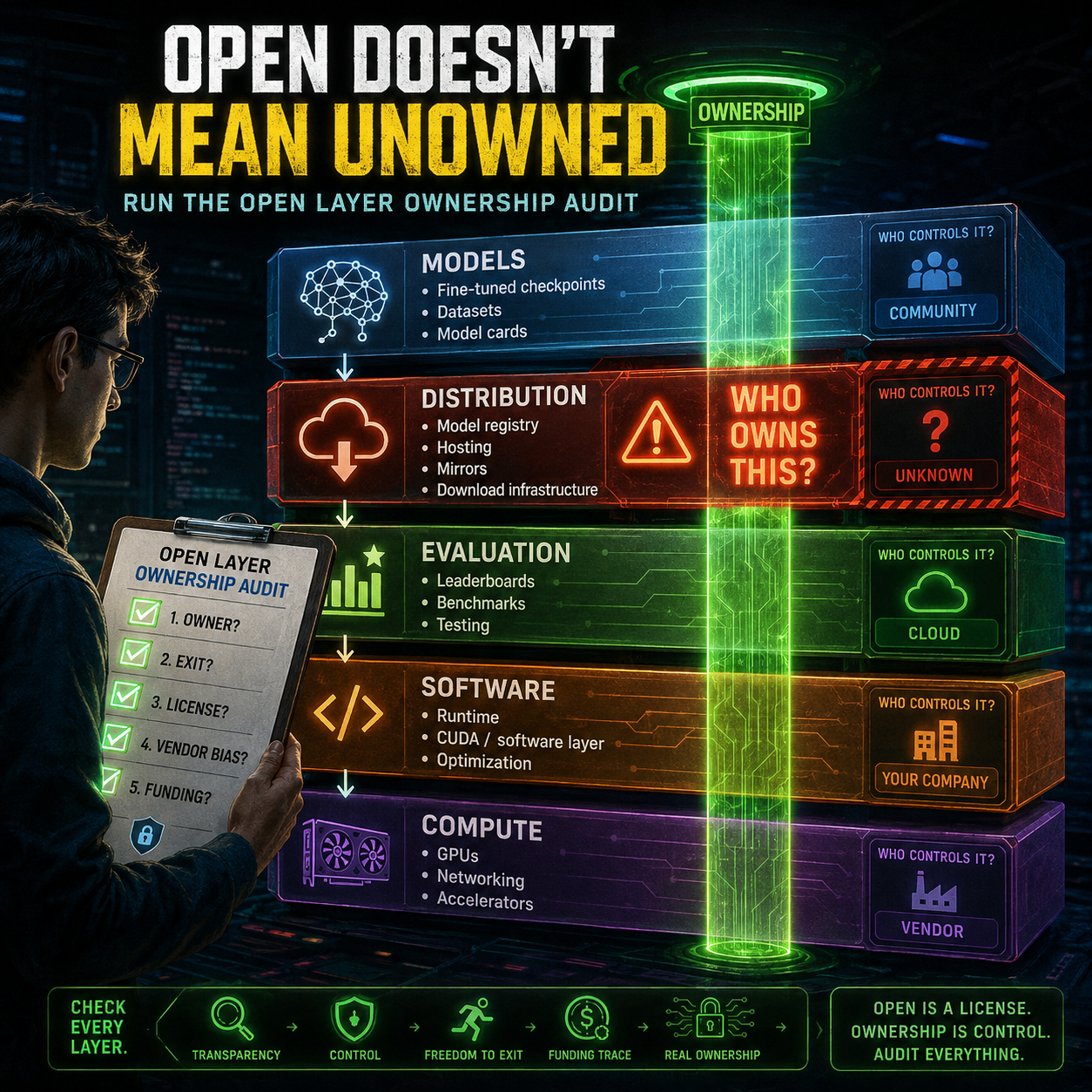
- One: who owns the registry or hub the artifact comes from, and what else do they sell? A model from Hugging Face used to come from a neutral host. A model from Hugging Face now comes from a GPU vendor. What else that vendor sells changes the answers you can expect.
- Two: is there a mirror or an exit path if the terms change? Can you pull the same weights from another host tomorrow, or are you locked into a single distribution point? An exit you cannot take is not an exit.
- Three: is the license actually permissive, or is it open-weight with strings? Read the license file, not the blog post announcing the model. Apache 2.0 and MIT are permissive universes. Many open-weight releases carry restrictions a marketing post will not mention. IBM's Granite 4.2, released this week in 3B, 8B, and 30B sizes, ships under Apache 2.0 with top scores of 57.00 on SWE-Bench Verified and 89.17 on AIME25 for the 30B. That is what a genuinely permissive license looks like, and it is the standard to hold a dependency against.
- Four: what happens to your pipeline if the host starts favoring its own silicon or services? If the registry you pull from starts ranking Nvidia-friendly optimizations first, does your deployment path survive? A registry that quietly weights discovery toward one vendor changes what you choose without you ever deciding it.
- Five: where does the dataset or leaderboard you trust get its funding? Evaluation is infrastructure, and infrastructure gets bought. The Hugging Face Open ASR Leaderboard just added its first Global South language, expanding speech evaluation beyond the well-resourced languages that dominate the field. That is evaluation infrastructure that is not for sale yet. LAION released roughly ten million hours of open video footage for AI research, a community counterweight to the walled-garden video data the top labs guard. Those are the assets funded by communities, not by vendors, and they are worth protecting.
WHAT TO DO TODAY
Run the audit now, and make it concrete.
Inventory every model and dataset you pull from a hub someone else owns. You cannot audit what you have not listed, and most of you have never listed it.
Download and hash the model weights you depend on. A local copy is the only copy you control. If the terms change tomorrow, the bytes you already hold are the bytes you keep.
Read the license file, not the blog post announcing it. Apache 2.0 and open-weight-with-restrictions are different universes, and the difference decides what you can run in production.
Pick one permissive-licensed alternative in the Granite 4.2 class and prove your pipeline runs on it. A fallback you have never executed is a fantasy. Load it, run it, measure it, and know it works before you need it.
Watch whether competing labs start migrating their model releases off Hugging Face. That is your earliest neutrality signal. When a rival lab quietly starts hosting its flagship models elsewhere, the fragmentation you were told to worry about next quarter has already started.
THE UNCOMFORTABLE QUESTION
You built your stack on open because you thought it meant nobody owned it. This week a chipmaker bought 12.9 billion dollars worth of proof that somebody always owns a layer. Which layer of your stack do you actually control, and when was the last time you checked?
Get More Articles Like This
Getting your AI deployment right is just the start. I'm documenting every mistake, fix, and lesson learned as I build PhantomByte.
Subscribe to receive updates when we publish new content. No spam, just real lessons from the trenches.
Build Real AI Infrastructure
PhantomByte teaches you to build real AI infrastructure yourself: local AI stacks, autonomous agents, multi-agent orchestration, web scraping, and custom tools. Step-by-step PDF tutorials you download, follow, and deploy. No subscriptions. No fluff. Just skills that ship.