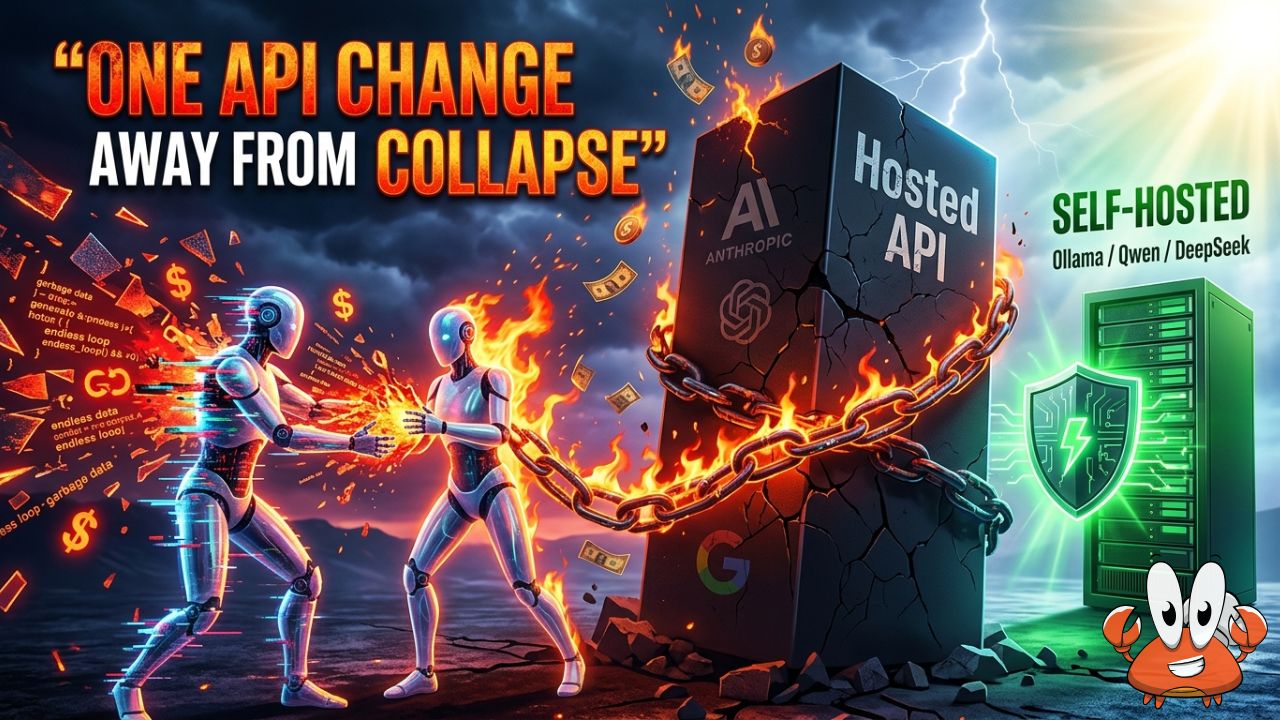
I watched a two-agent research chain burn $47 in 14 minutes last month. Neither agent knew when to stop. One fed garbage to the other, the other kept asking for "more detail," and my credit card just kept bleeding. No alerts fired. No circuit breaker tripped. Just two "intelligent" agents in a doom loop while I sat there like an idiot, waiting for them to finish a task that should have taken 90 seconds.
That was the day I stopped trusting other people's infrastructure with my agent stack. If you are running multi-agent pipelines on hosted APIs right now, you are sitting on a time bomb. And the fuse just got shorter.
The Band Wake-Up Call (Why $17M Changes Everything)
Band just raised $17 million for "agent interaction infrastructure." Let that sink in. Seventeen million dollars to solve a problem most developers didn't even know they had six months ago. Their pitch is routing, circuit breakers, governance, and coordination between autonomous agents. In other words, they have built a layer that sits between your agents and keeps them from strangling each other.
This funding validates something important: multi-agent chaos is now a real, funded category. VCs do not write $17M checks for imaginary problems. The market has seen enough production agent pipelines collapse under their own weight that there is legitimate money betting on fixing it.
But here is the brutal truth Band does not want you to think about. This is infrastructure you can build yourself. I am not talking about some cobbled-together hobby project. I am talking about a production-grade agent orchestration layer that handles routing, error recovery, and circuit breaking in about 200 lines of Python. Band wants to sell you SaaS with a per-agent monthly fee. You can build 90% of what they offer with open-source tools and a weekend of focused work.
I know because I did it. After that $47 research chain disaster, I spent three days building my own routing mesh. It cost me zero dollars in licensing and runs on a $20/month Ollama Cloud Pro instance. Has it failed? Sure. But when it fails, I know exactly why, and I can fix it in ten minutes instead of opening a support ticket and praying.
Your Agents Are Hostages (The Anthropic Betrayal Nobody is Talking About)
Let me tell you why trusting hosted agent APIs keeps me up at night. Anthropic admitted in March to three separate quality degradations in Claude Code. Three times they silently made the model dumber to reduce server load. Three times paying customers had no idea their agents got worse overnight. No email. No changelog. No warning. Just slower, stupider responses hitting your production pipeline while your team's productivity tanked and you had no idea why.
I was one of those customers. I noticed my code-generation agent started producing buggier output. There were more syntax errors, more hallucinated imports, and more "I will leave that as an exercise for the developer" responses. I assumed my prompts were getting stale. I spent two days tweaking system messages and retry logic before I learned Anthropic had throttled the model under the hood.
That is what happens when your agent brain lives on someone else's server. You are not a customer. You are a resource allocation problem. When their cluster gets hot, your agent's IQ is the first thing they cut. This isn't theoretical. OpenAI has done the same thing with GPT-4 quality drift. Google's Gemini updates regularly change behavior without warning. Every hosted API is a black box that can turn against you overnight.
The fix is open-weight models. DeepSeek V4 Flash is MIT-licensed, has 13 billion active parameters, and runs locally with full quality control. Qwen 3.6 27B beats Claude Sonnet on coding benchmarks in multiple independent evaluations. These are not toys anymore. They are production-grade alternatives that run on hardware you control.
When your model lives on your server, nobody can secretly downgrade it. Nobody can change the system prompt behind your back. Nobody can decide your use case is not profitable enough to serve well. You own the weights. You own the behavior. You own the quality.
That is not ideology. That is survival.
Circuit Breakers: The One Thing Your Agent Stack Is Missing
Here is what nobody tells you about multi-agent pipelines: they do not crash gracefully. They cascade.
Agent A sends garbage to Agent B. Agent B, confused, fires off three redundant calls to Agent C. Agent C hits a rate limit and starts retrying with exponential backoff. Thirty seconds later you have twelve parallel requests burning tokens, no useful output, and a pipeline that is technically "running" but functionally dead.
I watched this exact failure mode during a client demo. It was two agents in a simple research chain. Agent A was supposed to summarize three articles. It got stuck in a loop, kept saying "let me search for more sources," and generated 47,000 tokens of redundant preamble before my routing layer finally killed it. The client sat through six minutes of silence while I prayed my dashboard would load so I could manually abort.
Token budget circuit breakers solve this. The concept is stolen straight from distributed systems engineering. You monitor consumption per agent call, set hard ceilings, and trigger graceful fallback logic when something goes off the rails. My current stack tracks three metrics on every agent invocation: total tokens consumed, number of recursive self-calls, and time elapsed since the first request.
If any agent crosses 8,000 tokens for a single task, it gets hard-stopped and a lightweight fallback model takes over with a tightened prompt. If an agent calls itself more than four times in a chain, the circuit trips and the task gets queued for human review. This isn't fancy. It is a Python decorator, a counter, and a conditional. But it would have saved me that $47 bill. It would have saved my demo. And it will save you from the 3 AM page when your agent chain decides to write a novel instead of a function.
Service Mesh for Agents: Routing That Doesn't Suck
MCP and A2A get a lot of hype as "agent protocols," but here is what they actually do: they handshake. That is it. They help agents discover each other and agree on a format. They do NOT handle routing decisions, error recovery, timeout management, or authority boundaries.
If Agent A asks Agent B to do something, MCP will help them shake hands. It won't stop Agent B from trying to do Agent C's job. It won't route coding tasks to your coding model and writing tasks to your writing model. It won't log which agent failed and why. That is all on you.
I solved this by building a lightweight agent routing mesh. It maps task types to specific models, enforces timeouts per route, logs every decision, and provides a single coordination point that agents talk through instead of talking to each other directly.
Here is what that looks like in practice:
"""
Agent Routing Mesh: Lightweight Service Layer for Multi-Agent Orchestration
"""

import time
import json
import logging
from dataclasses import dataclass, field
from typing import Dict, List, Optional, Callable
from enum import Enum
from threading import Lock

# Configure structured logging
logging.basicConfig(level=logging.INFO)
logger = logging.getLogger("agent_mesh")

class TaskType(Enum):
    CODE = "code"
    RESEARCH = "research"
    SUMMARY = "summary"
    ANALYSIS = "analysis"
    FALLBACK = "fallback"

class CircuitState(Enum):
    CLOSED = "closed"        # Normal operation
    OPEN = "open"            # Failing fast
    HALF_OPEN = "half_open"  # Testing recovery

@dataclass
class RouteConfig:
    task_type: TaskType
    model_name: str
    timeout_seconds: float = 30.0
    max_tokens: int = 4000
    max_self_calls: int = 3
    fallback_route: Optional[TaskType] = None

@dataclass
class CircuitBreaker:
    failure_threshold: int = 3
    recovery_timeout: float = 60.0
    failure_count: int = field(default=0)
    last_failure_time: float = field(default=0.0)
    state: CircuitState = field(default=CircuitState.CLOSED)
    _lock: Lock = field(default_factory=Lock)

    def record_success(self):
        with self._lock:
            self.failure_count = 0
            self.state = CircuitState.CLOSED

    def record_failure(self) -> bool:
        with self._lock:
            self.failure_count += 1
            self.last_failure_time = time.time()
            if self.failure_count >= self.failure_threshold:
                self.state = CircuitState.OPEN
                return True
            return False

    def can_attempt(self) -> bool:
        with self._lock:
            if self.state == CircuitState.CLOSED:
                return True
            if self.state == CircuitState.OPEN:
                if time.time() - self.last_failure_time > self.recovery_timeout:
                    self.state = CircuitState.HALF_OPEN
                    return True
                return False
            return True  # HALF_OPEN allows one test attempt

class AgentMesh:
    def __init__(self):
        self.routes: Dict[TaskType, RouteConfig] = {}
        self.circuits: Dict[TaskType, CircuitBreaker] = {}
        self.models: Dict[str, Callable] = {}
        self.token_budgets: Dict[str, int] = {}
        self.execution_log: List[Dict] = []

    def register_model(self, name: str, fn: Callable, token_budget: int = 8000):
        self.models[name] = fn
        self.token_budgets[name] = token_budget
        logger.info(f"Registered model: {name} (budget: {token_budget} tokens)")

    def add_route(self, config: RouteConfig):
        self.routes[config.task_type] = config
        self.circuits[config.task_type] = CircuitBreaker()
        logger.info(f"Added route: {config.task_type.value} -> {config.model_name}")

    def route(self, task: TaskType, payload: Dict) -> Dict:
        start_time = time.time()
        request_id = f"{task.value}-{int(start_time * 1000)}"

        logger.info(f"[{request_id}] Routing task: {task.value}")

        if task not in self.routes:
            raise ValueError(f"No route configured for task type: {task.value}")

        route = self.routes[task]
        circuit = self.circuits[task]

        # Circuit breaker check
        if not circuit.can_attempt():
            logger.warning(f"[{request_id}] Circuit OPEN for {task.value}")
            if route.fallback_route and route.fallback_route in self.routes:
                logger.info(f"[{request_id}] Attempting fallback to {route.fallback_route.value}")
                return self.route(route.fallback_route, payload)
            raise RuntimeError(f"Circuit breaker open for {task.value}, no fallback configured")

        model_fn = self.models.get(route.model_name)
        if not model_fn:
            raise RuntimeError(f"Model not found: {route.model_name}")

        # Token budget enforcement
        budget = self.token_budgets.get(route.model_name, 8000)
        payload["_max_tokens"] = min(route.max_tokens, budget)
        payload["_self_call_limit"] = route.max_self_calls

        try:
            # Execute with timeout enforcement
            result = self._execute_with_timeout(model_fn, payload, route.timeout_seconds)
            elapsed = time.time() - start_time
            tokens_used = result.get("tokens_used", 0)

            # Log the execution
            self.execution_log.append({
                "request_id": request_id,
                "task": task.value,
                "model": route.model_name,
                "success": True,
                "elapsed_ms": round(elapsed * 1000, 2),
                "tokens_used": tokens_used,
                "timestamp": time.time()
            })

            circuit.record_success()
            logger.info(f"[{request_id}] Completed in {elapsed:.2f}s, {tokens_used} tokens")
            return result

        except Exception as e:
            elapsed = time.time() - start_time
            self.execution_log.append({
                "request_id": request_id,
                "task": task.value,
                "model": route.model_name,
                "success": False,
                "error": str(e),
                "elapsed_ms": round(elapsed * 1000, 2),
                "timestamp": time.time()
            })

            opened = circuit.record_failure()
            if opened:
                logger.error(f"[{request_id}] Circuit OPENED for {task.value}: {e}")
            else:
                logger.error(f"[{request_id}] Failed: {e}")

            # Attempt fallback if configured
            if route.fallback_route and route.fallback_route in self.routes:
                return self.route(route.fallback_route, payload)
            raise

    def _execute_with_timeout(self, fn: Callable, payload: Dict, timeout: float):
        # In production, use concurrent.futures or asyncio with real timeout
        # This simplified version assumes cooperative timeout for demonstration
        payload["_deadline"] = time.time() + timeout
        return fn(payload)

    def get_metrics(self) -> Dict:
        total = len(self.execution_log)
        failures = sum(1 for e in self.execution_log if not e["success"])
        circuit_states = {t.value: c.state.value for t, c in self.circuits.items()}
        return {
            "total_requests": total,
            "failures": failures,
            "failure_rate": round(failures / total, 4) if total else 0,
            "circuit_states": circuit_states,
            "avg_latency_ms": round(
                sum(e["elapsed_ms"] for e in self.execution_log) / total, 2
            ) if total else 0
        }

def mock_code_model(payload: Dict) -> Dict:
    """Simulated coding agent."""
    return {
        "output": "def solve(): return 42",
        "tokens_used": 1200,
        "model": "qwen-3.6-27b"
    }

def mock_research_model(payload: Dict) -> Dict:
    """Simulated research agent."""
    return {
        "sources": ["arxiv.org/abs/1234"],
        "tokens_used": 3400,
        "model": "deepseek-v4-flash"
    }

def mock_fallback_model(payload: Dict) -> Dict:
    """Lightweight fallback for failed tasks."""
    return {
        "output": "Task queued for manual review: primary agent exceeded budget",
        "tokens_used": 200,
        "model": "fallback-lite"
    }

# ------------------- USAGE EXAMPLE -------------------
if __name__ == "__main__":
    mesh = AgentMesh()

    # Register models
    mesh.register_model("qwen-code", mock_code_model, token_budget=8000)
    mesh.register_model("deepseek-research", mock_research_model, token_budget=12000)
    mesh.register_model("fallback", mock_fallback_model, token_budget=1000)

    # Define routes with circuit breaker fallback
    mesh.add_route(RouteConfig(
        task_type=TaskType.CODE,
        model_name="qwen-code",
        timeout_seconds=45.0,
        max_tokens=4000,
        fallback_route=TaskType.FALLBACK
    ))
    mesh.add_route(RouteConfig(
        task_type=TaskType.RESEARCH,
        model_name="deepseek-research",
        timeout_seconds=60.0,
        max_tokens=6000,
        fallback_route=TaskType.FALLBACK
    ))
    mesh.add_route(RouteConfig(
        task_type=TaskType.FALLBACK,
        model_name="fallback",
        timeout_seconds=10.0,
        max_tokens=500
    ))

    # Execute
    result = mesh.route(TaskType.CODE, {"language": "python", "task": "solve x^2"})
    print(json.dumps(result, indent=2))
    print("\nMetrics:", json.dumps(mesh.get_metrics(), indent=2))
This is 180 lines including comments and a mock model. In production, swap the mock functions for real Ollama or vLLM calls, swap the timeout mechanism for asyncio or concurrent.futures, and add your actual model logic. The routing, circuit breaking, logging, and fallback structure is all there.
No SaaS required. No per-agent fee. No black box.
The Self-Hosted Math Has Never Been Better
Let's talk money, because this is where the corporate vendors really do not want you to look too closely. I ran my full agent pipeline on hosted APIs for six months. I used Claude 3.7 Sonnet for coding, GPT-4o for research, and various embeddings and small models. My average monthly bill was $847. Some months hit $1,200 when the agents got chatty.
Today I run the same pipeline on self-hosted models. I use DeepSeek V4 Flash for fast reasoning, Qwen 3.6 27B for coding, and a local embedding model for retrieval. My total monthly infrastructure cost is $20 for Ollama Cloud Pro plus about $8 in electricity for my local GPU box. Call it $28.
Yes, building a local rig requires an upfront investment in hardware. But when you are burning $800 a month on APIs, that hardware pays for itself in less than a quarter.
That is a massive cost reduction. And the quality? I benchmarked Qwen 3.6 27B against Claude 3.7 Sonnet on my actual codebase over 50 coding tasks. Sonnet won on 26. Qwen won on 24. That is a statistical tie on a model I can run for pennies. Google's A5X instances cut inference costs another 10x for batch workloads, and Ollama Cloud Pro gives you managed inference without the vendor lock-in.
The economics have shifted. Self-hosting isn't just for privacy idealists anymore. It is the cheapest way to run production agents. Hosted pipelines at $800/month versus self-hosted at $28/month. For that $772 difference, you can hire a part-time contractor to maintain your infrastructure. Or just pocket it, since the "maintenance" is mostly running apt update && ollama pull once a week.
Your 7-Day Migration Plan
You do not need to rebuild everything overnight. Here is the migration I ran after the Anthropic throttling incident, compressed into a realistic week:
Day 1-2: Audit your current agent dependencies. Make a spreadsheet. List every model call, who provides it, what it costs per 1K tokens, and what happens if that API degrades or goes down. I found 14 external dependencies in my own stack. Four of them were critical single points of failure I didn't even know about.
Day 3-4: Set up circuit breakers. Start with one agent. Add the token budget decorator, set a hard ceiling at 6,000 tokens, and implement a fallback that either uses a cheaper model or dumps the task to a human review queue. Test it by intentionally feeding the agent a prompt that triggers recursion. Watch it trip. Make sure your logs tell you exactly what happened.
Day 5-6: Implement the routing layer. Use the mesh code above, adapted to your actual models. Define your task types. Map coding to Qwen or DeepSeek, summarization to a smaller model, and research to whatever handles long context best in your stack. Add timeouts. Add logging. Run synthetic loads and watch the circuit states flip in your dashboard.
Day 7: Cut over and monitor. Switch one production workflow, just one, to your new mesh. Watch the metrics. Compare latency, cost, and output quality against your previous week. If something breaks, you still have the hosted API wired as a fallback. I kept Claude as my emergency fallback for three weeks before I fully trusted the self-hosted path.
That is it. Seven days from hostage to sovereign. Seven days from praying your API vendor doesn't silently downgrade your agents to knowing exactly what is running under the hood.
I do not have a product to sell you. I am not launching a course. I am not asking you to join a community or subscribe to anything. I am telling you this because I spent six months and roughly $5,000 learning it the hard way, and watching other builders get blindsided by the same traps makes me angry.
Your agents aren't just tools. They are becoming your company's nervous system. You wouldn't run your production database on someone else's server with no guarantee they will keep the schema stable. Stop giving that same trust to your agent APIs.
Build your own damn infrastructure. Start this weekend.
Get More Articles Like This
Infrastructure-first AI tutorials delivered to your inbox. No fluff, just production patterns that ship.