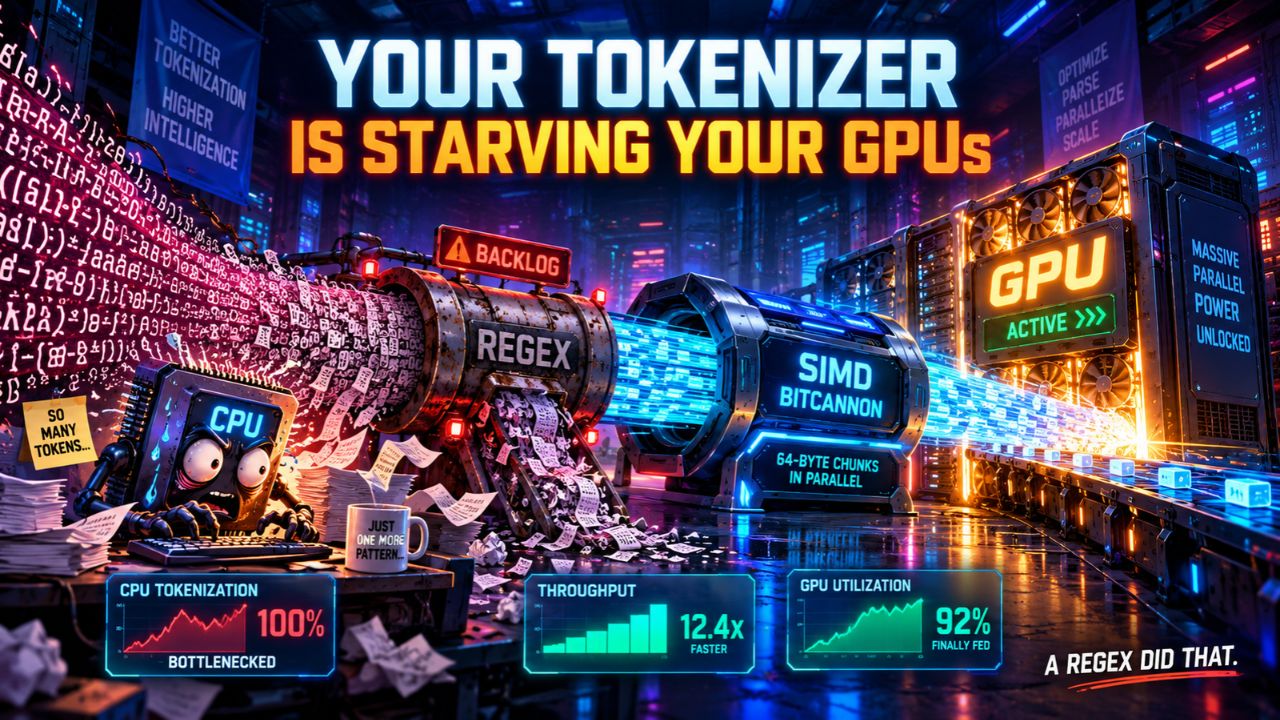
Hugging Face shipped tokenizers v1, and the headline number is that it is often tens of times faster than v0.23. On one thread on an Apple M4 Max, across the ten model families the new encode path covers, it encodes text 3 to 30 times faster than the current release. The interesting part is not the speed. It is why the speed was there to take: at scale, the tokenizer starves the model, and your GPUs sit idle waiting for the CPU to finish encoding text. The bottleneck was never the GPU. It was the regex.
You bought the accelerators. You instrumented the model. You almost certainly never put the encoder on a dashboard. Two of the oldest, least glamorous layers in the stack, encoding text and loading quantized weights, both got materially faster in the same week while everyone argued about model size. That is not a coincidence. That is where the throughput actually lives.
This is the same lesson as PhantomByte #193, Tokens per Watt: price the unit you waste, not the unit you brag about.
THE WORKLOAD SHIFT NOBODY PLANNED FOR
Start with what a tokenizer is, because the argument depends on it. It converts your text into the list of integers the model actually reads, in four stages: normalization, pre-tokenization, the model stage that maps pieces to vocabulary IDs, and post-processing that adds the special tokens. Eight of the ten model families measured in the v1 writeup use byte pair encoding, which starts from the raw bytes of a piece of text and repeatedly joins the highest ranked adjacent pair until no ranked pair remains.
For most of the last decade that work was noise. The Hugging Face team says it plainly: tokenization is light compared to the heavy modeling in the rest of the pipeline, so nobody engineered it. It was a library detail, not a capacity planning input.
Then workloads scaled. Training runs got bigger, serving stacks started holding many concurrent requests, and long inputs got reprocessed over and over. The team's framing is the one to keep: those conditions put enough pressure on the tokenizer that it starves the model of data. Their stated goal for v1 reads as an engineering requirement, not marketing. Your GPUs should never sit idle waiting for the CPU to complete its tokenization.
Here is why the cost multiplies instead of just adding. The model runs on the accelerator. The tokenizer runs on the CPU, once per request, before the accelerator gets anything to chew on. Twenty concurrent requests means twenty encodes competing for the same cores while the GPUs wait at the door. Your utilization dashboard shows a gap and blames the model, because the model is the only thing you charted.
WHAT V1 ACTUALLY CHANGED
Two changes carry most of the gain, and both are engineering, not research.
The first is the split. Byte pair encoding uses a regular expression to cut input into pre-tokens, and a merge never crosses a pre-token boundary, so that split decides what the rest of the pipeline sees. That pattern is a fixed parameter of the model. It ships with the tokenizer and never changes at runtime, which means there was never a reason to interpret it with a general-purpose regex engine on every encode. v1 replaces the regex with bitcannon, a hand-written splitter that treats the input's bytes as parallel streams of bits and finds boundaries with Boolean operations across whole SIMD registers, deciding 64 bytes per register operation. The team points at Parabix and simdjson as the same idea applied elsewhere.
The second is the merge pipeline. v1 keeps the merge working set in a scratch buffer owned by the caller, so the loop never touches the allocator. It links merged symbols as a doubly linked list inside one preallocated buffer, so a merge updates two indices instead of moving data. It packs each candidate pair into a single 64-bit value with the rank in the high bits, so comparison is an integer compare with no branch. It adds a thread-local word cache mapping pre-token bytes to finished IDs, so a repeated word is merged once and never again. Then it removes the last structural ceiling: one shared tokenizer now encodes from many threads at once, each thread drawing its scratch buffer and word cache from its own sub-pool instead of queuing on a single lock.
Now the part that tells you what this really was. v1 produces exactly the same token IDs as v0.23. Same output, same API, same vocabulary, same merge ranks. The team credits gigatoken, tiktoken, kitoken, tokie, fastokens, wordchipper, and ai-tokenizer for showing the ideas were worth trying, with patches and hardware testing from IBM, NVIDIA, and the ExecuTorch team. The ecosystem knew the answer for years. The old path was engineering debt, and you paid interest on it in idle GPU hours.
Read the caveat too, because it is the honest edge of the claim. A handful of grammars cover most byte-level byte pair encoding models, and bitcannon covers specific ones including GPT-2, cl100k, o200k, Tekken, and DeepSeek. If your model's split pattern is not among them, you keep the regex path and none of the speedup. Measure, do not assume.
THE LOADER GOT FIXED IN THE SAME WEEK
The companion release is quieter and just as useful. Transformers now runs GGUF quantized checkpoints natively. You pick a GGUF off the Hub, load it with from_pretrained and a gguf_file argument, and generate with the standard Python and PyTorch APIs. GGUF packages weights, tokenizer information, and an optional chat template into one file, and mixed-precision variants like Q4_K_M keep most tensors at 4 bits while holding sensitive ones higher. The team's own size table for a 4B Qwen3.5 checkpoint runs from 8.42 GB unquantized at BF16 down to 2.74 GB at Q4_K_M.
The engineering substance is in how they got the speed. They reuse llama.cpp's ggml kernels through the kernels library, and they reworked the generate loop for every transformers model, not just GGUF: dropping an unnecessary all-ones attention mask early so downstream attention code stops re-inspecting it, and deferring the stopping check so the CPU keeps scheduling work while the GPU runs instead of waiting on a readback every token.
PhantomByte #176 already showed you that quantization economics beat the full-precision-or-nothing assumption, with a 4-bit model beating its own full-precision original on 7 of 9 benchmarks. The gap was never the model. It was the loader path punishing you for choosing the cheap version. PhantomByte #181 made the same argument about machines you already own when NVIDIA shipped its Personal AI Router to pool idle local compute. The local stack and the Python stack have stopped being separate worlds. llama.cpp's engine is what powers Ollama, LM Studio, and Jan, and now the standard library loads its file format directly, starting with the Qwen3.5 architecture on Apple Silicon.
The limitations are worth stating because the writeup states them. The packed inference path is MPS-only for now, padded batches cannot take the same shortcut and can run slower, and architecture coverage is limited to Qwen3.5 dense and mixture-of-experts plus compatible Qwen3.8 checkpoints. This is a first rung, not a finished floor. It is still a first rung that used to cost you glue code.
WHY THIS IS WHERE PRICE CUTS COME FROM
Look at what the top of the market did on the same day, because it closes the argument.
Anthropic shipped Opus 5.5 and cut output token pricing to $20 per million tokens from $25 on the previous Opus, with the company saying the model is faster to run and reflects an overall drop in the compute required to serve it. OpenAI shipped updated GPT-6 Sol and Luna models at half the cost of the 5.6 series and attributed the price cut to improvements in caching and inference, not to a smaller model. OpenAI's release landed 90 minutes after Anthropic's.
Two labs, one afternoon, both selling efficiency instead of benchmark points. Now name where that efficiency physically lives: encoders, caches, kernels, loaders, and the generation loop that schedules them. Not in the parameter count. Not in the chart you screenshot for the board. The same week the tokenizer stopped wasting CPU cycles and the loader stopped wasting memory, the two biggest model vendors on earth priced their products on exactly that kind of work. That is my read on the pattern, and it is an interpretation, not a company statement, but the timing is hard to argue with.
THE THROUGHPUT LADDER: FOUR STEPS TO FIND YOUR IDLE GPU COST
Here is the framework to carry into your next capacity meeting. When GPU utilization is low under load and the model is not the bottleneck, walk down the Throughput Ladder in order and stop where the ceiling actually is.
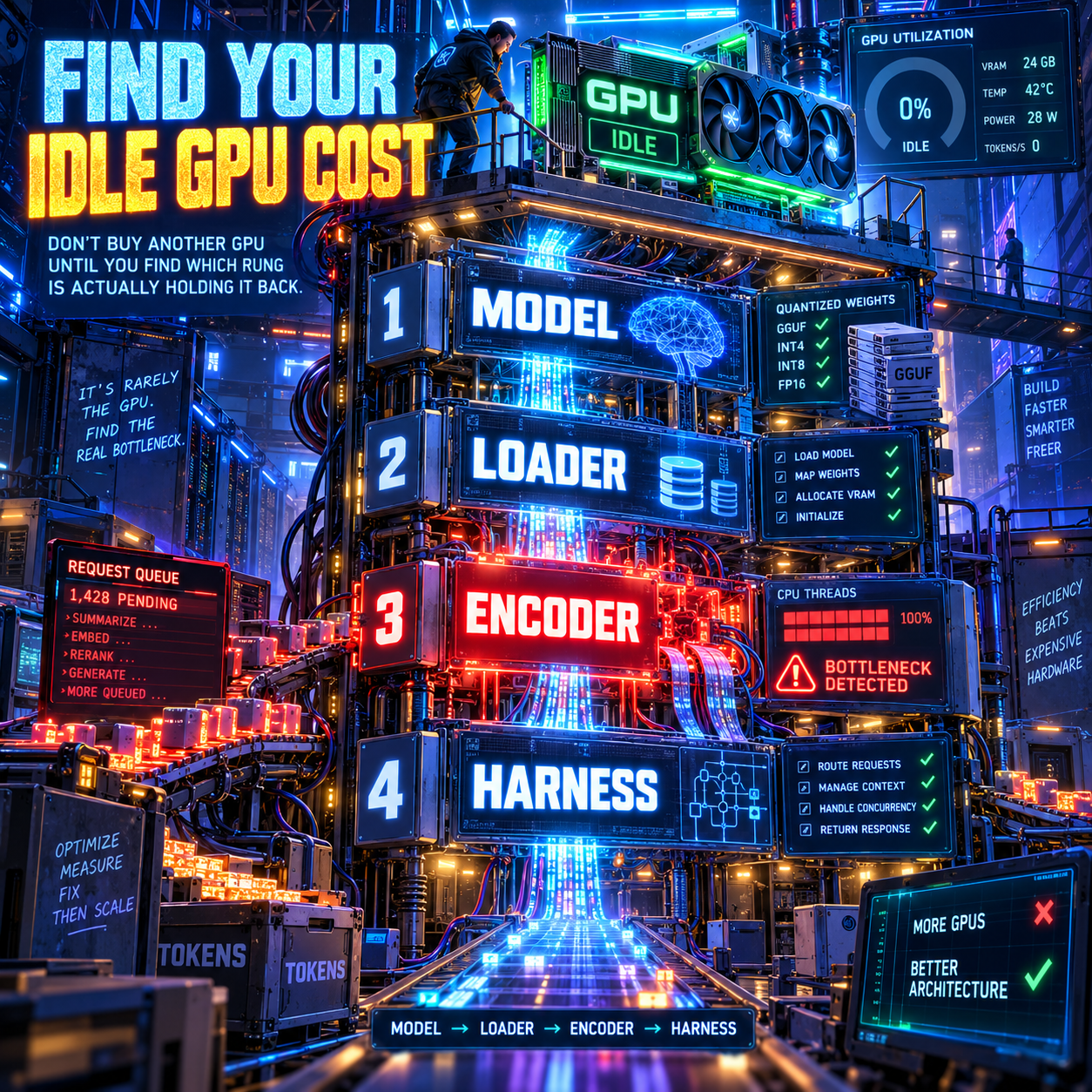
- Rung one, the model. Everyone instruments this and everyone stops here. It is the last place waste hides once the other three are ruled out, and it is the first place teams look. That is the whole problem.
- Rung two, the loader. Weight load, quantization choice, and the path from disk to device. The GGUF work in transformers is this rung, and so is every model you load by dequantizing when a packed kernel existed.
- Rung three, the encoder. The tokenizer, measured as CPU time per batch under concurrency, not per single request. Tokenizers v1 is this rung. If your GPU idles while the encoder runs, you just found your ceiling and it is on the CPU.
- Rung four, the harness. The wrapper code between the incoming request and the inference call: queues, serialization, retries, logging, and whatever middleware sits in the hot path.
The rule of thumb: if GPU utilization is low under load and the model is not the bottleneck, walk down the ladder before you buy more silicon. The reason is arithmetic. According to ZDNET's reporting, a 32 GB DDR5 kit that cost about $100 to $120 a year ago now runs around $400, and a 32 GB DDR4 kit that cost $60 to $70 now exceeds $200. AI data centers are expected to absorb about 70 percent of all memory chips produced globally in 2026, a single server rack can consume 20TB of HBM3E and 17TB of LPDDR5X, Micron shut its consumer Crucial brand to chase enterprise AI customers, and pricing has become volatile enough to quote hourly. The most optimistic estimates put relief in the second half of 2027, and even then at prices 60 to 100 percent above 2024 levels.
That is the frame, and it lands hardest on rung three, because the encoder is where the memory bill and the CPU bill meet. Those CPU threads doing your tokenization do not run on nothing. Every core mid-encode has to be kept fed by the system RAM sitting next to it, and that RAM now costs four times what it did a year ago. Waste CPU cycles on a regex scan and you are not just idling the GPU. You are holding a memory subsystem you paid quadruple for against a scanning loop that a library could have finished in a fraction of the time. Optimizing the encoder does not only buy back GPU throughput. It lowers the amount of RAM you have to provision to keep those threads productive, which is the only hardware cost on this ladder that is still climbing.
In a market where memory quadrupled in a year and capacity is being bought out from under you, idle compute is the most expensive compute there is. You cannot fix a regex with a purchase order.
WHAT TO DO TODAY
- Put the encoder on a dashboard: CPU tokenization time per serving batch, charted next to GPU utilization. If the GPU idles while the encoder runs, you found rung three.
- Upgrade to tokenizers v1 and measure before and after under concurrent load, not single-request latency. The tens-of-times headline is a throughput claim, and the 3 to 30 times encode result also scaled at 76 percent of linear across eight workers.
- Confirm your model's split grammar is one of the covered ones before you promise anyone a speedup. If it is not, you keep the regex path and no gain.
- If you run quantized models, test the native GGUF loading path in transformers before writing another line of glue code around llama.cpp.
- Read the prior-art list the v1 team credited. If your in-house encoder predates tiktoken, gigatoken, and kitoken, it is leaving throughput on the table that a library you already installed has already fixed.
- Walk the Throughput Ladder on one production serving path this week: model, loader, encoder, harness. Write down which rung was actually the ceiling, then check that against what you budgeted to fix.
THE UNCOMFORTABLE QUESTION
Your GPUs sat idle while a regex ran, and the fix shipped in a library you already had installed.
How many capacity plans did you write this year, and how many of them measured anything below rung one?
Efficiency is not a feature you buy at the top of the market. It is a layer you instrument at the bottom of your own stack, and the bill for skipping it shows up as silicon you paid for and never used.
Get More Articles Like This
Getting your AI agent setup right is just the start. I'm documenting every mistake, fix, and lesson learned as I build PhantomByte.
Subscribe to receive updates when we publish new content. No spam, just real lessons from the trenches.
Build Real AI Infrastructure
PhantomByte teaches you to build real AI infrastructure yourself: local AI stacks, autonomous agents, multi-agent orchestration, web scraping, and custom tools. Step-by-step PDF tutorials you download, follow, and deploy. No subscriptions. No fluff. Just skills that ship.