
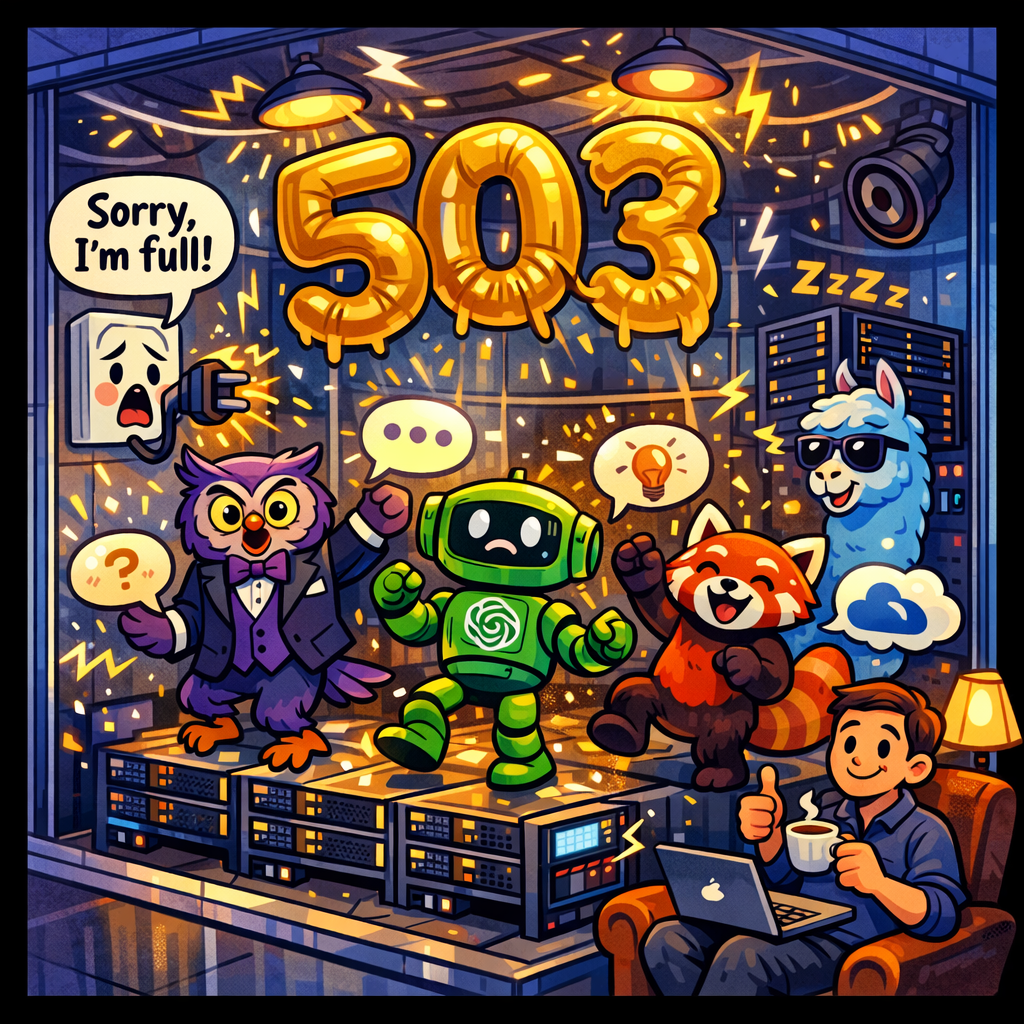
The AI energy crisis is what happens when data centers are built faster than power grids can supply them. When every major AI provider (Anthropic, DeepSeek, cloud-hosted Ollama APIs, and OpenAI) hits outages in the same week, that is not a coincidence. That is physics. There literally is not enough electricity to run all these models reliably, and your 503 errors are the proof.
If you have been building with AI APIs over the past few weeks, you have seen it. The 503 Service Unavailable. The "model is overloaded" message. The Claude request that times out, the DeepSeek endpoint that returns nothing, and the cloud Ollama inference that crawls to a halt.
The official explanations are always the same: "high demand," "capacity constraints," and "temporary outage." What nobody is telling you is that these outages share a root cause that has nothing to do with software. The grid is full. The data centers are coming online faster than the electrons to power them, and every provider is fighting for the same constrained supply.
The Headlines Are Screaming It
Let's connect the dots between news you have probably seen in isolation:
"AI Data Centers Power Crisis" (CarbonCredits.com, April 10, 2026): AI data centers now require 100 to 300 MW of continuous power. Conventional data centers use 10 to 50 MW. That is up to 10x more energy-intensive. The International Energy Agency projects global data center electricity use will exceed 1,000 TWh by the end of 2026, which is as much power as an entire mid-sized country like Japan.
"PJM Targets 15 Gigawatts of New Power for Data Center Boom" (Bloomberg, April 10, 2026): PJM Interconnection, the grid operator serving 65 million people across 13 states, says they need 15 GW of new generation specifically to handle data center demand. For context, 15 GW is roughly the output of 15 nuclear reactors. That is not the total grid capacity. That is the new capacity needed just to keep up with data centers.
"Stressed US Grid Forcing Data Centers to Get More Flexible" (Reuters, March 26, 2026): Grid operators are already telling data centers they cannot guarantee 24/7 power. The old model, where a big data center signs a big power purchase agreement and gets a reliable baseload, is breaking down. Data centers are being asked to be "flexible" with their demand. That is grid operator code for "sometimes we won't have enough for you."
"AI Power Demand Creates 'High Likelihood, High Impact' Grid Risks" (Politico/E&E News, March 18, 2026): The Department of Energy's own assessment states that AI power demand creates grid risks with both a high likelihood of occurring and a high impact when they do. This is the government's polite way of saying this is a crisis.
"UK and Ireland Face AI Energy Crisis as Demand Soars" (April 11, 2026): This is not just a US problem. The UK's National Grid is warning that AI demand could consume up to half of Britain's entire electricity growth through 2030. In Ireland, data centers are now projected to consume nearly one-third of the entire country's electricity by the end of this year.
"$3 Trillion Infrastructure Gold Rush" (Intellectia AI, April 12, 2026): Three trillion dollars in AI infrastructure investment is pouring into data centers globally. But the power infrastructure to support it is years behind.
Why Everyone Goes Down at the Same Time
Here is the part nobody connects: when you see ChatGPT, Claude, DeepSeek, and cloud-hosted Ollama all struggling in the same week, it is not because they share the same servers or run the same code. It is because they share the same grid.
AI data centers cluster in a handful of regions:
- Northern Virginia (Ashburn): The largest concentration on earth, served by PJM.
- Oregon/Central Washington: Columbia River hydro, Bonneville Power Administration.
- Texas: ERCOT territory, which already cannot keep lights on during heat waves.
- Netherlands/Ireland: Europe's primary data center corridor, where the grid is now stretched.
When PJM declares a capacity emergency, every provider drawing from that grid feels it simultaneously. There is no backup. You cannot reroute your model to a different power plant in real time. When the grid is stressed, every data center on it competes for the same constrained electrons. The providers that win are the ones who signed the biggest power purchase agreements. Everyone else gets throttled.
That is why your 503 is not about a bug in anyone's code. It is about an entire infrastructure hitting a ceiling that is measured in megawatts, not milliseconds.
The Numbers Behind the Shortage
Let's put some hard data behind this:
| Metric | Traditional Data Center | AI Data Center |
|---|---|---|
| Power draw | 10-50 MW | 100-300 MW |
| Power density per rack | 5-10 kW | 50-100+ kW |
| Grid interconnection wait | 12-18 months | 2-4 years |
| PUE (Power Usage Effectiveness) | 1.2-1.4 | 1.5-1.7 |
| Growth rate | 5-10% annually | 25-50% CAGR |
A single AI data center uses as much electricity as a small city. When several of them cluster in the same region, which they do because that is where the fiber and cooling infrastructure already exists, the local grid hits its limit.
The US grid interconnection queue currently has over 2.2 TW of generation projects waiting for approval. The average wait time is now stretching toward 5 years. AI companies are building data centers in 18 months. You see the problem. The data center is ready. The power is not.
ChatGPT vs Google Search: The 10x Problem
Here is a comparison that puts it in perspective:
A single Google search uses approximately 0.3 watt-hours of electricity.
A single ChatGPT query uses approximately 2 to 3 watt-hours, which is roughly 10x more.
Google processes about 8.5 billion searches per day. If even a fraction of those shift to AI-powered queries, we are talking about order-of-magnitude increases in electricity demand just for search.
Now multiply that across every AI application: code generation, image creation, video synthesis, and autonomous agents running 24/7. The IEA projects data centers could consume 6 to 8% of total US electricity demand by 2030. That is up from roughly 2% today.
Training the largest models compounds the problem dramatically:
- GPT-3 training: ~1.287 million kWh.
- GPT-4 estimated: 50x to 100x that, between 50 and 100 million kWh.
This is before a single user sends a single query.
Why "Renewables Will Save Us" Is a Lie
You will hear that clean energy is the answer. You will hear that Microsoft, Google, and Amazon have all committed to 100% renewable electricity. You will hear that nuclear deals like Microsoft's Three Mile Island restart will fill the gap.
Here is why that does not work:
Intermittency is incompatible with AI workloads. Solar produces power when the sun shines. Wind produces when the wind blows. AI inference runs 24/7. There is no "waiting for the sun to come up" when your model is serving 200 million queries a day. Battery storage exists but is not deployed at the scale or duration needed.
Nuclear is too slow. Microsoft's Three Mile Island deal is real, and while timelines have accelerated toward a 2027 restart, it is still too far away. Small modular reactors are still in the pilot phase. Meanwhile, AI demand is doubling every year. You cannot bridge a 2026 crisis with 2027 or 2030 solutions.
Jevons Paradox eats your efficiency gains. Every time we make AI more energy-efficient per query, total consumption goes up because the cheaper it gets, the more queries we run. This is a well-documented economic phenomenon. Efficiency does not reduce demand; it accelerates it.
The interconnection queue is the real bottleneck. Even if you could build a wind farm tomorrow, it takes years to connect it to the grid. The permitting, the transmission lines, and the environmental reviews are all designed for a pre-AI world where demand grew 1% per year, not 25%.
What's Actually Happening When You Hit a 503
When you send a request to an AI API and get a 503 back, here is what is happening underneath:
Your request hits a load balancer that distributes across GPU clusters in one or more data centers. The cluster is at capacity, not because there are not enough GPUs, but because the data center cannot pull enough power to run them all at full utilization.
Providers are now soft-capping their active clusters. They are literally leaving racks of GPUs dark because they do not have the power budget to turn them all on at once. Rather than brown out the entire data center, they selectively reduce capacity. This is load shedding. It is the same technique grid operators use during heat waves. When there are not enough electrons, someone does not get power. In the AI world, that someone is you.
This is why outages cluster in the afternoon (peak demand), during heat waves (grid stress), and across multiple providers simultaneously (shared grid dependency).
The Multi-Tenant Power War
When power is scarce in a data center, who gets priority? If you are running your workloads on shared cloud infrastructure (AWS, Azure, GCP), you are competing with every other tenant for the same constrained power budget. When the grid flexes, the cloud provider makes a choice:
- Premium contract customers keep their GPU allocation.
- Spot or on-demand instances get throttled first.
- API endpoints serve cached or reduced-quality responses.
- Free tier users get 503s.
Cloud providers are economic actors. When electricity gets expensive or scarce, they prioritize revenue. Your $0 API call gets dropped before the enterprise customer's $10,000 per month deployment. This is the multi-tenant power war, and it is happening right now.
What You Can Actually Do About It
I am not going to pretend there is a clean solution. There is not one. But if you are building AI-powered applications, there are ways to make your systems more resilient:
Build Multi-Region Failover Based on Power, Not Just Latency: Stop choosing cloud regions based solely on proximity to users. Factor in grid reliability. A Virginia region served by PJM during a heat wave emergency is a worse choice than an Oregon region with Columbia River hydro, even if latency is 20 ms higher.
Implement Graceful Degradation, Not Just Retries: When you get a 503, do not just retry with exponential backoff. That makes the problem worse. Instead, fall back to a smaller, less power-hungry model or serve cached responses.
Monitor Grid Conditions, Not Just API Status: Monitor the grid operator status for the regions where your AI workloads run. PJM, ERCOT, and CAISO all publish real-time capacity data. If your primary region is in grid stress, pre-emptively shift load before you start getting 503s.
Run Local Models as Insurance: We have been saying this at PhantomByte for months: local AI is not just about privacy or cost. It is about resilience. When the cloud cannot serve your model, a local inference engine keeps your application running.
Accept That This Gets Worse Before It Gets Better: The $3 trillion infrastructure investment is real. The data centers are being built. But the power is not coming online for years. Expect more outages, more throttling, and more "at capacity" messages.
The Brutal Truth
The AI industry is building the most power-hungry technology in human history faster than the grid can support it. Every provider is scaling compute beyond what the existing electrical infrastructure can deliver. The outages you are experiencing, the 503s, the timeouts, and the "model overloaded" messages, are not software problems. They are the first symptoms of a structural energy crisis.
PJM needs 15 GW of new power. The UK and Irish grids are warning about demand consuming massive portions of electricity growth. AI data centers draw 10x more power than traditional ones. The interconnection queue is five years deep.
When ChatGPT, Claude, DeepSeek, and cloud-hosted Ollama APIs all go down in the same week, it is not a conspiracy. It is not even really a capacity issue in the way we normally think about it. It is simpler than all of that.
There literally isn't enough electricity.
Get More Articles Like This
The AI infrastructure crisis is just beginning. I'm documenting every breakdown, outage, and lesson learned as we navigate this new reality.
Subscribe to receive updates when we publish new content. No spam, just real insights from the trenches.