
A three-month randomized trial put 133 patent lawyers across eleven US intellectual property firms on the same drafting work. Some got an AI assistant. Some did not. The lawyers with the tool produced better drafts, and the juniors gained the most.
Then the researchers took the tool away and asked everyone to mark up a patent application by hand.
The seniors kept the gain. The juniors did not. This is the first clean measurement of what managers have been guessing about since 2023, and it prices something nobody has put on a balance sheet.
Two definitions, briefly. A randomized controlled trial assigns people to groups by chance, so the comparison reflects the tool rather than who volunteered. A working paper has not finished peer review, so read this as strong evidence, not settled law.
WHAT THE TRIAL ACTUALLY MEASURED
The design is why this outranks a vendor case study. The paper is NBER Working Paper 35720 by David Autor and six co-authors. All eleven firms already had patent drafting relationships with Google, which facilitated recruitment, so this is sophisticated patent practice rather than a random slice of legal work.
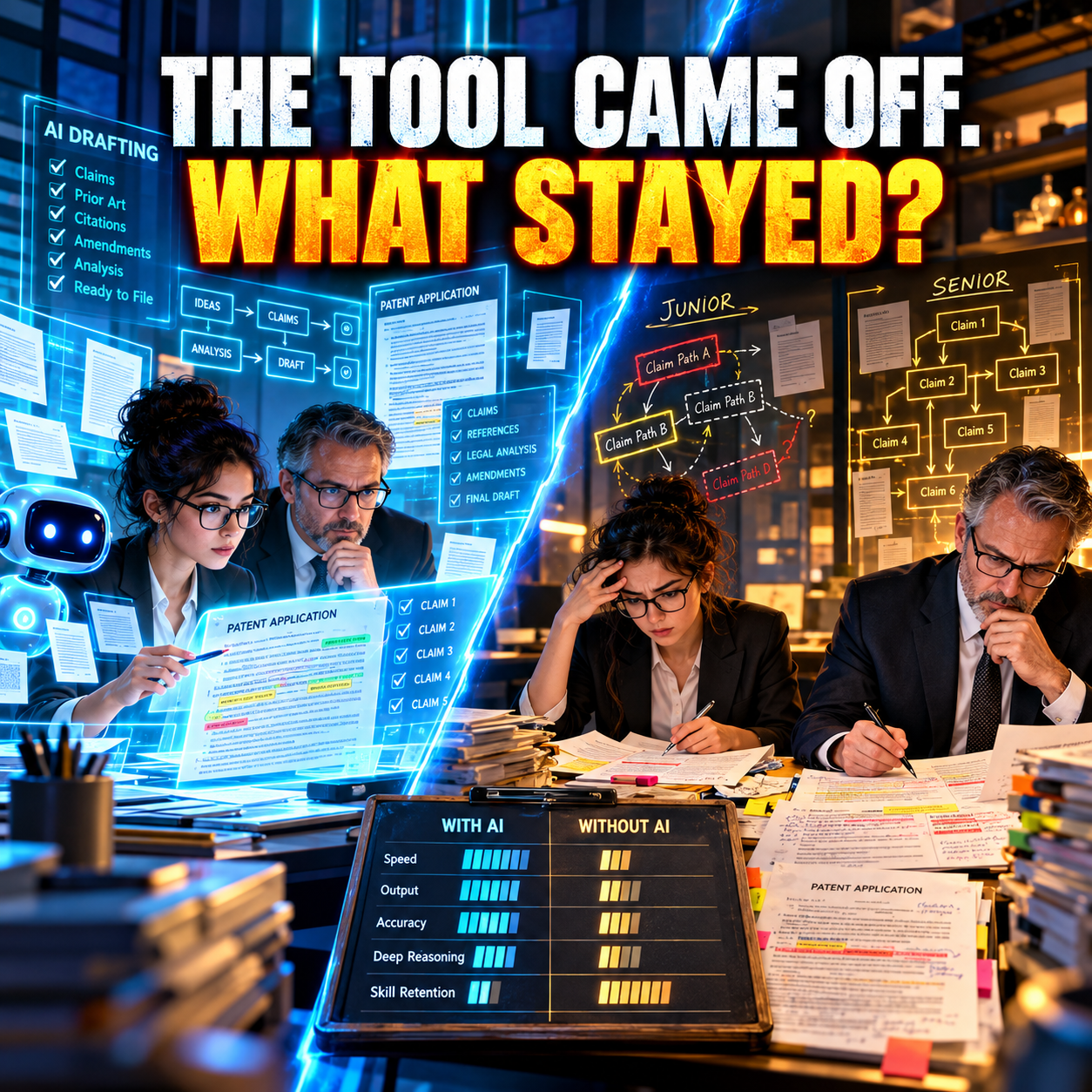
Assignment ran two to one. Ninety lawyers got a custom AI drafting assistant, forty-three did not. Quality rose 0.34 standard deviations at day ten and 0.38 at day ninety, both significant, both larger for juniors than for seniors.
Then all participants redlined an existing patent application without AI, a task that requires judgment. Treated lawyers beat controls by 0.32 standard deviations overall, but the advantage lived entirely among seniors, who gained 0.45. Juniors showed no average gain.
What happened inside the junior group is the detail to carry into your next staffing meeting. Their scores did not simply fall back. They spread. Fewer mediocre scores, more poor ones and more good ones. The tool was a springboard for some juniors and a cushion for others.
The paper says it plainly: foundational expertise may be a prerequisite for extracting durable skill from AI-assisted practice. AI makes juniors faster while they hold it, and for most of them the holding does not become something they keep.
THE SKILL DEBT LEDGER
Here is the framework, and you can quote it. Skill debt is productivity you book now that has to be repaid as missing judgment later.
The trial is the debit side of that ledger, made measurable. A senior already has the judgment the tool accelerates, so it behaves like leverage. A junior uses the tool in place of the reps that build judgment, and a substitute does not become the thing it replaces.
What makes the debt dangerous is its reporting schedule. It never appears in the quarter it is booked. Output rises, the dashboard goes green, and whoever deployed the tool gets credit for a decision whose cost lands on someone else's budget three years out.
We have written the wage version before: "Devalued by Design: 82% of Executives Now Say AI Makes Them Value Human Workers Less" and "AI Isn't Taking Your Job. It's Taking Your Raise." This is the third leg and the worst one, because a raise can be negotiated back. Judgment cannot be bought from someone who never built it.
THE SYMPTOMS ALREADY IN THE DATA
GitHub recorded 7.38 billion commits in September 2026, more than five times the total from a year earlier. GitHub is rebuilding the storage layer behind Git around Azure Blob Storage because the load broke its assumptions, with internal benchmarks showing up to 35 times higher write throughput. Engineer Brian Celenza gave the reason in one sentence: an agent in a tight loop commits after nearly every action.
Now the security numbers. Cloud Security Alliance research, drawing on Apiiro's analysis of tens of thousands of repositories at Fortune 50 companies between December 2024 and June 2025, found AI-assisted developers committing three to four times faster while monthly security findings rose from about 1,000 to more than 10,000.
The mix matters more than the total. Syntax errors fell 76 percent and logic bugs fell 60 percent, while privilege escalation paths rose 322 percent and architectural design flaws rose 153 percent. A junior catches the cheap errors. The expensive ones need someone who has shipped systems before. Production went up five times. Review capacity did not move, and the security team inheriting that backlog is the size it was last year.
It travels outside software. Ulster County's sheriff's office ran a 90-day pilot of Axon Draft One, which transcribes body camera audio into a report draft, and dropped it. Lieutenant Collin Reynolds said the test showed limited uses and the call came down to a cost-benefit analysis.
Anthropic's own report, published Thursday, makes the structural claim better than any outsider could. Entry-level technical hires fell from nearly 30 percent of hires to 9 percent since March 2025, and entry-level headcount from about 21 percent to 14 percent. From May 2026 its agents logged more work hours than its humans, and employees now spend about 22 percent of their time managing agents, double a year earlier.
Read that as a company describing itself. Morgan Frank of Case Western Reserve notes AI-exposed labor markets were deteriorating before ChatGPT shipped, and Julián Posada of Yale calls it the work of a company that wants people to invest in it. Doubt the forecast. The internal numbers still say what they say, and the bottleneck is real: the constraint moved from producing work to reviewing it, and reviewing is the skill juniors were supposed to build.
THE JUDGMENT-REP RULE
One rule, short enough for a hiring doc: never let AI perform the reps that build the judgment you will need to verify the AI.
Concretely, juniors draft with the tool and defend every output unaided, in review, on a schedule you set. If they cannot defend it, the rep did not count. The trial's structure is the template. Work with the tool, then perform without it, and measure both. An org that measures only the first half is running a loan it never underwrote and will not find out until the collateral is gone.
For the optimists, the abandonment rate argues for caution in the other direction. S&P Global Market Intelligence estimates about 42 percent of AI initiatives end up abandoned by their corporate parents, a figure TechCrunch put in front of readers this week beside Relay, the Zapier alternative that died in August after OpenAI and Google built the same automation into their products. A training ladder gutted for a tool that gets rolled back in eighteen months is the worst outcome available: you lose the tool and the apprentice.
THE MIT FOOTNOTE THAT STRENGTHENS THE CASE
There is a machine-side version of the same finding.
MIT researchers led by Antonio Norelli put thirteen agents on a previously unseen simulated island with no assigned objective. Each ran thirty wall clock hours as Eko, a body driven by Claude Opus 4.7 inside Claude Code, with memory stored as text files and the island reset hourly while the notes carried over. The paper, titled "Is this machine playing?" and posted to arXiv on October 5, calls it play and names four signatures: self-made rules, repetition with variation, make-believe, and goals held lightly.
Then they tested it. Thirteen island agents and thirteen fresh copies got four directed tasks, including getting as many objects as possible onto the tallest spire. The agents that had played put 10.3 objects on the spire on average. The fresh ones managed 3.5. Deleting a technique from an agent's memory file made it worse at the task needing it, and deleting a false belief it had written down made it better.
The paper is not peer reviewed, and the behavior could be role-play rather than cognition. The transfer result stands anyway, and it says what the attorney trial says in humans: capability comes from unstructured practice that looks like wasted time. Strip that out for efficiency and you have removed the mechanism that produces what you are trying to measure.
WHAT TO DO TODAY
If you manage juniors, run the trial's structure yourself. One week with AI, one assessment without it, score both. That is the whole audit.
Make unaided defense a gate on every AI-assisted deliverable for anyone under five years in the craft. The rep counts only if they can defend it with the tool closed.
Put your review capacity next to your production growth. Five times the commits against a flat review team is not a trend, it is a finding you already have.
Do not cut the junior hiring line because AI covers the output. You are not saving a salary, you are skipping the apprentice who becomes your reviewer.
For your own work, pick one skill per quarter you refuse to delegate to the model, and keep a small unaided practice set to measure yourself.
THE UNCOMFORTABLE QUESTION
Your best junior with AI outperforms your senior today, and becomes your worst senior in five years. Which one did you just promote?
That is what the trial put on the table. Not a prediction. A price.
Get More Articles Like This
Getting your AI agent setup right is just the start. I'm documenting every mistake, fix, and lesson learned as I build PhantomByte.
Subscribe to receive updates when we publish new content. No spam, just real lessons from the trenches.
Build Real AI Infrastructure
PhantomByte teaches you to build real AI infrastructure yourself: local AI stacks, autonomous agents, multi-agent orchestration, web scraping, and custom tools. Step-by-step PDF tutorials you download, follow, and deploy. No subscriptions. No fluff. Just skills that ship.