
The narrative died on April 14, 2026. For years, we have been told that training frontier models requires trillion dollar budgets, proprietary infrastructure, and armies of machine learning engineers only Big Tech can afford. Then Apertus dropped. A fully open 70B parameter foundation model, trained by academic and public institutions on the Alps supercomputer, proving sovereign AI at scale is not just possible; it is already here.
This is not another fine tuned Llama variant. This is a foundation model trained from scratch without corporate backing. The implications ripple through every institution considering AI sovereignty.
Technical Abstract: Apertus Foundation Model
- Model Name: Apertus 70B
- Hardware: Alps Supercomputer (NVIDIA GH200 Grace Hopper)
- Architecture: Scratch-trained Transformer
- Core Documentation: ArXiv 2604.12973
- Primary Innovation: High Performance Computing (HPC) to AI workload conversion
The Alps Infrastructure: HPC Meets AI Workloads
The Alps supercomputer runs on NVIDIA GH200 Grace Hopper processors. That is the easy part. The hard part involves converting an HPC system designed for traditional scientific computing into an AI training beast.
HPC workloads and AI training have fundamentally different characteristics. Traditional supercomputing runs MPI jobs with predictable communication patterns. LLM training needs massive tensor parallelism, constant gradient synchronization, and storage systems that can feed petabytes of tokens without choking.
The Apertus team faced three brutal engineering challenges.
Storage Bottlenecks: The Hidden Killer
Training data for a 70B model is astronomically large. We are talking petabytes of preprocessed tokens that need to be streamed continuously to GPUs. Any pause means idle compute. Idle compute means wasted money and extended training timelines.
Traditional HPC storage architectures were not built for this. They optimize for checkpoint/restart patterns and batch processing, not the relentless sequential reads that transformer training demands.
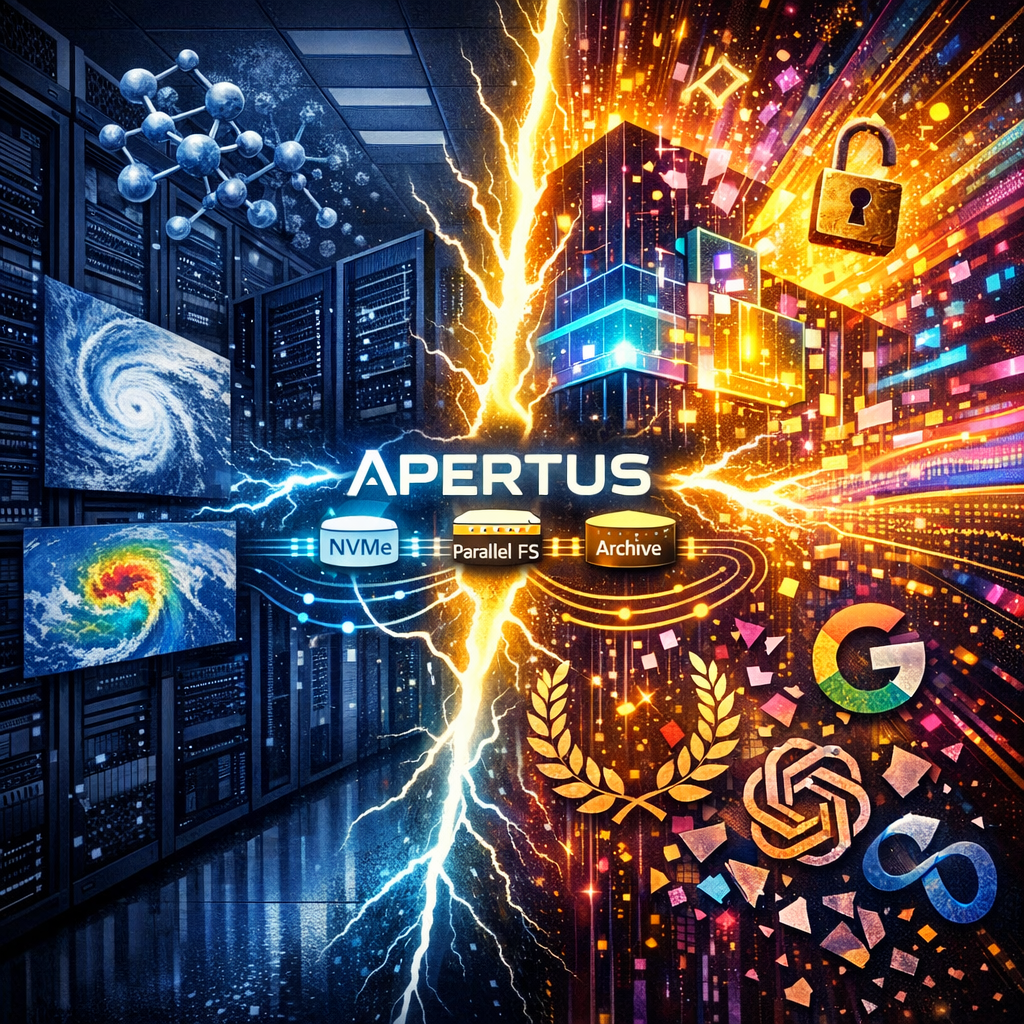
The solution involved multi tier caching strategies. Hot data stayed in NVMe pools close to compute nodes. Warm data lived on parallel filesystems. Cold data remained on archival storage with aggressive prefetching. The team redesigned data loading pipelines to keep GH200 clusters fed without saturating the interconnect.
This matters for your own infrastructure. If you are planning institutional scale training, storage is not an afterthought. It is the bottleneck that will make or break your project.
Interconnect Stabilization: When Network Topology Becomes Everything
Gradient synchronization across thousands of GPUs requires network fabric that does not flinch. The Alps system uses NVIDIA Quantum-2 InfiniBand, but getting stable all-reduce operations at scale required months of tuning.
Interconnect instability manifests in subtle ways. Packet loss triggers retransmissions. Retransmissions create stragglers. Stragglers force the entire cluster to wait. At 70B scale, even 0.1 percent inefficiency compounds into days of wasted training time.
The Apertus team documented extensive NCCL tuning, topology-aware process placement, and custom fault tolerance mechanisms. They could not afford silent corruptions or gradient divergence. Every bit had to be correct, every synchronization had to complete, and the system had to recover from failures without losing weeks of progress.
This is the unglamorous work that papers do not usually discuss. It is also the work that separates successful training runs from expensive failures.
HPC-to-AI Conversion: Rewiring Institutional Infrastructure
Most public sector institutions have HPC resources. Few have AI-optimized infrastructure. The Apertus project proved you can bridge that gap, but it requires deliberate architectural choices.
Software Stack Replacement
Traditional HPC schedulers do not handle GPU elasticity well. The team deployed Kubernetes-based orchestration alongside existing batch systems.
Power and Cooling Recalibration
AI workloads have different thermal profiles than CPU-bound scientific codes. Cooling systems needed adjustment to handle sustained GPU utilization.
Checkpoint Strategy Overhaul
LLM training checkpoints are massive. The team implemented asynchronous checkpointing with compression to minimize training interruptions.
Monitoring Infrastructure
Traditional HPC monitoring focuses on job completion. AI training needs real-time loss curve tracking, gradient health metrics, and early warning systems for divergence.
These conversions are not trivial. They are also far cheaper than building new infrastructure from scratch. For institutions sitting on underutilized HPC capacity, this is your roadmap.
What This Means for Sovereign AI
Apertus proves that public institutions can train frontier models without corporate partnerships or venture capital. That changes everything.
For Universities and Research Institutions
You do not need to wait for industry collaboration. You do not need to license proprietary models with restrictive terms. You can train models aligned with academic values: open weights, open data, and open evaluation.
The fine-tuning workflows become trivial once you control the base model. LoRA and QLoRA adapters let specialized research groups customize models for their domains without retraining from scratch. Your institution becomes a model producer, not just a model consumer.
For Government and Public Sector
Sovereign AI is not just about data privacy. It is about technological independence. When your critical infrastructure depends on models controlled by foreign corporations, you have outsourced your technological sovereignty.
Apertus shows that public sector training is feasible. The economics work if you have access to HPC resources and willing engineering talent. The open-source model releases mean you are not locked into vendor ecosystems.
For Private Institutions Considering Open Source
The public versus private AI debate just shifted. Private companies can no longer claim that only they have the expertise to train large models. Academic teams have proven they can do it with transparency and open collaboration.
This creates pressure on private model releases. If public institutions can train competitive open models, what justifies closed weights? The answer increasingly becomes: nothing except competitive moats that society might not want to accept.
The Fine-Tuning Economy
Once Apertus weights are public, the fine-tuning workflows explode. Researchers worldwide will adapt the base model for domain-specific knowledge, low-resource languages, specialized reasoning tasks, and edge deployment.
This is where sovereign AI becomes practical. You do not need to train a 70B model yourself. You take Apertus, fine-tune it on your data with QLoRA, and deploy it under your control. This allows local agent orchestration or research swarms to function with total data privacy.
The barrier to entry drops from hundreds of millions to thousands of dollars. That is the real revolution.
Engineering Lessons for Your Infrastructure
Start with Storage
Profile your data loading pipelines before you buy GPUs. Measure throughput, not just capacity. Design for 10 times your current needs because you will underestimate.
Invest in Network Expertise
Your machine learning engineers need to understand InfiniBand topology, NCCL parameters, and gradient synchronization patterns. This is not optional at scale.
Plan for Failure
Training runs will fail. Checkpoints will corrupt. Nodes will die. Build recovery mechanisms into your workflow from day one.
Do Not Ignore Monitoring
Loss curves tell you more than GPU utilization. Set up dashboards that track training health, not just hardware status.
The Open Source Model Release Landscape
Apertus joins a growing list of open foundation models. Llama, Mistral, Qwen, and now Apertus prove that open weights are not just community projects. They are competitive with proprietary offerings.
These models come without usage restrictions, without API dependencies, and without the risk of deprecation when corporate priorities shift. Your fine-tuned models remain yours forever. This matters for long term planning. Building production systems on licensed models means accepting someone else's roadmap. Open models let you control your own destiny.
What Comes Next
The Apertus team published their experience on ArXiv. Every institution considering AI sovereignty should study their engineering decisions, their failure modes, and their solutions. Then ask yourself: what is stopping your organization from doing the same?
The answer is not budget. It is not expertise. It is not infrastructure. Those are all solvable problems, and Apertus proved it. The real question is whether your institution values technological independence enough to pursue it.
Building Your Own Path
You are reading this because you care about sovereign AI. Apertus shows the ceiling is higher than we thought. If academics can train a 70B model on public infrastructure, what can you do with focused resources and clear objectives?
Start where you are. Fine-tune open models on your data. Deploy them under your control. Build workflows that do not depend on external providers. Document what you learn and share it. That is how movements grow. The era of Big Tech monopoly on frontier AI is over. The question now is what you will build with your sovereignty.
Get More Articles Like This
Infrastructure-first AI tutorials delivered to your inbox. No fluff, just production patterns that ship.