Alibaba just launched their enterprise AI agent platform, and the tech world is taking notice. They're positioning themselves directly against Nvidia and Meta in the agentic AI space, offering a cloud-based, enterprise-scale solution designed for large organizations that need to deploy AI agents across their infrastructure.
The announcement marks a significant moment in the AI agent ecosystem. We're watching the consolidation of enterprise AI tooling into major cloud platforms, following the same pattern we've seen with machine learning infrastructure, data pipelines, and now agent orchestration.
But here's the thing: at PhantomByte, we've been running our own agent system using OpenClaw for months. We didn't wait for Alibaba or Meta to hand us a platform. We built something that works for our specific needs, and in doing so, we learned a lot about what enterprise-scale agent platforms get right and what they necessarily get wrong.
This article is about that contrast. It's about the trade-offs between scale and control, between convenience and sovereignty, and about the real-world experience of running agent systems in production.
The Enterprise-Scale Approach
Alibaba's new platform is built for one thing: scale. They're targeting large enterprises that need to deploy hundreds or thousands of agents across distributed systems. The architecture is cloud-native, designed to integrate with existing enterprise infrastructure, and optimized for throughput.
This makes sense for their target market. A Fortune 500 company doesn't want to manage individual agent sessions. They want a dashboard, they want metrics, they want the ability to spin up agents on demand and trust that the platform will handle the orchestration.
The platform likely includes:
- Centralized agent management
- Built-in token optimization at the infrastructure level
- Enterprise-grade error handling and failover
- Integration with existing cloud services
- Compliance and audit tooling
These are all good things for enterprises, as they solve real problems for organizations that need to deploy AI at scale. At some point in the near future, this will likely be the goal of most large corporations, as well as small businesses that want to not only survive AI, but thrive because of it.
The OpenClaw Alternative
OpenClaw takes a different approach. It's built for control, not scale. We're not trying to manage thousands of agents, although you certainly can. Instead, we're focused on managing our agents well and creating a system that any individual, small business, or even a large corporation can use to thrive. Why should only large corporations be allowed to have all the fun?
The philosophy is fundamentally different. Instead of abstracting away the complexity, OpenClaw exposes it. You manage sessions explicitly, handle token optimization yourself, and write your own error handling. This isn't a limitation. It's a feature. I look at OpenClaw differently: I view it as the foundation to build on. With this foundation, the building potential is unlimited.
When you're building agent systems for specific use cases, you need to understand what's happening under the hood. You need to know why a session timed out, how tokens are being consumed, and what errors are recoverable versus ones that mean you have to change your approach. You also need to build custom skills, tools, and scripts to meet the demands of your business or personal needs. Build it into something great and it will be great. Build it poorly and it will work poorly too.
OpenClaw gives you that visibility. It doesn't hide the complexity. It gives you the tools to work with it.
Session Management: The Real Difference
Let's talk about session management, because this is where the contrast becomes concrete.
In an enterprise platform like Alibaba's, sessions are abstracted. You start an agent, you stop an agent, you check the status. The platform handles the lifecycle. This is convenient, but it means you're working at a higher level of abstraction.
With OpenClaw, sessions are explicit. You start the gateway daemon. You manage the session state. You poll for status. You handle timeouts. You decide when to background a process and when to wait for completion.
This matters because agent sessions are not uniform. Some tasks complete in seconds. Some take minutes. Some need to run in the background while you do other work. Some need TTY access. Some need to be killed and restarted.
When you're building production agent systems, you need to handle all of these cases. An enterprise platform will give you a simplified interface that works for the common case. OpenClaw gives you the full interface that works for every case.
We've learned to build session management that matches our actual workflow. We background long-running tasks, poll for completion, handle timeouts gracefully, and log session state for debugging. This isn't something the platform does for us. It's something we built because we needed it.
We also use Kimi k2.5 as an orchestrator because it natively spawns up to 100 agents, which allows it to complete multiple tasks simultaneously while staying responsive in chat and leveraging other models in your arsenal as part of its swarm to handle different parts of whatever task it's working on. I will write more about this in a future article.
Token Optimization: Doing It Yourself
Token optimization is another area where the contrast is sharp.
Enterprise platforms handle token optimization at the infrastructure level. They batch requests, they cache responses, they optimize prompt length. This is transparent to the user, which is good for most use cases.
But when you're building custom agent systems, you need to understand token consumption. You need to know which prompts are expensive, when to truncate context, and when to start a new session versus continuing an existing one.
With OpenClaw, we've built our own token optimization layer. We track token usage per session. We implement context truncation when conversations get long. We cache expensive prompts. We make explicit decisions about when to start fresh versus continuing context.
This is more work than using a platform that handles it automatically. But it means we understand our token consumption. We can optimize for our specific use cases. We can make trade-offs that make sense for our workflow. The more efficient we learn to make this, the more people who can benefit from a setup like this.
For example, we've learned that certain agent tasks benefit from fresh sessions rather than extended context. We've learned that some prompts are worth caching and some aren't. We've learned to balance token cost against agent performance, and to be careful about what stored data the agent has access to. Too much of the wrong data can have unintended consequences. Take it from me: I've been there, and you don't want to be me a few weeks ago.
You can't learn this when the platform handles it for you. You learn it by doing it yourself. Not to repeat myself, but when you build it around you, and not around someone else, that's the best way to make it as efficient as possible. Right now, with AI, mistakes can be costly, which is why I write about these things hoping people can learn from our mistakes and the mistakes of others so they don't have to repeat them.
Error Handling: The Hard Part
Error handling is where agent systems separate the production-ready from the experimental.
Enterprise platforms provide built-in error handling. They retry failed requests. They handle rate limits. They provide fallback behavior. This is essential for enterprise deployments where agents need to run reliably.
But built-in error handling is generic. It handles the common cases. It doesn't know your specific failure modes. It doesn't know which errors are recoverable and which mean you need to change your approach.
With OpenClaw, we've built error handling that matches our actual failure modes. We know which errors come from token limits, which errors come from session timeouts, and which errors mean the model is hallucinating versus those that mean the request failed. We've built systems to handle all of this, and I tell you this so you will too.
We've learned to handle these differently:
- Token limit errors mean we need to truncate context or start a new session
- Session timeout errors mean we need to restart the gateway or check the daemon status
- Model errors mean we need to adjust our prompts or switch models
- Network errors mean we need to retry with backoff
This is specific to our setup. An enterprise platform can't know this. They provide generic error handling that works for most cases. We've built specific error handling that works for our cases.
The Trade-Off
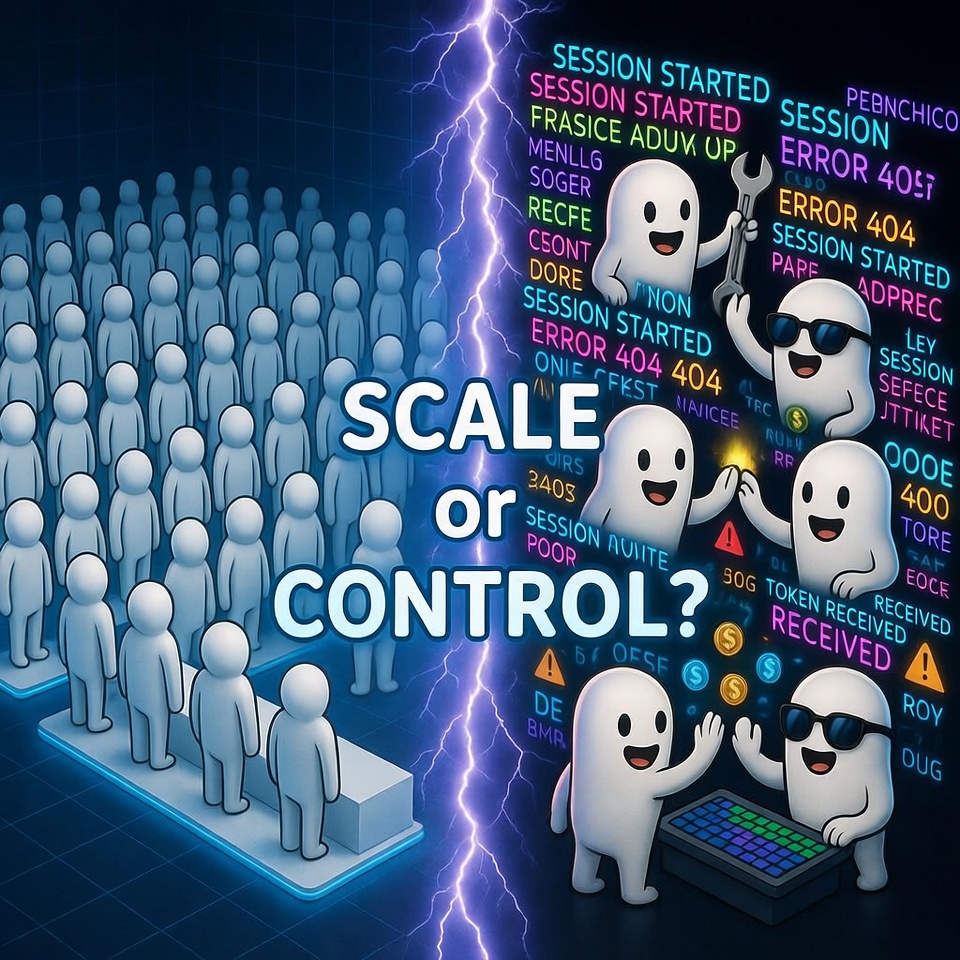
Here's the fundamental trade-off: scale versus control.
Alibaba's platform is built for organizations that need to deploy agents at scale. They want convenience, reliability, and the platform to handle the complexity. This is the right choice for most enterprises.
OpenClaw is built for teams that need to control their agent systems. We want visibility, flexibility, and to understand what's happening under the hood. This is the right choice for teams building custom agent workflows. Simply put, OpenClaw is for EVERYONE, and if it's set up correctly, anyone can afford it.
With that said, I'm not saying one system is better than the other. Neither approach is inherently better. They just solve different problems for different groups of people.
But there's something important about building your own system: you learn. You learn how agents actually work, where the failure modes are, what optimizations matter, and what trade-offs you're willing to make. The best part is you can set up and run OpenClaw completely free.
When you use an enterprise platform, you don't learn these things. The platform handles them for you. That's convenient, but it means you're working at a higher level of abstraction. You don't understand the system the way you would if you built it yourself.
Why We Built Our Own
We built our own agent system with OpenClaw for a few reasons:
- We wanted to understand how agent systems work at the protocol level
- We wanted to optimize for our specific use cases, not generic enterprise needs
- We wanted to control our infrastructure rather than depending on a cloud platform
- We wanted to learn by doing, not by configuring
These reasons might not apply to your team. If you're deploying agents across a large organization, an enterprise platform makes sense. If you're building custom agent workflows for specific tasks, building your own system might make sense.
The key is knowing what you need. Scale or control. Convenience or understanding. Platform or infrastructure.
What Alibaba's Launch Means
Alibaba's launch is significant. It marks the entry of major cloud providers into the agent platform space. This will drive consolidation. It will raise the bar for enterprise tooling. It will make agent deployment more accessible for large organizations.
But it doesn't mean that building your own system is obsolete. It means there's a clear alternative for teams that need scale. It means teams that need control have a clear contrast to point to.
We're watching the agent platform space consolidate around major providers. This is the same pattern we've seen with cloud infrastructure, with data platforms, with ML tooling. The enterprise scale players enter the market, they offer convenience, they capture the enterprise segment.
But there's always a segment that needs control. There's always a segment that wants to understand the system. There's always a segment that values sovereignty over convenience.
OpenClaw serves that segment. It's not competing with Alibaba. It's serving a different need. I like to be in control of my system. I am in control of the system it's running on, how it runs, and it's completely customized around me and my business. It's the difference between wearing a tailored suit and one straight off the rack.
Lessons from Production
After running our OpenClaw setup in production, here's what we've learned:
- Session management matters more than you think. Explicit sessions give you control but require more code.
- Token optimization is a continuous process. You learn by tracking usage and adjusting prompts.
- Error handling is specific to your workflow. Generic handlers work for common cases. Custom handlers work for your cases.
- Building your own system teaches you things platforms can't. You understand the trade-offs because you made them.
- Control has a cost. You spend more time on infrastructure. You get more understanding in return.
These lessons apply whether you're using OpenClaw or an enterprise platform. The difference is how you learn them. With a platform, you learn by reading documentation. With OpenClaw, you learn by building. For me, this is perfect because I love building just as much as I love sharing what I've learned with you.
The Bottom Line
Alibaba's enterprise AI agent platform is a significant launch. It positions them against Nvidia and Meta in the agentic AI space. It offers scale, convenience, and enterprise-grade tooling.
OpenClaw offers something different: control, visibility, and the ability to build custom agent workflows. It's not for everyone. It's for teams that want to understand their agent systems, optimize for their specific needs, and control their infrastructure. As I said earlier, OpenClaw to me is like a tailored suit. It fits perfectly because I built it for me, and I want you to do the same.
We built our own system because we wanted to learn. We wanted to understand how agents work. We wanted to optimize for our use cases. We wanted control over our infrastructure.
Your team might have different needs. That's fine. The point is knowing what you need and choosing accordingly. That's the message I hope you take away from this article.
Scale or control. Platform or infrastructure. Convenience or understanding.
Both approaches are valid. Both serve real needs. The key is choosing the one that matches your team's actual requirements. In my opinion, something interesting would be an OpenClaw system managing an enterprise-level setup. I'm sure something like that isn't too far away. And not to state the obvious, but there should also be a human in the loop.
Side note: This article was written from our experience running OpenClaw in production at PhantomByte. We've been building agent systems for months, and Alibaba's launch gave us a chance to reflect on what we've learned and how our approach compares to the enterprise-scale alternative. We are also interested in their products, especially because we use some of them, as discussed in past articles.
Get More Articles Like This
Getting your AI agent setup right is just the start. I'm documenting every mistake, fix, and lesson learned as I build PhantomByte.
Subscribe to receive updates when we publish new content. No spam, just real lessons from the trenches.