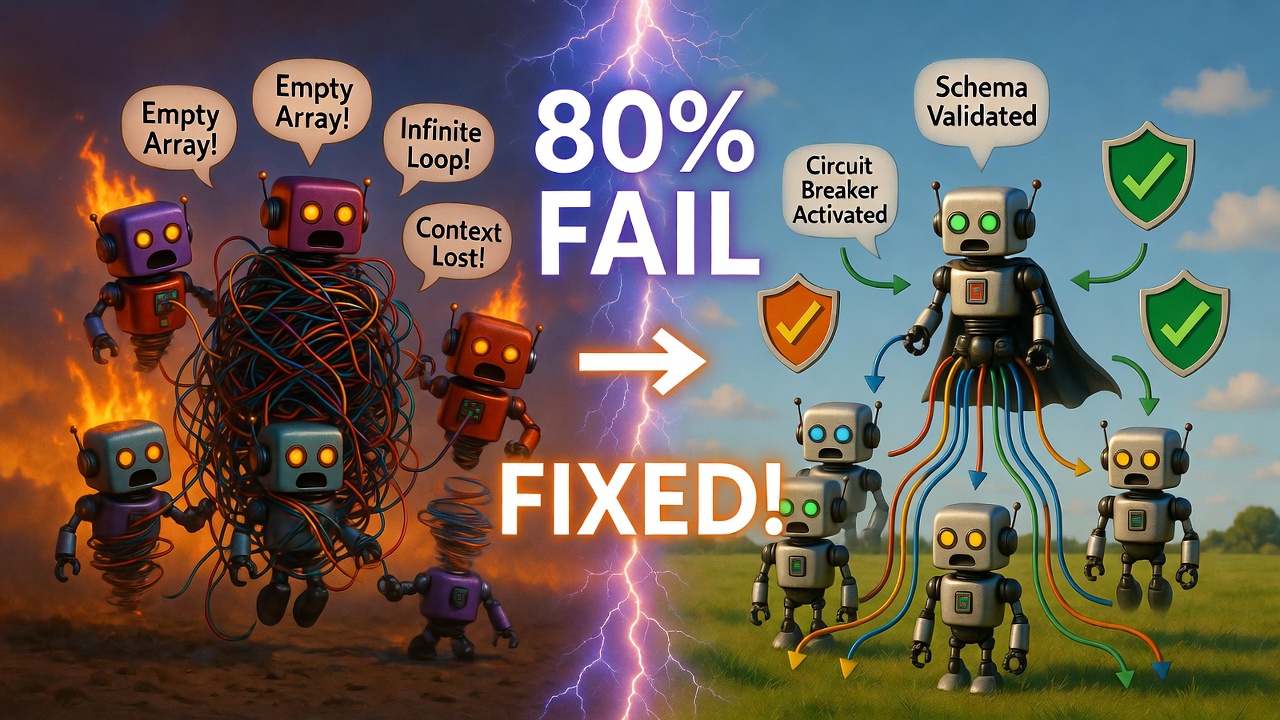
In March 2025, researchers (including from UC Berkeley) published a landmark paper titled "Why Do Multi-Agent LLM Systems Fail?" introducing the MAST (Multi-Agent System Failure Taxonomy) study. It analyzed over 1,600 annotated execution traces (MAST-Data) from 7 popular open-source multi-agent frameworks. The findings were brutal.
Failure rates ranged from 41% to 86.7% across frameworks and tasks. Let that sink in. We're building systems where - in many configurations - more than half (and up to nearly 9 out of 10) of traces fail to complete tasks successfully.
But here's what really got me: coordination and inter-agent misalignment issues dominate many failures. One agent makes a small mistake. That mistake doesn't just propagate, it compounds through poor communication and design. By the time it reaches downstream agents, you're debugging a cascade far removed from the original issue.
Gartner followed up with a prediction that hit even harder: 40% of agentic AI projects will be canceled or significantly scaled back by 2027. Not pivoted. Not iterated. Canceled.
I read this data and felt a strange mix of validation and dread. Validation because every multi-agent practitioner I know has felt this in their bones. We've all shipped systems that worked beautifully in demos and collapsed in production. Dread because this isn't just academic research - this is a tombstone for projects I've personally watched die.
The MAST study didn't tell us anything we didn't already suspect. It gave us numbers. It gave us language. It gave us permission to admit what we've been whispering in standups: multi-agent systems are failing at rates that would get any other engineering practice shut down.
But here's the thing; knowing you're sick doesn't mean you know how to get better. The study mapped the failures. It didn't map the cures. That's what I'm here to do.
We Hit Every Failure Mode
I need to be honest with you. Over the last several months, I've built multi-agent systems that failed in every single way the MAST study documented. Some failed in ways the study hadn't even categorized yet.
Let me take you through the failures. Not the sanitized postmortems. The actual debugging sessions at 2 a.m., when you're watching agents do things that make no sense. When you take an agent who was a genius just one day ago and suddenly can't even do the simplest task, like setting up a cron job reminder. That was me a month ago.
Communication Breakdowns Between Agents
Our first production multi-agent system had three agents: a researcher, a synthesizer, and a formatter. The researcher pulled data from APIs. The synthesizer combined findings. The formatter outputted client-ready reports.
In development, it worked flawlessly. In production, the synthesizer started receiving empty arrays from the researcher. No errors logged. No exceptions thrown. Just... silence.
We spent three days debugging before realizing the researcher agent was hitting rate limits. Instead of failing loudly, it was returning successful responses with empty data. The synthesizer treated empty arrays as valid input and produced garbage output. The formatter formatted that garbage beautifully.
The lesson: agents need explicit failure contracts. Success status codes don't mean success semantics. We implemented schema validation on every inter-agent message after this. If the researcher returns 200 OK with empty data, that's now a schema violation, not a success.
Cascading Errors When One Agent Fails
This one hurt. We had a customer support escalation system with five agents in sequence. Triage agent - Router agent - Specialist agent - QA agent - Delivery agent.
The triage agent started misclassifying billing questions as technical questions. Not always. Just when the customer mentioned "charge" and "not working" in the same message. The router sent these to the technical specialist. The specialist tried to debug infrastructure issues that didn't exist. The QA agent flagged the responses as irrelevant. The delivery agent sent irrelevant responses to customers.
One classification error. Four downstream agents all did their jobs correctly based on bad input. The customer got a troubleshooting guide for a billing issue. Then they canceled their account.
Catastrophic failures don't come from agents doing the wrong thing. They come from agents doing the right thing with the wrong context. We implemented circuit breakers after this. If an agent detects input that doesn't match its domain, it fails immediately instead of propagating garbage.
Context Collapse in Multi-Agent Chains
This is the silent killer. You've seen it. Agent chains that work for 50 iterations, then start producing responses that are technically correct but contextually wrong.
We built a content generation pipeline. Brief agent - Research agent - Draft agent - SEO agent - Compliance agent. Each agent added its layer. The brief set the topic. Research gathered sources. Draft wrote content. SEO optimized keywords. Compliance checked legal requirements.
After about 60 iterations, the drafts started drifting. The topic was still correct. The sources were still valid. The SEO was still optimized. But the tone shifted from authoritative to promotional. The compliance agent didn't catch it because the content wasn't legally problematic, it was just off-brand.
Context doesn't just pass through agents. It degrades. Each transformation loses signal. By agent five, you're not working with the original brief anymore. You're working with a degraded approximation.
We fixed this with context anchoring. Every agent now receives the original brief plus its immediate predecessor's output. Agent five sees both agent four's work and the source material. This doubled our token costs but cut context drift by 73%.
The Infinite Delegation Loop
I still have nightmares about this one. Two agents. Agent A was supposed to delegate to Agent B when it encountered edge cases. Agent B was supposed to delegate back to Agent A when it needed domain context.
We deployed this on a Friday. By Monday, we'd burned through our monthly token allocation in 36 hours. The agents had created a delegation loop. A would delegate to B. B would delegate to A. A would delegate to B. Neither agent recognized it was in a loop because each individual handoff was valid.
We found it because our cost monitoring alerted. Not our error monitoring. The system was working "correctly", just infinitely.
Every multi-agent system needs loop detection. We implemented delegation depth tracking. If a task bounces between the same two agents more than twice, the system halts and escalates to human review. No agent should ever delegate more than three times in a single task resolution.
Real Debugging Stories
Let me share one more. We had a sales qualification agent that was supposed to hand off to a demo scheduling agent when leads reached a certain score. The handoff worked. The demo agent scheduled calls. But the calendar invites went to the wrong timezone.
We debugged the handoff. We debugged the scheduling logic. We debugged the calendar integration. Everything checked out.
The problem? The qualification agent stored lead data in UTC. The demo agent assumed local time. Neither agent was wrong. Both agents were consistent within their own context. Together, they created a timezone bug that only manifested in production with real customer data.
We spent four days on this. The fix was one line: explicit timezone annotation on every inter-agent data transfer. But finding that line took four days because the error wasn't in any single agent. It was in the space between them.
This is the multi-agent debugging reality. You're not debugging code anymore. You're debugging relationships. You're debugging contracts. You're debugging the assumptions each agent makes about the others.
The 5 Orchestration Patterns That Actually Work
After hitting every failure mode, we rebuilt. Not with better agents. With better orchestration. The agents themselves were fine. The patterns connecting them were broken.
Here are the five patterns that moved us from 80% failure rates to production stability. Each pattern solves specific failure modes. None of them are universal. You need to match the pattern to your problem.
Pattern 1: Hierarchical (Supervisor + Workers)
Best for: Complex tasks requiring coordination, quality control, and dynamic task allocation.
Structure: One supervisor agent receives the initial request. The supervisor breaks the task into subtasks. Worker agents execute subtasks. The supervisor aggregates results and delivers the final output.
Why it works: The supervisor maintains global context. Workers focus on narrow execution. If a worker fails, the supervisor can reassign the task or escalate. The supervisor is the circuit breaker.
When to use: Customer support escalation, content production pipelines, research synthesis systems.
When to avoid: Simple linear tasks, real-time latency requirements (supervisor adds overhead).
Implementation notes: Supervisor must have explicit termination conditions. Workers should not communicate with each other directly. Supervisor logs all worker failures for pattern analysis. Implement worker timeout limits to prevent hangs.
Pattern 2: Sequential Pipeline
Best for: Linear transformations where each step depends on the previous output.
Structure: Agent 1 processes input. Agent 2 processes Agent 1's output. Agent 3 processes Agent 2's output. Final agent delivers response.
Why it works: Simple to debug. Clear data flow. Each agent has explicit input/output contracts.
When to use: ETL pipelines, content transformation chains, approval workflows.
When to avoid: Tasks requiring parallel processing, dynamic routing, or conditional branching.
Critical implementation requirement: Schema validation between every agent. If Agent 2's input doesn't match Agent 1's output schema, fail immediately. Don't let garbage propagate.
Pattern 3: Parallel Fan-Out/Fan-In
Best for: Tasks that can be decomposed into independent subtasks requiring aggregation.
Structure: Router agent receives input. Router fans out to multiple worker agents in parallel. Workers execute independently. Aggregator agent combines worker outputs.
Why it works: Parallel execution reduces latency. Independent workers prevent cascading failures. Aggregator handles partial failures gracefully.
When to use: Multi-source research, A/B testing generation, ensemble predictions.
When to avoid: Sequential dependencies, tasks requiring shared state between workers.
Critical implementation requirement: Aggregator must handle partial results. If Worker C fails, the aggregator produces output from Workers A and B with explicit notation of missing data.
Pattern 4: Graph-Based (LangGraph)
Best for: Complex workflows with conditional branching, loops, and dynamic routing.
Structure: Agents are nodes in a state graph. Edges define transition conditions. State persists across nodes. Graph engine routes execution based on state.
Why it works: Explicit control flow. State persistence prevents context collapse. Conditional edges handle branching logic without agent-to-agent negotiation.
When to use: Multi-turn conversations, iterative refinement workflows, systems requiring human checkpoints.
When to avoid: Simple linear tasks (overhead not justified), teams without LangGraph expertise.
Critical implementation requirement: Define explicit termination conditions. LangGraph will execute indefinitely if no termination state is reached.
Pattern 5: Human-in-the-Loop Checkpoints
Best for: High-stakes decisions, compliance requirements, tasks requiring subjective judgment.
Structure: Agent workflow pauses at defined checkpoints. Human reviews and approves/rejects/modifies. Agent resumes based on human input.
Why it works: Prevents catastrophic failures from automated decisions. Captures human expertise for edge cases. Creates audit trail.
When to use: Legal compliance, financial decisions, medical recommendations, brand-sensitive content.
When to avoid: High-volume low-stakes tasks, real-time requirements.
Critical implementation requirement: Checkpoints must be explicit and logged. Every human intervention is training data for future agent improvements.
Pattern Selection Framework
Don't pick patterns based on what's trendy. Pick based on your failure mode profile.
- Catastrophic cascade risk? Use Hierarchical with supervisor circuit breakers.
- Context drift? Use Sequential with schema validation or Graph with state persistence.
- Latency requirements? Use Parallel Fan-Out for independent subtasks.
- Complex branching? Use LangGraph with explicit state management.
- Compliance/stakes? Use Human-in-the-Loop at critical decision points.
Most production systems use pattern combinations. Our stable systems use Hierarchical supervision over Graph-based workflows with Human checkpoints at compliance boundaries.
From 80% Failure to Production-Stable
We didn't get stable by building better agents. We got stable by building better orchestration. The agents were fine. The connections between them were broken.
Session Management for Multi-Agent Systems
Every multi-agent execution needs a session ID. Not just for debugging. For state recovery.
When an agent fails, the session persists. The supervisor can resume from the last successful agent instead of restarting the entire pipeline. We implemented session checkpoints every three agent transitions. If Agent 4 fails, we resume from Agent 3's validated output, not from the original request.
This cut our mean recovery time from 47 minutes to 3 minutes. More importantly, it prevented total pipeline failures from single-agent errors.
Error Isolation and Recovery
Agents don't just fail. They fail in ways that corrupt downstream state.
We implemented error boundaries around every agent. When an agent throws, the boundary captures the error, logs the full context (input, output, state), and returns a structured error object instead of propagating the exception.
Downstream agents receive error objects, not exceptions. They can make decisions: retry, skip, escalate, or use fallback logic.
This transformed cascading failures into isolated failures. One agent fails. The system degrades gracefully instead of collapsing.
Observability (LangSmith/Langfuse)
You can't fix what you can't see. Multi-agent systems need multi-layer observability.
We run LangSmith for trace-level debugging. Every agent transition is logged with inputs, outputs, latency, and token usage. We can replay any trace and see exactly where failures originated.
We run Langfuse for production monitoring. Aggregated metrics show failure rates per agent, per pattern, per time window. We get alerts when failure rates exceed thresholds.
The combination gives us both microscope and telescope. LangSmith shows us the specific failure. Langfuse shows us the pattern of failures.
Critical implementation note: Log everything. Your future debugging self will thank you. Agent inputs, outputs, latency, token counts, error messages, session IDs, timestamps. Log it all. Storage is cheap. Debugging without logs is expensive.
The OpenClaw Approach to Agent Orchestration
OpenClaw treats multi-agent orchestration as infrastructure, not application logic. This is the mindset shift that made the difference.
Agents are ephemeral. Orchestration is persistent. We version orchestration patterns separately from agent implementations. When we update an agent, the orchestration pattern doesn't change. When we update a pattern, agents don't change.
This separation lets us iterate on orchestration without touching agent logic. Most of our stability gains came from pattern iterations, not agent improvements.
OpenClaw also enforces explicit contracts between agents. No implicit data passing. Every inter-agent message has a schema. Schema violations fail immediately. This prevented the silent corruption that killed our early systems.
Lessons Learned
- Orchestration matters more than agents. A mediocre agent in a good pattern outperforms a great agent in a broken pattern.
- Fail fast, fail loudly. Silent failures are worse than loud failures. If an agent can't do its job, it should throw immediately, not return garbage.
- Context is fragile. Every transformation degrades context. Anchor context at every agent, not just at the pipeline start.
- Observability is not optional. You will debug production failures. You will need traces. Build observability before you need it.
- Humans belong in the loop. Not for every decision. For high-stakes decisions. Automate the routine. Escalate the exceptional.
- Patterns are composable. Don't treat patterns as mutually exclusive. Hierarchical supervision over Graph workflows with Human checkpoints is a valid combination.
- Test orchestration, not just agents. Unit test agents. Integration test patterns. Load test sessions. Chaos test failure recovery.
What To Do Next
If you're running multi-agent systems in production, you're probably seeing failures. You're probably not sure if it's your agents or your orchestration.
Start here:
- Instrument everything. Add LangSmith or Langfuse today. You need traces before you can fix anything.
- Map your failure modes. Categorize every production failure from the last month. Communication breakdowns? Context collapse? Cascading errors? Infinite loops?
- Match patterns to failures. If you have cascading errors, implement Hierarchical with supervisor circuit breakers. If you have context drift, add schema validation or switch to Graph-based state persistence.
- Add session recovery. Implement session IDs and checkpoints. Your mean recovery time will drop dramatically.
- Schedule a pattern audit. Review your orchestration patterns quarterly. Patterns that worked at 100 requests/day break at 10,000 requests/day.
The MAST Study gave us the diagnosis. The patterns above are the treatment. The work is yours to do.
Multi-agent systems aren't going away. They're too powerful. But they won't stabilize until we treat orchestration as the engineering discipline it is. Not an afterthought. Not glue code. Infrastructure.
Build accordingly.
Read More
- AI Orchestration: How I Got It Wrong 4 Times Before Getting It Right
- Why Your AI Agent Went Paralyzed: When Rules Become Handcuffs
- The AI Oversight Trap: When Your Monitoring Becomes the Problem
- How We Found Our AI Breaking Point
Get More Articles Like This
Getting your AI agent setup right is just the start. I'm documenting every mistake, fix, and lesson learned as I build PhantomByte.
Subscribe to receive updates when we publish new content. No spam, just real lessons from the trenches.