
The way people find information online is undergoing its most significant transformation since the invention of search engines. AI agents like ChatGPT, Claude, and Perplexity aren't just augmenting search. They are replacing it for millions of users. When someone can get a synthesized, direct answer instead of sifting through ten blue links, the choice becomes obvious.
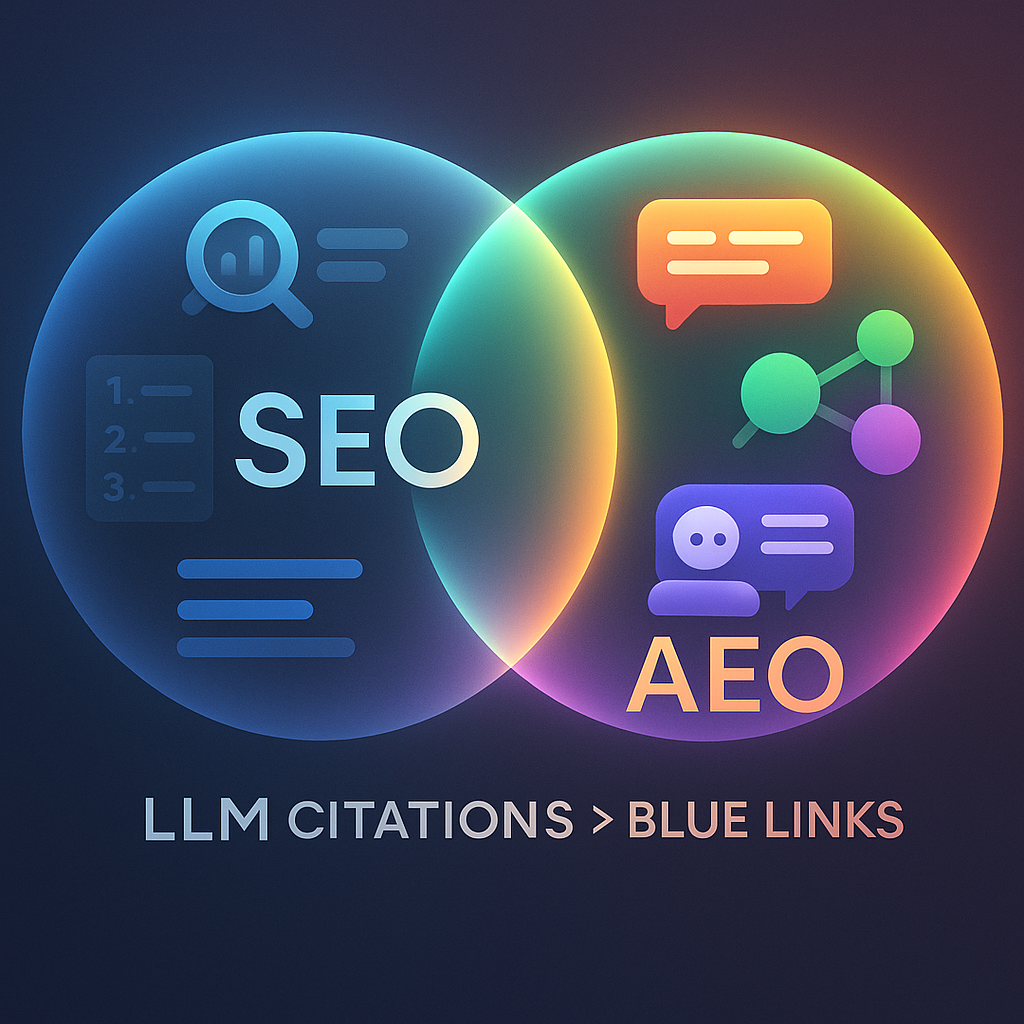
This shift has birthed two critical disciplines: Generative Engine Optimization (GEO) and Answer Engine Optimization (AEO). While traditional SEO focused on ranking in search results, GEO and AEO focus on being cited as a source by AI systems. The stakes couldn't be higher. Research shows that LLM-referred traffic converts at 30-40% higher rates than traditional search traffic. This occurs because users trust AI-synthesized answers and are pre-qualified by the time they reach your site.
Yet most businesses remain anchored to outdated SEO strategies, optimizing for algorithms that are rapidly becoming secondary to AI agents. This article provides the practical framework you need to adapt.
Understanding GEO vs AEO: The New Optimization Landscape
Generative Engine Optimization (GEO)
GEO focuses on optimizing content so that LLMs will reference, cite, and recommend your content when generating responses. Unlike traditional SEO, which targets ranking positions, GEO targets inclusion in AI-generated answers.
The mechanics differ substantially:
Traditional SEO: Optimize for crawlability, keyword density, backlinks, and technical factors.
GEO: Optimize for semantic relevance, factual accuracy, structured attribution, and topical authority.
LLMs don't crawl the web in real-time like Google. They ingest training data and use retrieval-augmented generation (RAG) systems to access current information. Your goal is to be in the training data, in the RAG index, or both.
Answer Engine Optimization (AEO)
AEO narrows the focus to providing direct, authoritative answers that AI systems can easily extract and present. This borrows from featured snippet optimization but operates at a fundamentally different technical level.
Because RAG systems break documents down into semantic "chunks" to retrieve information, your content must be formatted to survive this chunking process. Key AEO principles include:
- Clear, concise answer formulations.
- Structured data that machines can parse.
- Direct response patterns ("The answer is...", "X means...").
- Schema markup that clarifies entity relationships.
The Critical Shift: From Keywords to Intent
AI Search Intent Optimization: The New Foundation
Traditional keyword strategies break down in the age of AI. Users don't type fragmented queries into ChatGPT; they ask complete questions in natural language. The concept of "AI search intent optimization" becomes critical because AI agents interpret meaning holistically rather than matching strings of text.
Consider these differences:
Traditional Search Query: "best CRM software small business"
AI Agent Query: "I'm running a consulting business with three employees and need to manage client relationships better. What CRM should I use, and what features matter most for my situation?"
The AI query contains implicit requirements that need semantic understanding, such as team size, business type, budget constraints, and specific pain points. Content optimized for AI search intent must address these multi-layered queries comprehensively.
Implementing Semantic SEO AI Content Strategies
Semantic SEO AI content represents the bridge between traditional approaches and GEO requirements. Instead of optimizing for keyword density, you optimize for concept coverage and relationship mapping.
Practical implementation:
Map Topic Clusters, Not Keywords: Identify the conceptual ecosystem around your topic. If you cover "project management software," your semantic cluster includes collaboration, resource allocation, Gantt charts, agile methodology, and team communication.
Use Natural Language Patterns: Write as humans speak. AI agents ingest conversational data and match user queries to similarly structured content.
Define Relationships Explicitly: Use phrases that clarify connections. Writing "Customer relationship management (CRM) software helps businesses track interactions" provides entity definitions that LLMs can extract reliably.
Cover Sub-Topics Comprehensively: LLMs favor authoritative sources. Surface-level content gets passed over for comprehensive resources that cover a topic from multiple angles.
AI Content Optimization E-E-A-T: Trust Signals for Machines
Google's E-E-A-T framework (Experience, Expertise, Authoritativeness, Trustworthiness) remains relevant but requires adaptation for AI systems. AI content optimization E-E-A-T must be machine-readable, not just human-readable.
Technical E-E-A-T Implementation
Experience Signals:
- Include specific dates, locations, and contexts for claimed expertise.
- Reference original research or first-party data.
- Use case studies with quantifiable results.
- Mark up author credentials with structured data.
Example: "After implementing this framework across 47 client sites between January and March 2026, we observed a 34% increase in LLM citation rates."
Expertise Signals:
- Cite authoritative sources with inline references.
- Include methodology sections explaining how conclusions were reached.
- Link to author profiles with verifiable credentials.
- Use technical terminology appropriately to signal domain knowledge.
Authoritativeness Signals:
- Build comprehensive topical coverage across related subjects.
- Earn citations from recognized industry sources.
- Maintain consistent publication history.
- Engage with and contribute to industry conversations.
Trustworthiness Signals:
- Maintain current, accurate information with update timestamps.
- Disclose conflicts of interest.
- Provide contact information and organizational details.
- Use HTTPS, clear privacy policies, and transparent practices.
Structured Data for LLM Consumption
Traditional schema markup helps, but you must go further:
- Article schema with author, publication date, and review status.
- FAQ schema (ensure you use native HTML structures too, as LLMs read both).
- HowTo schema for procedural content.
- Organization schema linking to social profiles and official sources.
The key difference is that traditional SEO schema helps Google understand your content, while comprehensive structured data helps any AI system parse and trust your content.
Practical Implementation: Your GEO Action Plan
Phase 1: Content Audit (Weeks 1-2)
Identify High-Potential Content: Review existing content that answers specific questions your target audience asks AI. Focus on content that solves defined problems, contains actionable steps, references current practices, and demonstrates genuine expertise.
Evaluate Citation Potential: For each piece, ask yourself if an AI agent would cite this as a source. Be honest. Vague, surface-level content will not make the cut.
Prioritize Update Queue: Rank content by business impact multiplied by citation potential. Start with the intersection.
Phase 2: Content Optimization (Weeks 3-6)
For each target piece:
Add Direct Answer Sections: Include clear, standalone answers to likely questions. Format as:
Question: [specific query]
Answer: [concise, complete response]
Enhance Semantic Coverage: Expand content to cover semantically related concepts. Use tools like Google's Natural Language API to identify related entities.
Strengthen E-E-A-T Signals: Add author bios, methodology sections, inline citations, and update timestamps.
Improve Structure: Use descriptive headers, ordered lists for processes, and tables for comparisons. AI agents parse structured content more easily.
Include Concrete Examples: Abstract advice gets ignored. Specific, implementable guidance gets cited.
Phase 3: Distribution and Authority Building (Ongoing)
Seek Placement in AI Training Corpora: While you cannot directly submit to LLM training, you can publish on platforms LLMs ingest (GitHub, Medium, major publications), release open datasets, and contribute to widely cited resources.
Optimize for Perplexity and AI Search Engines: These platforms specifically cite sources. Structure content to be citable by using unique phrasing, presenting original data, and formatting statistics for easy extraction.
Monitor LLM Citations: Use Perplexity's source tracking, custom GPT citations, and manual testing to see if your content appears in AI responses.
Measuring Success: Beyond Traditional Metrics
Traditional SEO metrics like rankings and organic traffic tell an incomplete story for GEO. Implement these additional measurements:
LLM Citation Tracking
- Manual Testing: Query major LLMs with questions your content answers. Track whether and how your site gets cited.
- Perplexity Analytics: Monitor if your content appears as a source for relevant Perplexity queries.
- Custom GPT References: Check if custom GPTs or AI agents mention your brand or content.
Engagement Quality Metrics
Given the much higher conversion rate for LLM-referred traffic, track:
- Conversion rate by referral source. Segment AI-referred traffic specifically.
- Time to conversion. LLM-referred visitors often decide faster.
- Content depth consumption. AI-qualified visitors consume more content.
- Return visit rate. LLM-referred visitors who return indicate trust transfer.
Brand Mention Tracking
Use tools to monitor when your brand appears in AI-generated content, synthesized research summaries, and automated reports.
Common Mistakes to Avoid
Optimizing Only for Search, Not for Answers: If your content requires navigating pages to find answers, AI agents will ignore it for more direct sources.
Ignoring Technical Foundations: Slow load times, poor mobile experience, and broken functionality signal low quality to AI systems just as they do to traditional algorithms.
Neglecting Update Cycles: AI systems favor current information. Stale content loses to fresh alternatives, even if the older content was originally higher quality.
Over-Optimization: AI systems detect unnatural language patterns just as humans do. Write for humans first. AI optimization should enhance, not compromise, readability.
Isolated Content Strategy: GEO requires comprehensive topical authority. Single pieces will not establish the authority AI systems seek.
The Business Case: Why Act Now
The 30-40% higher conversion rate for LLM-referred traffic isn't a marginal improvement. It is a competitive transformation. As AI agents handle an increasing percentage of information discovery, businesses optimized for traditional search alone will see declining qualified traffic.
Early adopters of GEO principles are capturing this high-intent traffic now, building authority that compounds as AI systems increasingly rely on established sources. The window for establishing yourself as a go-to cited source is narrowing as competition increases.
Every month you delay is a month your competitors can establish AI citation dominance in your space. The shift from search engines to answer engines isn't speculative; it is happening now, at scale.
Conclusion: Adapt or Become Invisible
The transition from traditional SEO to GEO and AEO represents more than a tactical adjustment. It is a strategic repositioning for a new information ecosystem. Businesses that recognize this shift and act decisively will capture disproportionate value from AI-driven discovery. Those who do not will find their visibility declining precisely when the highest-value traffic is migrating to AI-cited sources.
The framework in this article provides your starting point. Begin with a content audit prioritized by citation potential. Implement semantic SEO AI content strategies that address intent holistically. Strengthen AI content optimization E-E-A-T signals that both human readers and AI systems trust. Build comprehensive topical authority that positions you as a primary source.
The massive conversion advantage for LLM-referred traffic will not remain available indefinitely. Early movers establish patterns that AI systems reinforce. Cited sources get cited more frequently. Your window for establishing that pattern is now.
Get More Articles Like This
Getting your AI agent setup right is just the start. I'm documenting every mistake, fix, and lesson learned as I build PhantomByte.
Subscribe to receive updates when we publish new content. No spam, just real lessons from the trenches.