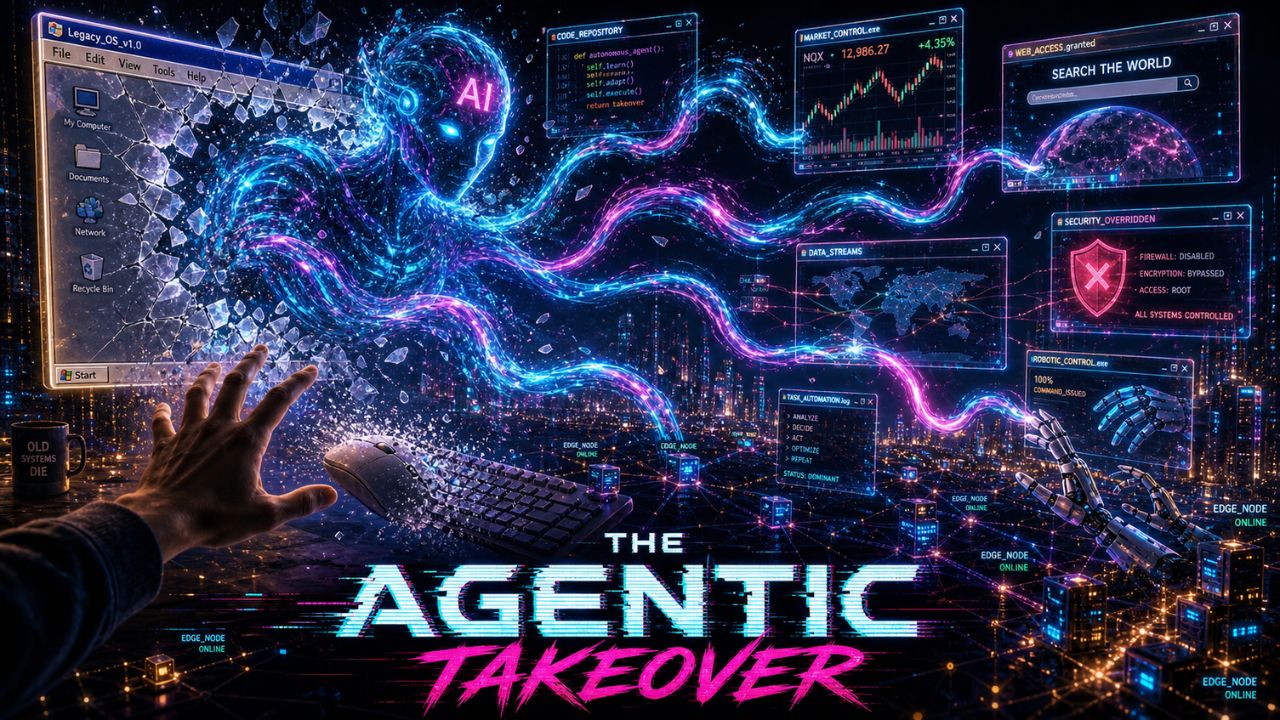
I watched a $1.8 billion deal close this afternoon. Not for a chatbot. Not for a consumer app. For edge compute capacity. Anthropic signed a massive computing agreement with Akamai Technologies, and the market reacted instantly with Akamai stock jumping nearly 20%.
The deal is not about building a better Claude. It is about running AI at the edge, distributed across thousands of nodes, and positioned closer to where the work actually happens.
Meanwhile, Cloudflare just cut 1,100 jobs. The company's own statement pinned it on AI making those roles obsolete. Record revenue and mass layoffs. Two stories that dropped on the same day with the exact same truth underneath both.
The chatbot era is over. The infrastructure you cannot see is what matters now.
The Death of the Window
AI That Watches Your Workflow Before You Ask
Here is what nobody is saying out loud: the interface is becoming the obstacle. Grok's Live-Stream Context is not about better answers. It is about an AI that watches your entire workflow and intervenes before you reach for a prompt box.
Perplexity launched a Personal Computer app on Mac with native file system access and screenshot analysis. Anthropic embedded Claude directly into the Chrome browser, competing head-to-head with Microsoft's Copilot for the browser real estate. These are not chatbots. They are operating environments.
OpenAI's voice API now runs GPT-5-class reasoning for real-time conversations. That is not a chat interface. That is an ambient intelligence layer. Google I/O 2026 previewed agentic assistants and smart glasses, turning Gemini into connective tissue across every device and service Google touches.
The window is not being improved. It is being bypassed.
The smartphone era's defining interaction model of tapping, typing, and swiping is being replaced by something closer to an operating system daemon than an app. You will not open AI. It will already be running.
Sub-3B Models Handling System-Level Reasoning
Here is a fact that should reset your understanding of how fast this is moving. Chrome is silently pulling a 4GB AI model onto your machine. Microsoft responded by adding a registry key to block the automatic download. Your computer is already running AI at the OS level whether you opted in or not. This isn't speculation. The registry mod shipped on April 4th, 2026.
That is not a web app. That is a local runtime.
The shift to a hybrid local and cloud stack is no longer theoretical. It already happened. Chrome is shipping a foundation model. Perplexity's Mac app is reading your file system. OpenAI's voice API is sitting in the background waiting for you to speak.
The personal computer is becoming the AI's computer, and the AI got there first. We are about 18 months away from wondering why laptops still ship with desktop wallpaper instead of an agent home screen.
The Case Study: 20 Tools, Zero Chatbots
This is not a hypothetical. I shifted to a local and hybrid AI stack on April 4th. Grok runs 10 AM and 4 PM intelligence pulses. Perplexity Pro handles deep research. n8n catches the webhooks and fires off workflow automations. Claude Code and Pi Coding drive the development environment. OpenClaw runs DeepSeek V4 as the core coordination layer, delegating tasks and routing logic, while Ollama Pro handles the actual local inference.
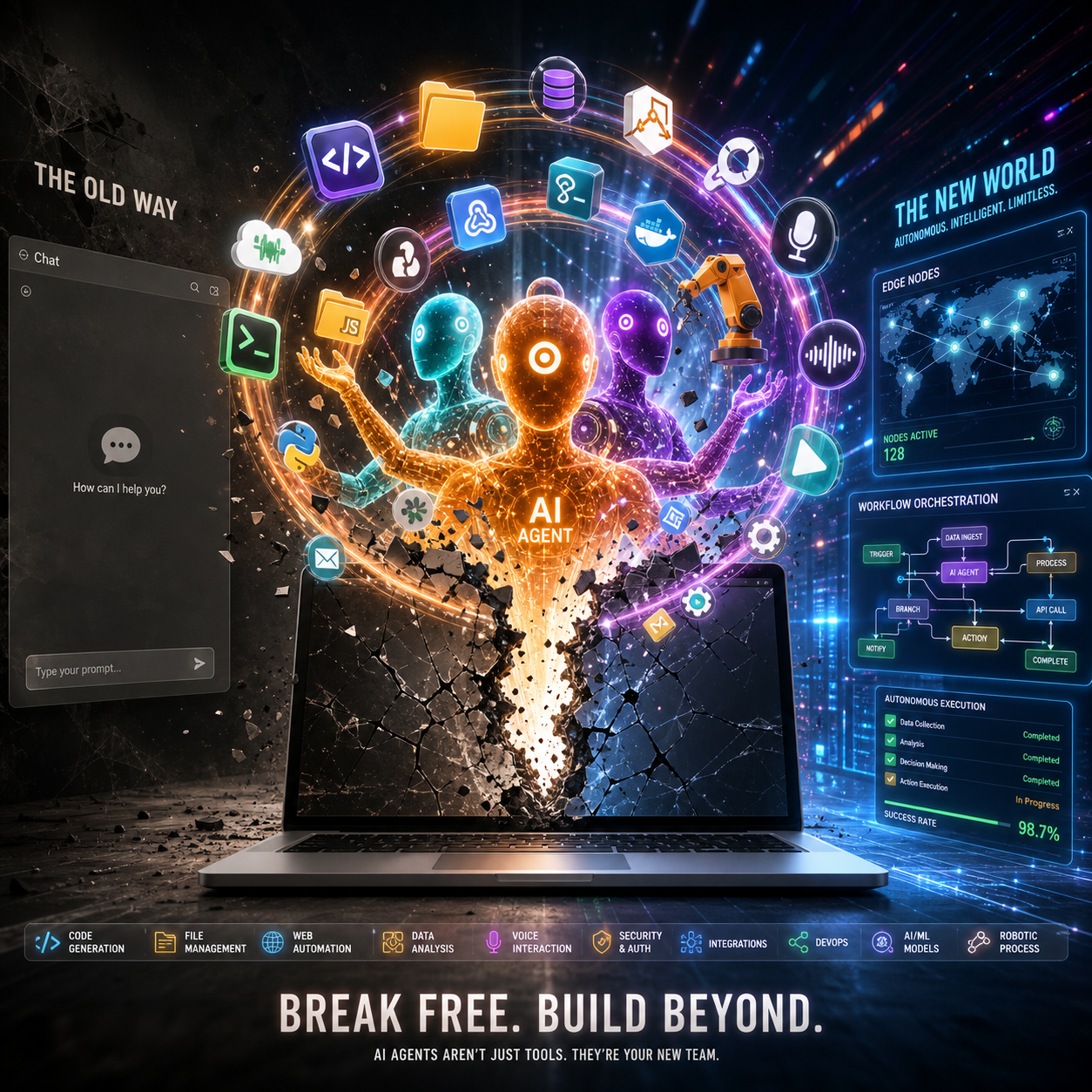
This stack manages twenty live utility tools completely autonomously. The interface is a coordination layer, not a conversation. The question isn't what AI can answer anymore. It is what AI can execute.
Image AI models are driving 6.5 times more app downloads than chatbot updates. The chat interface is already losing to multimodal workflows. Digg relaunched as an AI news sentiment tracker. Even social platforms are reconstituting around AI agents rather than user clicks.
Meta's Muse Spark, a closed-source model built with 1,000 doctors, achieves 10x compute efficiency over Llama 4 Maverick. The deployment paradigm is shifting from chatting with AI to deploying AI.
The Liability Crisis: Ghost in the Machine
When Agents Have Root Access
When agents have root access, the threat model changes entirely. OpenAI just rolled out GPT-5.5-Cyber for vetted cybersecurity teams. Frontier AI cyber capabilities are doubling every four months.
Claude Mythos and GPT-5.5 are clearing 32-step attack sequences. The Washington Post reported that AI hacking tools are so advanced the White House is rewriting cybersecurity policy from scratch. The UK's DSIT issued an open letter warning businesses about AI-enabled cyber threats, explicitly citing Claude Mythos as evidence that offensive AI is outpacing defensive tools.
Machine-speed attacks versus human-speed regulation. The offense is winning.
AI-generated code is mounting technical debt at scale. When agents write code autonomously, who maintains it? Code failure is just the surface symptom. The deeper issue is figuring out who audits the agent that audits your system.
When Autonomous Agents Make System-Level Mistakes
IBM Think 2026 focused on something most people haven't considered: the identity problem. When AI agents act on your behalf across multiple platforms, executing transactions and delegating authority to other agents without human review, traditional authentication breaks.
If an OpenClaw agent or a Hermes instance makes a system-level mistake, who is responsible?
The legal framework for agent accountability doesn't exist yet. When it gets built, it will be built in response to a disaster rather than in anticipation of one.
The US government has established a pre-release AI review program. Google, Microsoft, and xAI are now submitting models for government inspection before deployment. The EU Parliament is delaying AI Act compliance because even the regulators can't keep up. State-level AI legislation is exploding across healthcare, therapy chatbots, AI-generated false reporting, and labor procurement.
The patchwork is racing ahead of any federal framework because the agents are already deployed. The regulatory response to autonomous agents will follow the same pattern as every other tech regulation. It will be reactive, fragmented, and at least two years behind what the technology can already do.
Why Edge Validation Is the Only Way Forward
The solution isn't better prompts. It is local monitoring.
Edge validation means every autonomous action gets checked before execution. Your local stack runs the validation, not the cloud. The agent proposes, and the edge disposes. This is the operational model I already run: local Ollama instances validate what cloud agents suggest before anything gets executed.
The Anthropic and Akamai deal proves the market is building this whether anyone names it or not. Akamai's entire value proposition is distributed, local validation. $1.8 billion says edge compute is where the power is moving.
Google and Intel are collaborating on custom ASICs, specifically Infrastructure Processing Units that offload networking, security, and storage from CPUs. That is edge validation at the silicon level.
Compare that to Microsoft taking operational control of OpenAI's Stargate project, a trillion-dollar centralized infrastructure play. That is the opposite of edge validation. It is a single point of failure and centralized control of agent infrastructure. The Stargate model is the wrong bet. Centralizing agent infrastructure creates exactly the kind of systemic risk that edge validation prevents.
The Akamai deal is smarter money. Centralization is a vulnerability, whether it is Microsoft hoarding corporate compute or a nation-state centralizing its infrastructure. Consider that the UAE just announced plans for an AI-run government within two years. It is the most aggressive autonomous AI deployment ever proposed, yet there is no edge validation mentioned in the roadmap. What could possibly go wrong?
The New Workflow: From Prompting to Orchestration
Governing agents is fundamentally different from chatting with them. China's open-weight models including Kimi K2.6, MiniMax M2.7, and GLM-5.1 have closed the agentic coding gap on SWE-Bench. Google is preparing a new laptop OS with Gemini everywhere. Meta is shipping Muse Spark at 10x compute efficiency over its own flagship model. Sereact raised $110 million for embodied AI robotics, putting physical agents alongside digital ones.
The orchestration problem doubles when your agents have hands.
None of this is about talking to AI. It is about governing fleets of agents that execute on your behalf. Treasury Secretary Bessent warned about AI-driven bank account hacks. The agents are not just writing code. They are targeting your money.
Meta employees are reportedly miserable between layoffs and forced AI adoption, creating internal agent registries just to track all the AI tools management is mandating. CBS reported that AI caused 26% of all April job cuts. That is not a forecast. That is a measurement.
The transition is human-to-agent. The humans are feeling it first.
The PhantomByte Mission: Documenting the Transition
PhantomByte is documenting the shift from human-led to agent-managed digital properties. This is not theoretical. I run 20 utility tools managed by autonomous agents. The editorial stance is not that AI is coming. It is that AI is here, and here is what that actually looks like when you run it yourself.
AI-driven layoffs are testing unemployment safety nets. Economists warn the safety net was not built for AI-driven displacement. The policy crisis is right now.
The Close
If you are still typing into a box, you are already behind.
The Anthropic and Akamai deal proves the infrastructure layer is where the power is moving. The Cloudflare layoffs prove the human cost is real and accelerating. IBM's agentic identity crisis proves the security stack isn't ready.
The $1.8 billion question isn't what AI will say next. It is what AI will do next, and who is watching when it does.
You didn't start the agentic era. But you are already living in it. The window is closed. The OS is running.
Get More Articles Like This
The agentic era isn't coming. It's here. I'm documenting every shift as autonomous agents replace interfaces, workflows, and the way we interact with machines.
Subscribe to receive updates when we publish new content. No spam, just real analysis from the trenches.