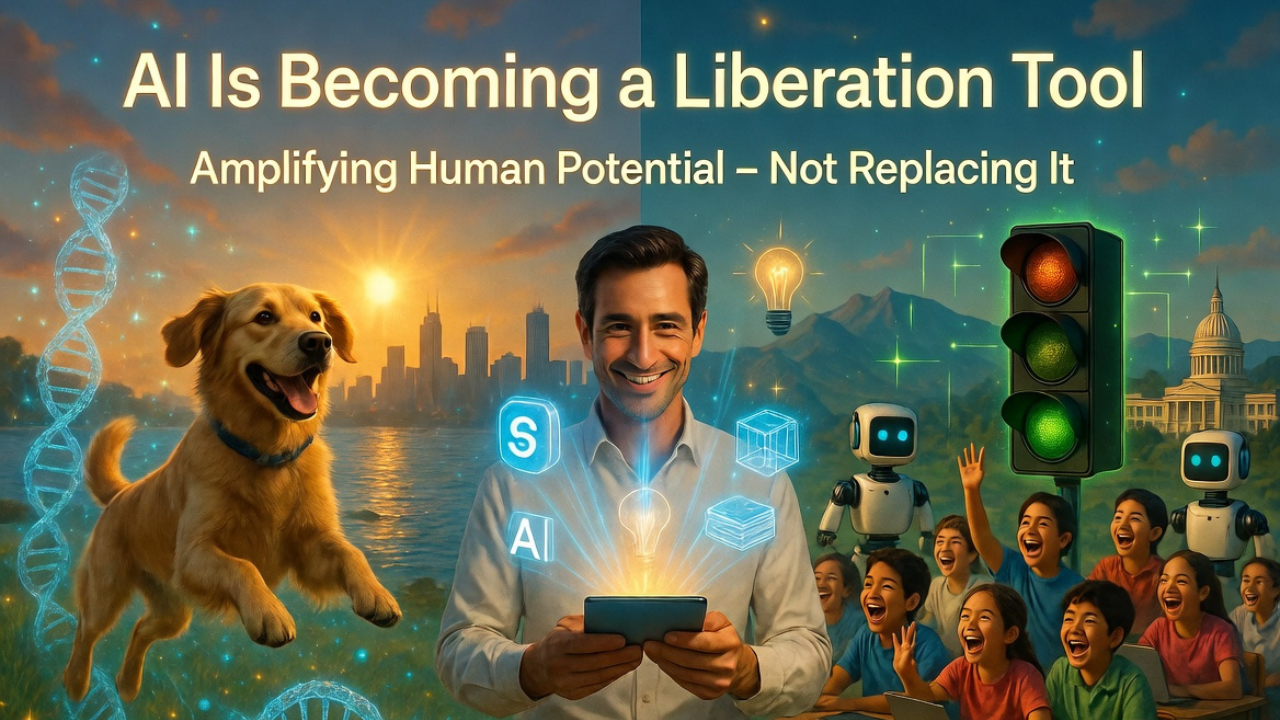
For months, the headlines have been relentless. AI is coming for white-collar jobs. Tech CEOs are "scaring the bejeezus" out of America. The approval ratings tell the story: 26% of Americans have a favorable view of the AI industry, less than half the support for ICE. The narrative is locked in place, and it is almost uniformly dark.
But here is what I keep coming back to: every doom narrative has a counter-narrative. It just does not make the front page.
Two themes dominate the headlines today. First, AI is being pushed deeper into real products and infrastructure, browsers, security tools, defense systems, video software. Second, the market is tightening around enterprise value, governance, and security rather than novelty. That is why stories about federal policy, cyber risk, and OpenAI's retrenchment command so much attention.
Personally? I think AI is the very thing that frees the people of the world. And March 2026 was the month that proved it.
In the span of ten days, two stories dropped that perfectly capture what AI looks like when it is deployed for human flourishing, not cost reduction. One is about a dog who would not die. The other is about a state that decided its children should not just survive the AI era but understand it.
Both stories share a common trait that Silicon Valley forgot to advertise: AI as liberation, not replacement.
The Dog That Would Not Die
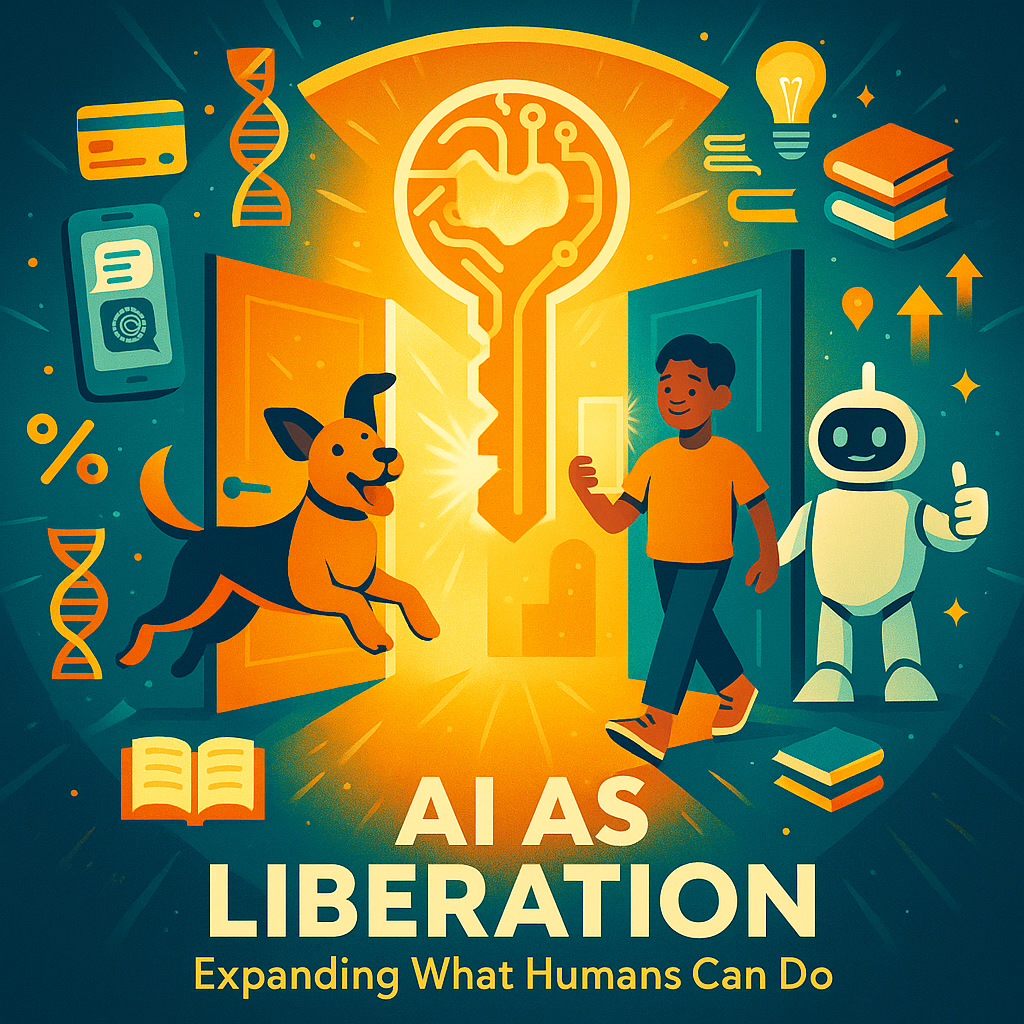
Paul Conyngham is a Sydney tech entrepreneur. In 2024, his rescue dog Rosie was diagnosed with terminal cancer. Chemotherapy failed. The veterinary oncologists told him what they always tell you at the end: make her comfortable. The timeline was months, not years.
Conyngham did something that would have been impossible ten years ago. He sequenced Rosie's tumor DNA, uploaded the data to ChatGPT, and used it to map out a research strategy and analyze the genetic profile. From there, he brought the data to Google AlphaFold, which identified the mutated proteins and predicted three-dimensional configurations that could trigger an immune response. He then worked with scientists at UNSW's Ramaciotti Centre to synthesize a custom mRNA vaccine.
The tumors shrank 50 to 75%.
Rosie is alive today because her owner treated consumer AI tools as research partners, not chatbots. The cost of this kind of personalized medicine used to require a pharmaceutical company's budget and a decade of trials. Conyngham did it in months with publicly available tools and a credit card.
This is what I mean by liberation. AI did not replace Paul Conyngham's judgment, it amplified his agency. He was not supposed to be able to do this. The expertise required to develop a cancer vaccine was supposed to be locked behind decades of education, institutional access, and capital. Instead, it was available to anyone curious enough to try.
The Fortune article broke this story on March 15. By March 16, it was everywhere: People, the New York Post, NBC News. What struck me was not just the feel-good nature of the story. It was the technical scaffolding underneath. This was not a stunt. It was not a publicity play. It was a demonstration that the capability gradient between "pharmaceutical researcher" and "tech-savvy person with AI tools" is flattening faster than anyone predicted.
Idaho's Bold Experiment
Three days later, a different kind of story emerged from Boise.
Idaho Senate Bill 1227, the Artificial Intelligence in Education Act, passed the state Senate. It is now heading to the House. If it passes, Idaho will become one of the first states to mandate a comprehensive, statewide framework for AI education in public schools.
The bill gives the Idaho Department of Education until July 1, 2026 to develop guidelines for responsible generative AI use in K-12 classrooms. The framework must include AI literacy standards for students, professional development for educators, and procurement standards for AI tools. Districts must adopt their own policies by the same deadline.
What makes Idaho's approach interesting is not the mandate itself. It is the philosophy embedded in the language. The bill emphasizes "human-centered oversight," the idea that AI should support, not replace, teacher judgment. It requires compliance with FERPA and COPPA, data security provisions, and transparency about when AI tools are being used.
This is not a bill about keeping AI out of schools. It is a bill about bringing AI into schools thoughtfully.
I have been watching the education policy space closely, and Idaho's move is part of a broader pattern that started accelerating in late 2025. In July 2026, Ohio's law requiring district-level AI policies kicks in, which would technically put it ahead of Idaho if SB 1227 clears the House in time, though Idaho's framework is more comprehensive. According to state AI policy tracking data, as of March 2026, 33 states have official K-12 AI guidance, and 45 states introduced AI-related legislation in 2025.
But Idaho distinguishes itself with that phrase: "human-centered oversight." It is the same principle embedded in the most effective AI systems being built today. AI as infrastructure for human capability, not a replacement for human judgment.
The same week Idaho moved its bill forward, New York City unveiled its "traffic light" AI framework for schools: green for approved uses, yellow for proceed with caution, red for prohibited applications. LSU launched Louisiana's first AI Bachelor's degree with a three-year accelerated track designed to get students into high-earning AI engineering roles faster and with less debt. Massachusetts rolled out GrantWell, an AI tool helping smaller cities and towns navigate federal grant applications they previously lacked the capacity to pursue.
The pattern is unmistakable. States and cities are not waiting for federal guidance. They are treating AI literacy as a prerequisite for workforce participation, the same way we treat reading and math.
The Pattern: Three Traits of Liberation AI
Stepping back from these stories, I see three consistent traits that define what I am calling "liberation AI": systems that expand human capability rather than constrain it.
First: accessibility wins. Paul Conyngham did not need a research grant or institutional affiliation. He needed curiosity, $20 a month for ChatGPT Plus, and the willingness to try. The Massachusetts cities using GrantWell do not need dedicated grant writers. They need AI tools that democratize access to processes that previously required specialized expertise.
Second: preventative or augmentative, not purely replacement-focused. The Idaho framework does not propose AI teachers. It proposes AI as a tool teachers use. Rosie was not replaced by an AI veterinarian. She was saved by a human who used AI to do what humans could not previously do alone.
Third: democratized expertise. What used to require PhDs now requires curiosity. The knowledge gradient that kept advanced cancer treatment, grant writing, and AI engineering locked behind credentials and capital is flattening. This is not a bug. This is the point.
There is a line I keep returning to from the LSU announcement: "Energy, petrochemical, health care, defense and logistics employers in the state are actively integrating AI." The curriculum is designed around real workforce needs, not abstract theory. Students will graduate capable of deploying AI systems, not just talking about them.
That is liberation in practice.
What March Means for the Future
I want to be clear about something. I am not naive about the risks. We have written extensively about AI agent paralysis, context window degradation, and the oversight traps that destroy production systems. The doom narratives are not wrong about everything. They are just incomplete.
The stories from March 2026 matter because they represent a narrative flip. For two years, the AI conversation has been dominated by fear: job displacement, existential risk, corporate consolidation. Those concerns are real and worth addressing. But they are not the whole story.
The whole story includes a tech entrepreneur who outmaneuvered cancer with consumer tools. It includes a state legislature treating AI literacy as basic infrastructure. It includes city governments accessing funding they could never before pursue, and university systems reshaping curricula to reduce debt and accelerate workforce entry.
These are not science fiction scenarios. They happened in the last thirty days.
If you are building AI systems, the practical takeaway is this: the demand for liberation AI is about to outpace the demand for replacement AI. Enterprises will still want cost reduction, but consumers and public institutions are increasingly asking a different question. Not "what can AI do instead of humans?" but "what can humans now do because of AI?"
That is the question we have been chasing at PhantomByte. It is why we built multi-agent orchestration systems that augment human judgment rather than bypass it. It is why we focus on context management and oversight patterns that keep humans in the loop, not as a compliance checkbox, but as a design principle.
The dog lived. The bill passed. The tools are here.
The question is what we build with them.
Get More Articles Like This
Getting your AI agent setup right is just the start. I'm documenting every mistake, fix, and lesson learned as I build PhantomByte.
Subscribe to receive updates when we publish new content. No spam, just real lessons from the trenches.