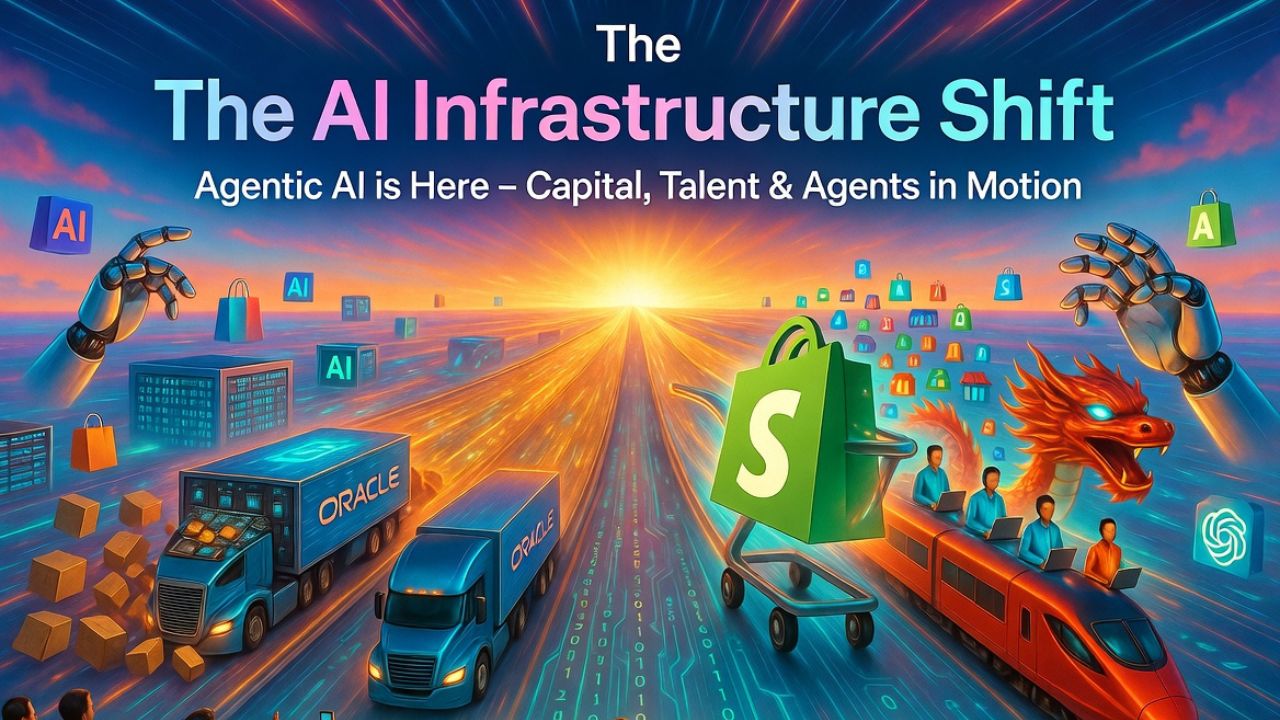
I have been saying it for months, and I will say it again: the true era of agentic AI is already here. It did not arrive in the sci-fi, terminator sense that keeps people up at night. Instead, it manifested in a quiet, structural way that changes everything without asking permission.
This week proved me right.
If you have been following AI news today, you have seen the headlines stacking up like dominoes. China just locked down 50% of the world's top AI research talent. Oracle slashed 18% of its workforce, meaning thousands of people were gone overnight, to free up $10 billion for AI data centers. Shopify flipped a switch and suddenly 5.6 million merchants are discoverable directly inside ChatGPT. Waymo also landed its fourth major airport expansion.
These are not isolated stories. They are coordinates on the same map. What we are witnessing is a massive resource reallocation happening in real time. Capital, talent, infrastructure, and attention are all flowing toward AI with a velocity I have not seen since the internet boom of the late 90s. Except this time, the stakes are higher and the timeline is compressed.
The AI era is not coming. It is restructuring everything right now. Nations and corporations are betting everything on AI today, rather than next year or in five years. The land grab is happening, and if you are not paying attention, you are going to wake up in a world that was built without your input.
The Global Talent Realignment
Let me start with the number that kept me up last night. By 2025, China will account for half of the world's top AI researchers, which is up from 29% in 2019. Meanwhile, the US share has fallen from 20% to 12%. These are not projections from a think tank trying to get press coverage. These are tracked migrations, visa applications, publication records, and conference registrations.
I have watched this shift for years and underestimated how fast it would happen. There is an assumption in Silicon Valley that talent flows naturally toward open collaboration and places that respect individual autonomy. That assumption is being tested right now. China's 15th Five-Year Plan treats AI dominance, humanoid robots at scale, and quantum computing breakthroughs as national priorities with massive funding streams.
This is geopolitical strategy played out through hiring decisions and lab placements. When a top AI researcher chooses Beijing over Boston, they are picking a vision of how AI gets deployed at a massive, state-backed scale. Money matters, but so does the sense of working on a project that a government treats as an existential priority. Researchers are drawn to the compute resources that would take years to secure in the US and the feeling that they are building something that will actually ship.
If you are hiring AI talent, you must stop assuming geography does not matter. The best researchers have more options than ever before. If you are building a team, think hard about the vision you are selling and whether it competes with the sheer scale of international state-sponsored initiatives. The talent war is the foundation everything else gets built upon.
The Capital Reallocation
We need to talk about the Oracle layoffs because most people are missing the core business reality. Letting go of 18% of the workforce carries a massive human cost that should not be minimized. Thousands of people received a meeting invite that turned into a termination call, leaving them angry and traumatized.
However, the business pages are not clearly stating the underlying math. Oracle freed up roughly $10 billion in annual operating costs and immediately announced where that money is going. It is being routed directly into AI data center infrastructure and compute capacity. Oracle decided that the future value of AI infrastructure exceeds the present value of their legacy enterprise operations.
This calculus will be replicated across the board. Every major corporation with significant legacy operations is running the same math right now. They are looking at their headcount, operating costs, and margins while asking what would happen if they redirected this capital toward AI compute. The AI infrastructure investment wave is not funded by new money, but by old money being aggressively reallocated.
If you work at a large corporation, start asking questions now. Track the hiring patterns and read the earnings calls to understand which functions are viewed as core to the AI future and which are deemed expendable. If you are building AI infrastructure, this is your moment. Remember that infrastructure is a long game, and companies like Oracle are building for the next decade.
Agents Entering the Mainstream
The Shopify announcement matters because it shows where abstract AI becomes a concrete consumer experience. Making 5.6 million merchants discoverable inside ChatGPT, Microsoft Copilot, and Google AI changes the e-commerce landscape. You can have a natural language conversation to find products, compare options, and check out directly on the merchant's site.
I have been skeptical about agentic AI for a while because most chatbots just pretend to be agents. But this is agentic AI actually working at scale inside tools people already use. Shopify built an integration layer that exposes merchant catalogs to AI systems through structured APIs. When you ask for a running shoe under $150, the AI queries the Shopify network, pulls real inventory data, and surfaces recommendations with checkout links.
This is the agent economy becoming real. The merchant gets AI-driven traffic without running ads, and the consumer gets personalized recommendations without hunting through review sites. More importantly, the AI gets structured data that makes its outputs actually useful. AI is no longer just answering questions, but rather acting on your behalf to complete economic transactions.
This infrastructure is highly composable. Shopify proved the pattern, and every other platform in travel, finance, and healthcare will replicate it. We are delegating economic agency to these systems. If you are building AI products, study this integration pattern because structured data paired with natural language interfaces and direct action is the exact formula for agents that work.
The Reasoning Reality Check
We need to pause here and acknowledge something that complicates this rapid deployment. AI still cannot reliably do math at the level you would expect from systems reshaping the world. The FormalProofBench benchmark tested top AI models on graduate-level mathematical proofs in Lean 4, and the best model scored only 33.5% accuracy.
Most systems tested could not handle proofs that a competent graduate student would solve without breaking a sweat. We are deploying AI everywhere while it still fails at fundamental reasoning. The systems are incredibly brittle, meaning a slight variation in how a problem is stated causes the whole logical structure to fall apart. The AI is simply pattern matching at an extraordinary scale, and pattern matching has hard limits.
This creates a dangerous tension between massive capability and massive gaps. AI can write code for production, but it cannot formally verify that the code is correct. We are building economic infrastructure on foundations that we know are incomplete. The gap between capability and reliability is exactly where critical accidents happen.
If you are deploying AI in your work, you must build verification layers and test systematically. Assume there are edge cases you have not found yet. The teams that understand their technical limitations are the only teams worth betting on right now.
The Power of Local Deployment
We are missing something important in the constant debates about future frontier models. Practical, local AI is quietly working and genuinely improving lives right now. Speechify recently launched local AI models for Windows transcription where your audio stays entirely on your device. It works offline and respects data sovereignty, which is what responsible AI deployment actually looks like.
Similarly, the Ring App Store expanded into elder care and business monitoring. Adult children can set up AI monitoring for aging parents that detects falls or unusual patterns without the need for constant, invasive video surveillance. Small businesses can monitor for safety issues without hiring physical security guards. Waymo also expanded to a fourth major airport, proving that autonomous transportation is becoming reliable local infrastructure.
These deployments are not trying to be artificial general intelligence. They are solving specific problems with specific tools and doing it exceptionally well. Most people care about whether AI can help them transcribe a meeting privately or keep their aging parent safe. These quiet, practical tools are where AI will actually earn its place in the world.
The Path Forward
The land grab is real, and the systems restructuring capital and daily life are accelerating. China's talent capture, Oracle's restructuring, and Shopify's API integration are facts on the ground. The technology is highly capable of driving efficiency, but the structures we are building could easily enable dangerous concentrations of power.
You must pay attention to where capital is flowing and stay informed about who is building the underlying infrastructure. Build with intention, whether you are writing code, making investment decisions, or choosing which AI tools to deploy in your own stack. We should choose to build toward tools that empower rather than control.
This week proved the land grab is happening. Next week, another set of headlines will prove it all over again. The only question left is what you choose to do with that knowledge. I will see you in the build.
Get More Articles Like This
Getting your AI agent setup right is just the start. I'm documenting every mistake, fix, and lesson learned as I build PhantomByte.
Subscribe to receive updates when we publish new content. No spam, just real lessons from the trenches.